

By Heath Gilbert | Cameron School District Exposed | March 25, 2026
A synthetic opioid described by state officials as a “hidden killer” has been detected in the wastewater of Cameron High School. Parents were not notified through any official district channel.
UPDATE — March 25, 2026
Since this article was published, two significant developments have emerged. First, the question of who deleted the original Facebook post has been answered. The group administrator of the Cameron Community Forum confirmed the post was not removed by admins. The original poster came forward herself, explaining she took it down after the school’s response made her look like she was spreading false information. In her own words, the school was “acting like they didn’t know what I was talking about” — and then turned around and released a public statement confirming everything she said.
That statement came in the form of a letter signed by Superintendent Dr. Matt Robinson and sent to Cameron R-1 families on March 25, 2026. In it, the district confirms that Cameron R-1 chose to participate in the voluntary DPS wastewater monitoring program — directly contradicting the earlier claim relayed through a school secretary that the district did not know the testing was occurring.
The district has announced a community informational presentation on April 8th at 6:00 p.m. in the Cameron R-1 Performing Arts Center, featuring Sergeant Hux of the Missouri Highway Patrol. That date is worth noting: it falls the day after the April 7th school board election. Cameron voters will go to the polls without the benefit of that presentation.
One final note: in an official letter to parents about one of the most dangerous synthetic opioids currently circulating in Missouri, the district misspelled the drug’s name — writing “Nitazine” rather than “Nitazene.” It is a small thing. But when a community is being asked to trust that its school district is on top of an emerging drug threat, attention to detail matters.
What We Know
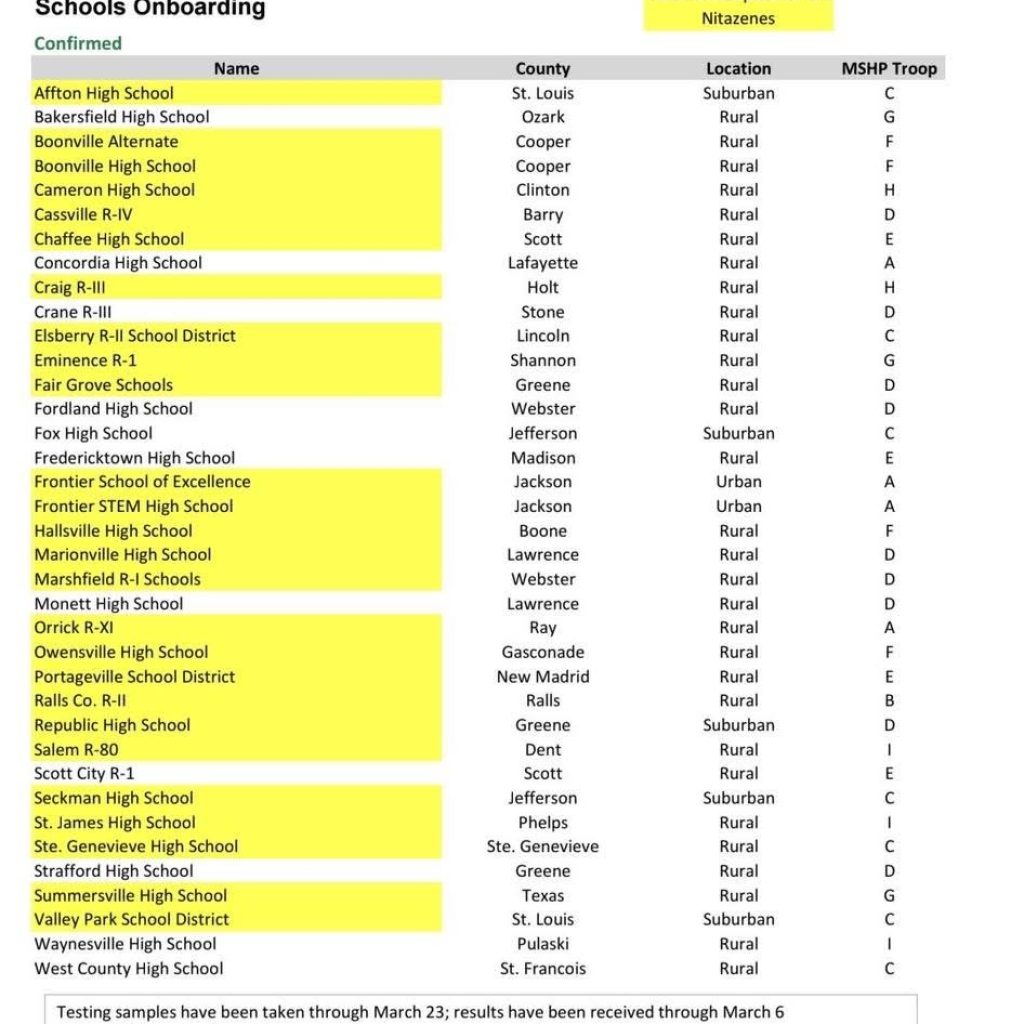
Cameron High School is among 26 Missouri schools that have tested positive for nitazenes through a voluntary wastewater monitoring program led by the Missouri Department of Public Safety (DPS), in coordination with the Department of Health and Senior Services (DHSS), the Department of Elementary and Secondary Education (DESE), and the Department of Mental Health (DMH). The results cover testing samples taken through March 23, 2026, with results received through March 6.
Nitazenes are a class of synthetic opioids that are five to ten times more potent than fentanyl. They have been found in counterfeit pills, illicit powders, unregulated cannabis products, and vape liquid — often without the user’s knowledge. Fourteen Missourians died from nitazene-related overdoses in 2024, more than triple the total recorded from 2019 through 2023 combined. Critically, standard drug tests do not detect nitazenes. A specific, targeted test is required to identify their presence.
Cameron High School appears on the official state list — confirmed positive — in Clinton County, Rural, under MSHP Troop H.
This story was first reported regionally by Fox4 and KMBC.
A Note on What Wastewater Testing Actually Means
Some community discussion has confused wastewater with drinking water. These are not the same thing. Wastewater is the water that exits through toilets, sinks, and drains — it is not water that anyone drinks. A positive nitazene result in the wastewater at Cameron High School means the substance was present in the bodily waste of people who used the bathrooms at that facility — students, staff, or anyone else who was inside that building and used those facilities. This is not a contaminated water supply issue. It is evidence that nitazenes were present in someone’s system while they were inside Cameron High School.
How This Story Came to Light — And Then Disappeared
I first learned about this story through a post in the Cameron Community Forum on Facebook. That post was subsequently deleted. I am unable to confirm whether the original author removed it or whether group administrators took it down.
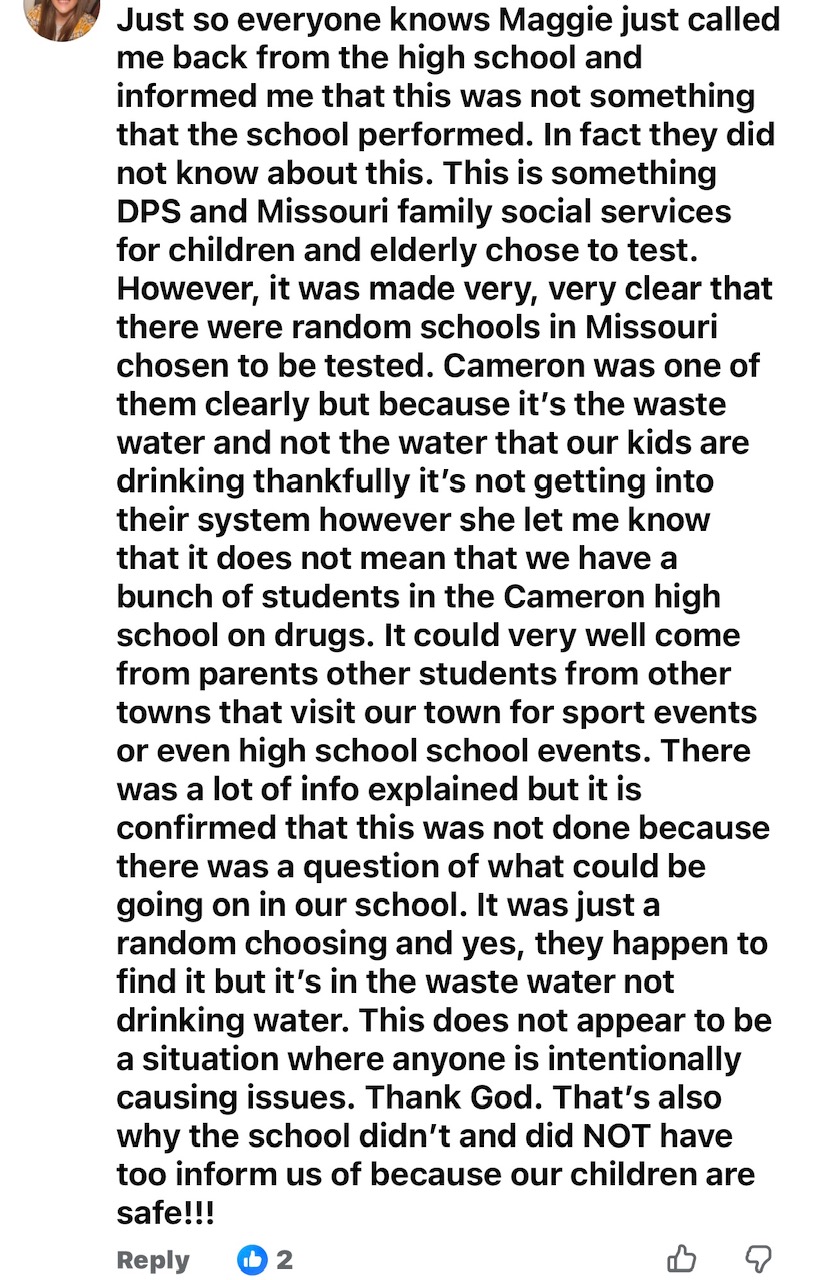
Before that post was removed, a parent posted a follow-up in the same group describing a phone call she made directly to Cameron High School. I captured screenshots of that post before it too was deleted. According to that post, a school secretary told the parent that the school did not perform the testing, did not know the testing was being conducted, and therefore had no obligation to notify parents. The post further relayed the school’s suggestion that the positive result could have come from visiting students or parents from other towns who used the school’s facilities during sporting events.
The school’s position, as reported through this community member: the children are safe, it’s wastewater not drinking water, and the district had no obligation to inform parents.
The Stories Don’t Add Up
According to multiple news outlets, this was a voluntary program — meaning Cameron R-1 had to opt in. An email from DPS Director Mark James to Missouri superintendents, obtained and reported by KCUR, invited schools to enroll and explicitly stated the program required “no additional responsibilities for your staff,” meaning outside personnel came to Cameron High School to collect the samples. Someone at the district level received that email, made a decision, and said yes. The school secretary’s claim that the school “did not know” this was happening does not hold up against that paper trail.
The “visiting teams and parents” explanation doesn’t hold up either. Stercus Bioanalytics, the contractor running this program, designs its methodology specifically to measure a school’s own population — not Friday night crowds. The entire point of the program, in Governor Kehoe’s own words, is to identify drug use in schools. Testing during a public event would make that data meaningless. The district should find out exactly when that sample was collected, check it against the school calendar, and tell parents what they find.
Questions the District Has Not Answered
Because of my documented history with Cameron R-1, I have little expectation that the district will respond to my inquiries. But the questions that need answering are straightforward, and any parent or community member has the right to ask them:
- Did Cameron R-1 voluntarily enroll in the DPS school wastewater monitoring program? If so, who authorized that participation, and when?
- When was the wastewater sample collected at Cameron High School — what day of the week, what time of day, and under what circumstances?
- Does the district’s current random drug testing program — administered to students participating in extracurricular activities — include tests capable of detecting nitazenes, fentanyl, or other synthetic opioids beyond the standard opioid panel?
- Now that the district is aware of a confirmed positive result, what specific steps is it taking in response?
- Why was no official communication sent to parents?
- Is the Board of Education aware that these tests were being conducted, and were they presented with the results?
We are also calling on the district and the Board of Education to release the full results of these wastewater tests as a public record. This testing was conducted in a public school, funded by public dollars, as part of a state program designed to protect the public. The community has a right to know exactly what was found in their school. Release the results.
With a school board election just two weeks away on April 7th, voters have a unique opportunity to put these questions directly to the seven candidates seeking seats on the Cameron R-1 Board of Education. How a candidate responds to a confirmed positive nitazene test in the school’s wastewater — and whether they believe parents deserved to be notified — tells you a great deal about how they would approach transparency and accountability if elected. These are not political questions. They are public safety questions, and every candidate should be prepared to answer them.
This Is Not the First Time
The Cameron R-1 School District’s reluctance to communicate openly with parents about drugs in its building is not new. In August 2024, I personally reported to Superintendent Dr. Matt Robinson that a student had obtained and used fentanyl inside Cameron High School. That report went nowhere. Records requests to both the Cameron Police Department and the Clinton County Sheriff’s Office returned the same answer: “no records exist.” I subsequently addressed the Cameron City Council directly about the fentanyl allegations and what appeared to be an institutional coverup — that address is on the public record and can be viewed here.
When I confronted Cameron High School’s assistant principal on video about why the district’s own school resource officer had no knowledge of students smoking marijuana on CHS property — the same building where nitazenes have now been detected in the wastewater — his response was telling. Rather than acknowledge the district’s mandatory reporting obligations under Missouri law, he asked: “What would somebody else’s definition of a drug problem be? Is one incident a drug problem? Is five?”
Missouri law does not ask how many incidents it takes to constitute a problem. RSMo 167.117 requires the principal to immediately report any controlled substance discovered on school premises to local law enforcement. One incident is enough. The law is not ambiguous.
The pattern here is consistent: drugs appear inside Cameron High School, the district minimizes, deflects, or goes silent, and parents are left to find out on their own — if they find out at all. The nitazene detection in the school’s wastewater is the latest chapter in that pattern.
What Should Happen Now
I want to be clear about something: if Cameron R-1 voluntarily participated in this monitoring program, that deserves credit. Wastewater surveillance is a legitimate and effective public health tool. It identifies drug trends anonymously at the community level, without targeting individual students, and it gives schools and law enforcement the information they need to act.
But participation in a program designed to protect students carries with it a responsibility to be honest with parents when the results come back positive for one of the most dangerous synthetic opioids ever identified. Nitazenes killed 14 Missourians last year. They cannot be detected by standard drug tests. They are showing up in products kids don’t even know are laced. This is not a situation where silence is an acceptable response.
Cameron parents were not notified through any official district channel. They found out through Facebook — and then those posts disappeared too.
The Board of Education meets once a month. The community has a right to answers. If the administration won’t provide them voluntarily, the board should demand them — and if the board won’t, the public should show up and ask directly.
This story is developing. If the district issues an official statement or provides clarifying information, this article will be updated to reflect it.
Heath Gilbert is the publisher of Cameron School District Exposed and Breach Holder on Substack. He has covered Cameron R-1 since September 2022.

Update — March 10, 2026: This article has been updated to include reader responses.
Teacher retention has come up in Cameron R-1 board meetings for at least three years. It gets mentioned. It gets discussed. And then the meeting moves on. What has never happened — not once in those three years — is a serious, specific conversation about what is actually causing teachers to leave, or what the board intends to do differently to stop it.
The problem is real. Missouri is facing a statewide teacher shortage, and Cameron is not immune. But statewide trends do not explain everything. Districts with similar demographics and similar budgets manage to retain staff at higher rates. The difference, more often than not, comes down to workplace culture, administrative leadership, and whether employees feel heard and supported.
On those fronts, Cameron has reason to be concerned.
What One Candidate Said
In response to a questionnaire I recently distributed to candidates in the April 2026 Cameron R-1 board election, I asked each candidate directly: teacher retention is a serious issue in Cameron and across the state — how can Cameron resolve it? You can read the full responses from all participating candidates here.
Dan Kercher, a candidate who previously served on the Cameron school board, offered this answer: acknowledge that the issue exists statewide, and then “simply point out the good parts of what we have.”
That is not a plan. That is a press release.
Teachers are educated professionals. Most hold bachelor’s degrees at minimum; many hold master’s degrees or higher. They are trained to observe, evaluate, and think critically. If Cameron R-1 were genuinely a great place to work, those professionals would not need a board member to point it out to them. They would already know it. They would tell their colleagues at other districts. Word would spread, and Cameron would have no shortage of qualified applicants eager to come here.
The fact that retention remains a persistent problem is itself the answer to Kercher’s suggestion. They can see what Cameron has. They are choosing to leave anyway.
Pointing out the good parts does not address why teachers are leaving. It does not identify what is driving turnover. It does not create any mechanism for the board to learn what employees actually experience inside the district. And it does nothing to change whatever conditions are making people choose to work somewhere else.
What makes Kercher’s answer particularly notable is that he served on this board for six years. Retention was a problem during that time. If the solution were simply to promote the district’s strengths, that approach had ample opportunity to work. It did not.

Blaming the Messenger
Board members have, on occasion, pointed to me as a contributing factor in Cameron’s staffing difficulties. I will note for the record: I am not a school administrator. I do not set workplace policy. I do not conduct employee evaluations. I do not determine whether staff feel supported, respected, or fairly compensated. What I do is report on what the district does — and what it fails to do.
If the argument is that my reporting makes Cameron a less attractive place to work, that argument has the causation reversed. The reporting exists because of conditions inside the district. Addressing me does not address those conditions. And the only concrete action the board has ever taken in response to me is a ban from district property. No retention plan. No policy changes. No structured outreach to staff. A ban. If the board genuinely believes that banning a journalist solves a teacher retention problem, that belief tells you something important about how seriously they are taking the problem.
The Exit Interview Problem
To my understanding — and the district is not going to confirm this for me — exit interviews for departing staff are currently conducted by the superintendent. I understand the practice. What concerns me is who is conducting them and what happens to the information afterward.
The board of education in Cameron operates at significant distance from day-to-day district operations. Board members communicate through the superintendent, not directly with building administrators or staff. That means any information the board receives about why employees are leaving has passed through at least one set of hands before they hear it — and sometimes two.
There is a documented pattern in this district of the superintendent failing to bring critical information to the board. I have previously reported on a specific incident in which board members stated publicly that they had not been informed of a serious matter that occurred more than a year prior. The superintendent had not told them. That pattern of incomplete disclosure is directly relevant to any conversation about exit interviews, because it raises a legitimate question: if he withholds information about serious incidents, is it reasonable to assume he is fully and accurately conveying what departing employees say about his leadership or his administration’s culture?
There is a second problem beyond what the superintendent chooses to share. Consider the building principal who conducts an exit interview and learns that a teacher is leaving because they believe that principal is a poor leader or creates a hostile environment. That principal then reports the findings to the superintendent. Is there any realistic expectation that the principal will volunteer that information accurately? Their professional evaluation and advancement prospects are tied to their relationship with the superintendent. Self-interest makes honest reporting unlikely.
The current system filters every piece of honest feedback through the people most likely to be the subject of it. That is not an oversight. It is a structural failure.
There is also the question of whether employees would even raise concerns in a superintendent-conducted exit interview in the first place. If a teacher has spent years feeling unsupported by district administration and has no reason to believe that reporting it will lead to any change, why would they say so on the way out the door? The interview becomes a formality. A box checked. And the board never learns anything useful.

A Different Approach
If the Cameron R-1 board of education genuinely wants to understand and address teacher retention, the solution is straightforward: cut out the middleman.
There are seven board members. They could rotate exit interview responsibilities, with one member sitting down with each departing employee. Once a month, whatever was learned gets presented to the full board in executive session. The board then has unfiltered, firsthand information — not a summary produced by the person whose leadership may be under scrutiny.
From there, the board can direct the superintendent or specific administrators to make changes and create measurable benchmarks to verify those changes are being implemented. They can track whether the interventions are working. They can hold administrators accountable by name if the problems continue.
This approach also protects the employees. Departing staff information remains shielded under Missouri’s Sunshine Law. But more importantly, it creates conditions where employees might actually be honest. Telling a school board member why you are leaving is a different conversation than telling the superintendent. The power dynamic is different. The incentive to soften criticism is different.
Once the board completes an exit interview, they can still inform the superintendent of relevant takeaways. Information still flows to administration — it just starts at the board level instead of ending there.
Don’t Wait for the Exit Interview
But exit interviews are, by definition, reactive. They capture information from people who have already decided to leave. A board serious about retention should not wait until staff are on their way out the door to ask how things are going. Board members should be conducting routine, scheduled meetings with randomly selected staff members throughout the year — informal conversations designed to take the temperature of the workforce before frustration reaches the point of no return. Not performance reviews. Not disciplinary matters. Simply: how are you doing, what is working, what is not, what would make this a better place to work? If the board hears the same complaint from three different teachers in three different buildings, that is a pattern worth acting on — before those teachers become exit interviews.
Why This Matters Beyond Cameron
Every school district in Missouri is dealing with some version of the retention problem. Most of them are responding the same way Cameron has: acknowledging the issue, referencing statewide trends, and waiting for conditions to improve on their own.
A district that actually solves it — that actively learns from every departure, changes what needs to change, and builds a culture where good teachers choose to stay — will stand out. Word travels in education communities. Teachers talk to other teachers. A district with a genuine reputation for treating its staff well and listening to their concerns will attract people who are frustrated somewhere else. That is not a pipe dream. It is what happens when institutions take accountability seriously instead of performing it.
The Board Has the Power to Act
The current board’s approach has been largely deferential. Trust the professionals. Let the superintendent handle it. The problem with that philosophy, in a district with this particular history, is that it produces exactly the outcome we have seen: three years of concern, no measurable improvement, and a board that cannot tell you with any confidence why teachers are actually leaving.
The April 2026 election offers an opportunity to change that. Voters should be asking candidates not whether they appreciate teachers, but whether they are willing to do the uncomfortable work of finding out what is driving them away — and whether they are willing to hold the right people accountable when they find out.
Pointing out the good parts is not an answer to that question.
Heath Gilbert is an independent investigative journalist covering Cameron R-1 School District. He publishes at Cameron School District Exposed and Breach Holder on Substack.
Update — March 10, 2026
Since publishing this article, a former Cameron R-1 employee reached out in the comments with something that stopped me cold.
In her own words: “I would have gladly talked to board members about issues before leaving but I was told by administration that was not allowed.”
She went further, describing the culture inside the district: “We were told there was a chain of command. Often fearing for retaliation and our jobs.”
It does not stop there. After she left the district, she shared this: “I had a friend that was a teacher in the district that was told by an administrator that she could not be friends with me or talk to me even via social media because I was a parent in the district.”
An administrator directing an active employee to cut off contact with a private citizen over who they are allowed to be friends with is not policy. That is control.
At the November 2024 school board meeting, board member Ryan Murphy asked me directly why people come to me with their concerns instead of coming to the board. It was a fair question, and I did not have a complete answer for him that night.
We now have at least a partial one.
They were told they weren’t allowed.
By Heath Gilbert | Cameron School District Exposed
On February 18, 2026, the Cameron Citizen-Observer published a response from Cameron R-1 Superintendent Dr. Matt Robinson addressing concerns I have raised about the district. The article was titled “Robinson Responds to Flurry of Gilbert’s Attacks.” In it, Robinson addressed four numbered issues. He closed by announcing he will not be responding to every letter to the editor.
Responding isn’t the same as answering. And in at least one case, what Robinson did say doesn’t hold up to the documented record.
I published a full analysis of the Citizen-Observer’s journalistic failures over at Breach Holder: No Name on It: The Citizen-Observer Prints a Platform Piece and Nobody Claims It. This article is about Robinson’s response itself — point by point, with documentation.
Point 1: The Landi Ban and Election Interference
What Robinson said: “Mr. Landi’s restrictions are part of the Board packet and can be accessed by anyone for their review: These restrictions stem from conduct that occurred before Mr. Landi’s decision to run for the Board.”
What the record shows: Robinson’s statement is factually inaccurate — though whether it matters to this community remains an open question. Three years of documented constitutional violations have not moved the needle for those who worship at the Church of the Dragon. For them, the mascot is the institution, and the institution cannot be questioned. But for those paying attention, this one does matter — because a superintendent made a provably false statement to a newspaper, and the newspaper printed it without challenge.
Dan Landi’s ban was extended based on a video that was recorded on the same day he filed his paperwork to run for the Cameron R-1 Board of Education — and the video was recorded after he completed that filing. The board reviewed this video. They knew what was on it. They knew when it was recorded. And they extended the ban anyway.
I have reviewed the video in full. The interaction it documents shows Dan Landi speaking politely and civilly with former district employee Gina Bainum. There is nothing in that video that would justify a ban extension — and certainly nothing that supports Robinson’s characterization of events to the newspaper.
There is a second problem with Robinson’s claim that deserves equal attention: he cannot possibly know when Dan Landi decided to run for the board. Robinson knows when Landi filed. The decision to run precedes the filing. Robinson offered the newspaper a statement he has no way of substantiating, and the newspaper printed it without asking a single follow-up question.
The Question Robinson Never Answered: Ann Clark
Board member Ann Goodwin-Clark is an incumbent candidate running for re-election to the Cameron R-1 Board of Education. Dan Landi is running against her.
Ann Goodwin-Clark voted to extend the ban on her direct electoral competitor without recusing herself from that vote.
Robinson’s response does not mention Ann Goodwin-Clark. Not once. The Citizen-Observer’s article does not mention Ann Goodwin-Clark. Not once.
Board President Andi Lockridge recused herself from voting on Dan Landi’s original ban because she acknowledged having a “part” in the complaint against him. That established clearly that the board understands the concept of recusal. Goodwin-Clark did not extend that same standard when her own political future was on the line.
The full documentation of Landi’s ban and the Goodwin-Clark vote is here: Incumbent Votes to Ban Electoral Opponent from School Property Through Election Period.
That is the election interference question Robinson was asked to answer. He didn’t answer it. He changed the subject to board packet accessibility — and that choice is telling.
Consider what happened on the same night: the board first voted to extend Dan Landi’s ban, then voted to approve the Bridges Legal Services contract. Robinson had no trouble addressing the contract publicly. He offered a defense of it to the newspaper without hesitation.
But on the vote that came first that same evening — the one where an incumbent board candidate voted to keep her electoral opponent banned from school property — Robinson had nothing to say. He had the same amount of time to look into both. He chose to comment on one and go silent on the other. That silence is its own answer.
Point 2: The Social Media Shutdown and Vinzent Cooper
What Robinson said: School districts are not required to maintain social media pages. The platforms had become “a forum for negativity and division” requiring significant staff time. He attached the district’s letter to the community and says “that speaks for itself.”
What Robinson didn’t say: Anything about Vinzent Cooper — or what shutting down those accounts may have destroyed.
Vinzent Cooper was banned from district property and meetings in November 2025. His ban letter cited “zero tolerance for cyberbullying” and “personal attacks on staff.” The specific conduct cited included comments made on the district’s own Facebook page — comments that called staff members “liars” and “thieves,” referenced a staff member as an “Oompa Loompa,” and raised concerns about library content and the district’s academic performance.
Read that carefully. “Zero tolerance for cyberbullying” and “personal attacks on staff” — applied to constitutionally protected criticism of public employees — is not a safety policy. It is a free speech suppression policy dressed in more acceptable language. By that standard, the district has declared zero tolerance for the First Amendment. Robinson did not address that in his response. He couldn’t, because there is no defensible answer. No wonder he failed to mention Cooper by name.
Those are constitutionally protected statements. Calling a public employee a liar is protected political speech. Calling someone an Oompa Loompa — on a post about the school’s Willy Wonka musical, no less — is clearly satirical commentary. Raising concerns about library content and academic performance is exactly the kind of speech the First Amendment was designed to protect.
Robinson calls it negativity and division. I call it transparency and accountability. To Robinson, those two things may very well look the same.
Robinson characterizes the Facebook page as a forum overrun by “negativity and division.” That characterization does not match what I observed while the page was active. The district posted frequently — sometimes multiple times per day over more than a year. Cooper replied to only a small fraction of those posts.
The page was not a battleground. It was a public forum where a community member occasionally raised critical questions. But here is the problem: the public can no longer evaluate that characterization for themselves. Robinson ordered those accounts deactivated, and the record that would confirm or contradict his description of events no longer exists.
The community is left with only Robinson’s word for what the page looked like — because Robinson had the evidence removed. Framing a deleted record as proof of negativity and division is not an honest accounting of what happened. It is a justification built on evidence that was destroyed.
There is a larger question Robinson did not address at all: what happened to the public record when the district deactivated those accounts?
Missouri Revised Statute 610.026 governs the retention and disposal of public records. The district’s Facebook and Instagram pages were official government-affiliated accounts containing public posts, public comments — including my own documented criticism of district operations — and the very comments cited as justification for Cooper’s ban. When those accounts were deactivated, that content disappeared with them.
Does the deletion of an official government social media account and its contents constitute destruction of public records under Missouri law? That is a question I am not qualified to answer definitively — but it is one the district has not been asked to answer publicly, and one that deserves a direct response.
Robinson’s letter to patrons — the one he says “speaks for itself” — acknowledged that deactivating the accounts prevented district patrons and taxpayers from responding to posts from the school. Robinson is correct that it speaks for itself. What it says is this: the district was deleting public comments from an official government-affiliated social media page.
That is not a matter of preference or policy. Courts have consistently held that when a government entity opens a public forum — including a social media page — and then selectively deletes comments based on viewpoint, it violates the First Amendment. The district’s own letter confirms they were doing exactly that. Robinson cited it as a defense. It reads as a confession.
That was my point from the beginning — stated repeatedly and documented thoroughly — and it is precisely the point Robinson avoided addressing in his response to the newspaper. The full story is here: Running From Critics: Cameron R-1 Deletes Social Media.
Point 3: The MOU and the School Police Department
What Robinson said: Nothing.
Read his response again. On the question of whether the Cameron R-1 school police department is lawfully operating, Dr. Matt Robinson offered the community no response whatsoever. The Citizen-Observer did not press him on it.
The concern raised is direct and statutory. Missouri Revised Statute 162.215 is unambiguous: a school district may operate a police department only upon the execution of a memorandum of understanding with each municipal law enforcement agency and county sheriff’s office that has law enforcement jurisdiction over the school district’s premises. The language is mandatory. “Only upon.” “Each.”
The Cameron R-1 School District operates under the jurisdiction of five law enforcement entities. Three of those entities signed the current MOU. Two did not.
The reasons those two agencies declined to sign are not part of the public record. But they are reasons Robinson has never been asked to address publicly, and reasons he appears content to leave unexamined. When law enforcement agencies that originally agreed to partner with a school district walk away from that partnership, the community deserves to know why.
Robinson said nothing. The newspaper didn’t ask. These are not small questions — they are the only questions that matter when a school district operates a police department. His silence on this point is the most telling part of his entire response.
Point 4: Bridges Legal Services and the Custodian of Records
What Robinson said: The agenda included a policy naming the custodian of records, and the Bridges Legal Services contract fell under that item. Bridges does not and will not have the exclusive right to access and disseminate public records. Hiring Bridges was a fiscal responsibility decision — cheaper than hiring a full-time compliance staff member. The Sunshine Law’s notice requirement “was certainly met.”
What remains unresolved: The agenda item Robinson references was a policy identifying the custodian of records and the alternate. That is all it was. There was nothing in that agenda item — no language, no description, no hint — that would lead any member of the public to expect a contract with an outside legal services firm to be voted on that night.
I watched the video of that meeting. I have followed these meetings consistently for years — public employees have served as custodian of records for as long as I have been paying attention to this district, long before I was banned from attending in person. When I saw that agenda item, my assumption — the reasonable assumption — was that another employee would be named to the position. Even I did not see a contract coming. If an unpaid community watchdog who monitors every meeting and has filed dozens of Sunshine Law requests was caught off guard, how would any ordinary member of the public have known?
A policy designation and a vendor contract are not interchangeable. Robinson’s assertion that the Sunshine Law notice requirement “was certainly met” is his own conclusion, not a legal determination.
His claim that hiring Bridges was a fiscally responsible decision is also impossible to evaluate — because the district never made the contract public. The community cannot assess whether it was a good deal, a bad deal, or something in between. Robinson cited fiscal responsibility to justify a contract nobody has been allowed to see.
A genuinely fiscally responsible procurement process typically involves issuing a Request for Qualifications, receiving competing bids, and selecting the best option for taxpayers. The board was presented with a single contract and asked to vote on it. There is no evidence an apparent competitive process took place. Without competing bids, Robinson’s fiscal responsibility claim has no foundation — and he offered none.
Robinson also cited the urgency created by the departure of the district’s communications officer as justification for the last-minute contract addition. That justification does not hold up.
The district’s own custodian of records policy already named Kelly Walker as the alternate custodian of records — a position she had fulfilled for years before being replaced. Walker was available. Walker was already designated in district policy. She could have resumed the position immediately, giving the board adequate time to conduct a proper procurement process.
There was no emergency. I have watched the video of that meeting. The contract was emailed to board members at the last minute — they went to their computers to read it before voting. Two minutes later, they voted. That is not due diligence. That is not fiscal responsibility. That is a board being asked to rubber-stamp a decision that had already been made.
Missouri law does provide a narrow exception to normal notice requirements. RSMo 610.020.4 states that when a public governmental body departs from normal notice and agenda requirements, the nature of the good cause justifying that departure must be stated in the minutes. The question worth asking is whether that justification appears in the meeting minutes — and whether it can be considered good cause when a qualified alternate was already named in district policy and available to step in immediately.
The deeper question — whether routing Sunshine Law compliance through a private legal services firm creates a structural barrier to public records access — is one Robinson chose not to engage. He asserted Bridges won’t have exclusive access. The contract terms, and how that plays out in practice for residents who file records requests, are what the public should be watching.
The pattern of Sunshine Law compliance failures at Cameron R-1 is documented here: Do As We Say, Not As We Do: Cameron School Board Violates Missouri Sunshine Law.
The Closing Statement That Says Everything
Robinson ended his response with this: “I will not be responding to every Letter to the Editor.”
He’s right that he doesn’t have to. But the record doesn’t stop existing because he stops responding to it.
The board watched a video of Dan Landi being polite to a former district employee — a video recorded after Landi filed to run for their board — and extended his ban. Ann Goodwin-Clark, his electoral competitor, cast a vote in that decision without recusing herself. Robinson told the newspaper the restrictions predate Landi’s candidacy. He cannot know that, and the documented timeline contradicts it.
The district banned Vinzent Cooper for calling a staff member an Oompa Loompa on a post about the Willy Wonka musical, then shut down its social media accounts — and with them, potentially the public record of everything that was said there. Robinson calls that negativity and division. The First Amendment calls it protected speech. And RSMo 610.026 may have something to say about what happened to those records when the page went dark.
The school police department is operating under an MOU that two of five required agencies refused to sign. RSMo 162.215 requires all five. Robinson said nothing.
A contract was added to a board meeting agenda at the last minute, voted on after a two-minute review, with no apparent competitive bidding process and a qualified alternate already available to fill the vacancy. Robinson called it fiscal responsibility. The public has never been allowed to see the contract.
The board allows this. The community has watched it happen meeting after meeting. The board sets policy, approves contracts, and votes to ban community members from public meetings. The board answers to the voters. Cameron R-1’s next board election is an opportunity to ask whether the current leadership has earned continued trust — and whether it is time for new voices at that table.
Dr. Robinson is correct that he doesn’t have to respond to every letter to the editor. But every non-answer is its own answer. And this community deserves better than a superintendent who responds to documented concerns by changing the subject — or not responding at all.
Sources & Related Reading
Cameron School District Exposed
- Incumbent Votes to Ban Electoral Opponent from School Property Through Election Period — Documentation of the Landi ban and Goodwin-Clark vote
- Running From Critics: Cameron R-1 Deletes Social Media — District’s own letter admitting comment deletion
- Do As We Say, Not As We Do: Cameron School Board Violates Missouri Sunshine Law — Bridges Legal Services contract and agenda disclosure issues
- Cameron’s Puppet Master — Editor’s written admission of advertiser pressure on editorial decisions
Breach Holder (Substack)
- No Name on It: The Citizen-Observer Prints a Platform Piece and Nobody Claims It — Analysis of the Citizen-Observer’s journalistic failures in the Robinson article
Missouri Statutes Referenced
- RSMo 162.215 — School district police department MOU requirements
- RSMo 610.020 — Missouri Sunshine Law: Open Meetings and agenda notice requirements
- RSMo 610.020.4 — Good cause exception for departing from normal notice requirements
- RSMo 610.023 — Custodian of Records designation and public access rights
- RSMo 610.026 — Public records retention and disposal requirements
Heath Gilbert is an independent journalist and government accountability advocate. He has documented Cameron R-1 School District operations through Missouri Sunshine Law requests since September 2022. He publishes Cameron School District Exposed and Breach Holder on Substack.

By Heath Gilbert
Cameron School District Exposed
On September 12, 2024, the Cameron R-1 School District issued a press release that sent shockwaves through the community: a firearm had been discovered in a student’s vehicle on school property. The district assured parents that everyone was safe, the weapon was secured, and they would be investigating. Then, as has become their pattern over the past three years, the district went silent.
What they never told the community was that they got it wrong. What they never explained was why basic firearm safety protocols weren’t followed. What they never addressed was whether a student was unjustly punished and publicly branded. And what they certainly never acknowledged was yet another apparent violation of their own Memorandum of Understanding with the Cameron Police Department.
This is the story the Cameron School District doesn’t want you to know.
The Dispatch Record They Couldn’t Hide
Thanks to a public records request, I obtained Cameron Police Department dispatch records from September 12, 2024. At 14:02:22, Officer 1125—School Resource Officer Palmer—contacted CPD dispatch with a request to “run gun serial number.” The notes clearly state: “gun located in students car.”
At 14:03:49, dispatch closed the incident with a telling notation: “i notified 1125 we cannot run firearms serial numbers.”
This dispatch record confirms several critical facts: there was suspicion of a firearm in a student vehicle, the school district had physical possession of what they believed was a weapon, and they attempted to run a serial number through law enforcement channels.
The Truth Emerges Through Community Whispers
While the district maintained its public silence, the truth began trickling out through the community grapevine. In the Cameron Community Forum, an individual who claimed to work with the student’s father revealed that it wasn’t a firearm at all—it was an airsoft rifle. The school had also confiscated an emergency seatbelt cutter from the vehicle, apparently treating basic safety equipment as contraband.
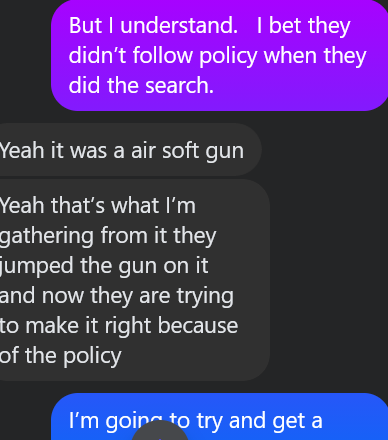
On September 17, 2024, I encountered SRO Palmer after a school board meeting. When I pressed him about how a trained officer—a hunter and veteran—could mistake a plastic airsoft rifle for a real firearm, he repeatedly responded with “no comment.”
But I’m persistent. After continued questioning, Palmer finally made a statement that, while I cannot quote verbatim more than a year later, I interpreted as essentially asking whether I truly believed he—with his training and experience—couldn’t tell the difference between a real firearm and an airsoft rifle.
This raises critical timeline questions. At 14:02 on September 12th, Palmer requested a serial number check—suggesting he believed at that moment he was dealing with a real firearm. But at some point between that dispatch call and our September 17th conversation, Palmer clearly came to understand it was an airsoft rifle. When did that realization occur? And if Palmer eventually determined it wasn’t a real gun, why wasn’t that immediately communicated to the community through a corrective press release?
Palmer’s statement to me suggested that by mid-September, he knew the difference. So who made the initial misidentification? At the time, the Cameron School District employed only two school police officers: Palmer and SRO Ward. While we don’t have the complete incident report to know all the details, the fact that Palmer was on scene and in a position to request a serial number check suggests he had direct involvement with the suspected weapon. If so, this raises serious questions about supervisory responsibility. Palmer was the senior officer. Whether he personally handled the item or another officer did, he was responsible for ensuring proper protocols were followed—including the fundamental safety step of clearing and making safe what they believed was a loaded firearm.
Interestingly, in October 2024, SRO Ward resigned from the Cameron School Police Department. The district has never explained why, but one has to wonder if this incident played a role. If Ward was held accountable for the misidentification through his departure, why does Palmer—the supervising officer responsible for ensuring proper protocols—still have his position? Is this selective accountability? Did the district sacrifice the junior officer while protecting the senior one? This sounds a lot like the November details involving a certain coach and math teacher. These are questions the district’s silence leaves unanswered.
The MOU Violation Nobody Wants to Discuss
Here’s where this gets serious. The Cameron School District has a Memorandum of Understanding with the Cameron Police Department that specifically governs how certain incidents are to be handled. My understanding of this MOU is that when a potential weapon is discovered on school property, the school district is prohibited from conducting the investigation themselves. They are required to immediately turn the matter over to the local police department.
Instead, the school district took possession of what they believed was a firearm, attempted to run the serial number themselves, and then conducted their own internal investigation. If my understanding of the MOU is correct, this represents a clear violation of the agreement they have with CPD—an agreement that exists precisely to ensure proper handling of serious incidents like this.
The Firearm Safety Failure That Should Terrify Every Parent
But there’s an even more disturbing aspect to this story that speaks to basic competency and safety.
When school resource officers removed what they believed was a firearm from that student’s vehicle, the very first action they should have taken—before calling dispatch, before documenting serial numbers, before doing anything else—was to make the weapon safe. Clear it. Verify whether it was loaded. Ensure no round was chambered.
This is not advanced tactical training. This is basic hunter safety course material. Every firearm is treated as if it is loaded until you personally verify otherwise.
Had the officer who retrieved that “firearm” followed elementary safety protocols and cleared the weapon, they would have immediately discovered it was an airsoft rifle. The entire incident would have been resolved in seconds. There would have been no dispatch call. No serial number check. No press release. No public alarm. No student suspension. No family humiliation.
Instead, school police officers handled what they believed was a loaded firearm without clearing it first—a breathtaking failure of basic gun safety that should concern every parent whose child attends Cameron schools.
The Student Left in Limbo
According to my conversations with the individual who knew the family, the student was suspended and kept out of school while the district “reviewed” the matter. The family was told to remain quiet for a week while the review was conducted.
Here are the questions the district has never answered:
- Was the student ultimately allowed to return to school?
- If so, how long were they kept out for possessing what turned out to be a toy?
- Were they allowed to make up the missed work?
- Was this student punished under a policy that may not even prohibit airsoft rifles on school property?
- Was an apology issued to the student and family for the misidentification?
- What disciplinary action, if any, was taken against the officers who failed to properly clear what they believed was a firearm?
The Cameron School District cannot legally tell us the student’s name or specific disciplinary details. But they absolutely could—and should—have issued a follow-up statement clarifying that the original press release was based on incorrect information.
The Public Relations Cleanup That Never Came
When the district issued that September 12th press release announcing a firearm on campus, they put this student’s reputation on trial in the court of public opinion. Students knew whose car was surrounded by police. They knew who was called to the office. They knew who disappeared from school.
The rumor mill at any high school is vicious. What do you think students were saying about this kid? What assumptions were made? What labels were applied? In an era where school shootings dominate the news cycle, being publicly identified as the student who brought a gun to school carries devastating social consequences. In a school district with well-documented bullying problems, was this student bullied because of the misinformation released to the public by the Cameron School District due to poor police work and a mockery of an investigation?
The district created this problem with their press release. They branded this student—perhaps unjustly—as someone who brought a weapon to school. And then they simply walked away, leaving that student to deal with the social fallout of their mistake.
A simple follow-up statement could have clarified the situation: “Out of an abundance of caution, we initially reported an item as a firearm. Upon further investigation, we determined this was not the case. We appreciate the community’s patience and understanding.” They wouldn’t have to name the student. They wouldn’t have to reveal disciplinary details. They would simply have to be honest.
But honesty and transparency have never been the Cameron School District’s strong suits.
The Pattern We’ve Been Documenting for Three Years
I want to be crystal clear about something: I don’t know if district policy specifically prohibits airsoft rifles on school property. That’s actually relevant information the district should have clarified in a follow-up statement. Even if the item was ultimately harmless, is it still a violation to bring realistic-looking replica weapons to school? That would have been an excellent teachable moment for the entire community.
Instead, the district chose silence. They chose to bury the story. They chose to let a potentially false narrative stand uncorrected in the public record.
This is not an isolated incident. This is the pattern we’ve been documenting since September 2022. The Cameron R-1 School District consistently chooses opacity over transparency, silence over accountability, and institutional protection over public trust.
When my initial Sunshine Law request for the police report was denied, the district’s Custodian of Records cited RSMo 610.021(14) and FERPA, claiming they couldn’t provide records with only a student name redacted because “such records would contain personally identifiable information related to an identified student.” They went on to cite RSMo 610.024, stating they wouldn’t provide “blank pages with redactions and citations” because doing so “would reveal the contents of the exempt information and thus defeat the purpose of the exemption.”
Translation: “We have records, but we’re going to use student privacy as a shield to prevent you from learning about our mistakes.”
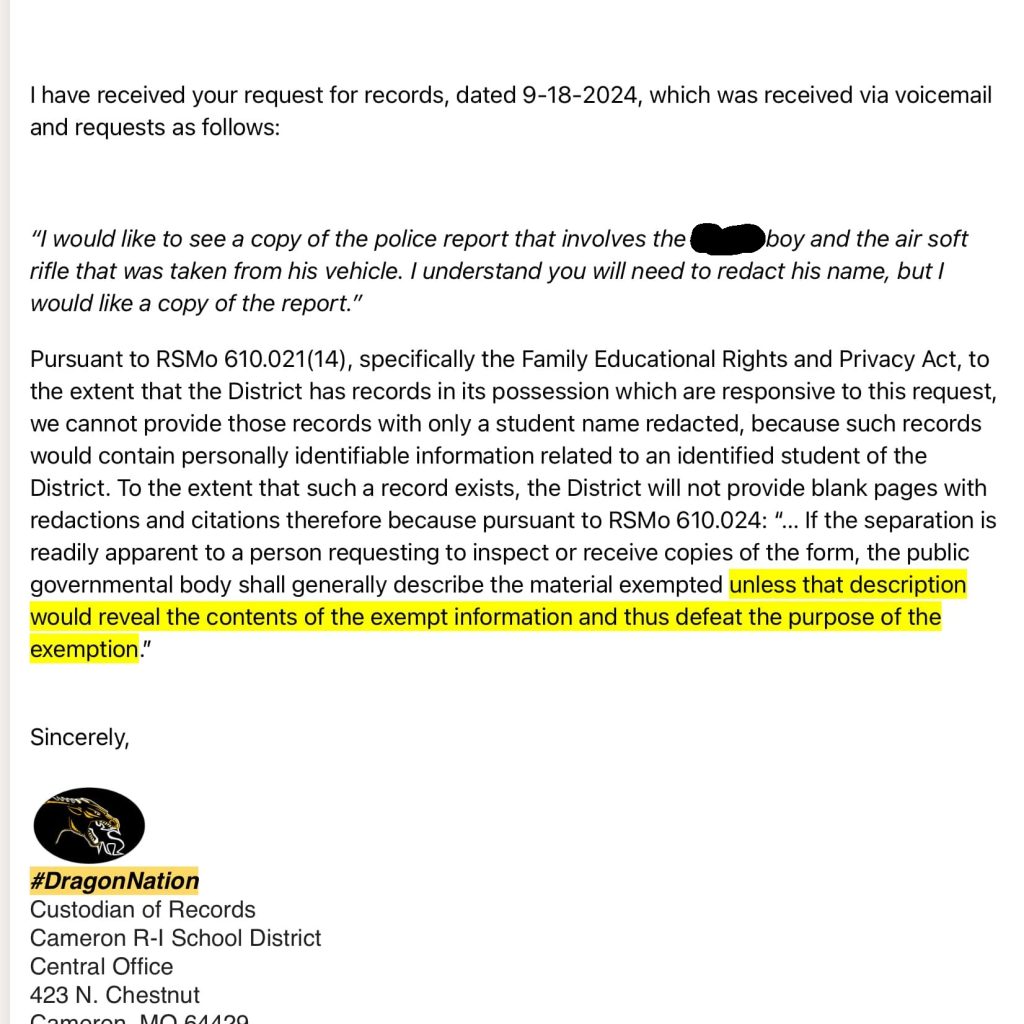
The irony is that I wasn’t asking them to identify the student—I already knew who it was from community sources. I was asking for documentation of how the incident was handled, whether proper protocols were followed, and whether the MOU with CPD was honored. Those are matters of public accountability that have nothing to do with student privacy.
The Questions That Demand Answers
The Cameron community deserves answers to these questions:
- Does the district’s MOU with Cameron Police Department require them to turn over weapons investigations to CPD? If so, why didn’t they?
- What training do school resource officers receive in basic firearm safety and identification?
- Why wasn’t the suspected firearm immediately cleared and made safe, which would have instantly revealed it was an airsoft rifle?
- Was SRO Ward’s October resignation related to this incident?
- Does district policy specifically prohibit airsoft rifles or realistic weapon replicas on school property?
- How long was the student suspended or kept out of school?
- Was the student’s academic standing affected by missing school days?
- What compensation or remediation was provided to the student and family for the public mischaracterization?
- Why was no corrective press release issued to clarify the initial announcement?
- How and where was this “firearm” stored during the “investigation”? Was a “weapon” that hadn’t been cleared and made safe stored inside the school building?
- Did the actions of the district and the arguably wrongful suspension put the school district and taxpayers in jeopardy of a lawsuit?
- What policy changes have been implemented to prevent similar misidentifications in the future?
The Real Issue: Institutional Accountability
This story isn’t really about an airsoft rifle. It’s about a school district that consistently refuses to be forthright with the community it serves. It’s about administrators who treat transparency as optional rather than obligatory. It’s about a culture where mistakes are buried rather than acknowledged and corrected.
For three years, I’ve been documenting this pattern. The Cameron R-1 School District announces partial truths, withholds complete information, uses student privacy laws as shields against legitimate accountability questions, and then simply goes silent when inconvenient facts emerge.
This September 2024 incident is textbook Cameron School District: dramatic announcement, investigation promised, community left in the dark, questions left unanswered, records requests stonewalled, and ultimately, another story buried by institutional silence.
A Message to District Leadership
To Superintendent Matt Robinson and the Cameron R-1 School Board:
Your silence is not protecting student privacy. Your refusal to issue a corrective statement didn’t protect that student—it abandoned them to deal with the social consequences of your mistake. Your invocation of FERPA to deny basic accountability records is not a legitimate exercise of legal protection—it’s a cynical abuse of privacy laws to avoid public scrutiny.
You could have handled this incident with basic honesty: “We made a mistake out of an abundance of caution. Here’s what we’re doing to ensure better training and protocols going forward.” Instead, you chose what you always choose: silence, stonewalling, and institutional self-protection.
This is why three military veterans have been banned from your board meetings. This is why I’ve spent three years documenting your failures. This is why I’m dug in like a tick and not going anywhere. This is why the community’s trust continues to erode.
You have created an accountability crisis through your own choices. And until you start treating transparency as a responsibility rather than an inconvenience, incidents like this will continue to chip away at whatever credibility you have left.
Conclusion: The Transparency Crisis Continues
Cameron parents send their children to school trusting that the district will keep them safe and treat them fairly. When mistakes happen—and they will, because humans are imperfect—the community expects honesty and corrective action.
Instead, the Cameron R-1 School District offers press releases that tell half-truths, investigations conducted behind closed doors in apparent violation of their own MOUs, records requests denied under questionable legal theories, students potentially punished for policies that may not exist, and a wall of silence when uncomfortable questions are asked.
This is not how public institutions are supposed to operate in a constitutional republic. This is not how you build community trust. This is not how you demonstrate respect for the taxpayers who fund your operations.
The Cameron School District had multiple opportunities to handle this incident with integrity: immediately clear the suspected weapon (proper safety protocol), recognize it was an airsoft rifle (competent observation), decide if that violated policy (clear rules), apply appropriate consequences if any (fair process), and inform the community of the outcome (basic transparency).
They failed at every step.
And now, as always, they hope silence will make it go away.
It won’t.
Because there are still a few of us who believe public institutions owe the public honesty. There are still a few of us who will keep asking the questions nobody wants to answer. There are still a few of us who remember that in a transparent constitutional republic, sunlight is the best disinfectant.
Whatever happened to the gun?
It was never a gun. But the real question is: whatever happened to accountability at the Cameron R-1 School District?
UPDATE: Airsoft Dad Breaks His Silence
January 12, 2026
This afternoon at approximately 12:30 PM, I received a response to my request for comment from the father at the center of the September 2024 airsoft rifle incident. Speaking on condition of anonymity to protect his child’s identity, the father—whom we’ll call “Airsoft Dad”—has authorized me to share his account of what happened after the district’s own police department misidentified toys as a firearm.
How It Started
According to Airsoft Dad, another student who had a problem with his son reported the item in the vehicle. Airsoft Dad claims this student knew it was an airsoft toy. When school staff confronted Airsoft Student, he immediately told them it was an airsoft pistol—not a real firearm.
Despite this disclosure, the school district police proceeded to search the vehicle and treat the matter as a weapons incident.
The Punishment
Airsoft Student received a full year expulsion from the Cameron School District.
According to Airsoft Dad, the items found in his son’s vehicle were:
- An airsoft pistol (a toy that fires plastic BBs)
- A nerf gun (a foam dart toy)
- A seatbelt cutter (a common emergency safety tool)
- A box of corroded .22 caliber shells that Airsoft Student didn’t know were there—they “had been in there for a while because they were corroded” and “probably were in there from when my mom had the car before she gave it to him”
No criminal charges were ever filed. “No charges were filed and never got a police report,” Airsoft Dad confirmed. He was “never at the station with my son or anything.” The Cameron School District Police Department conducted the investigation, and despite finding only toys and forgotten ammunition—nothing that warranted involvement from the actual Cameron Police Department or criminal prosecution—the district expelled his son for 365 days.
Meanwhile, according to Airsoft Dad, around the same time another student who allegedly made threats against a Cameron school on social media received only five days of in-school suspension. While I cannot independently confirm all details of that separate incident, I do recall a district press release addressing social media threats during that same September 2024 timeframe.
The Disparity
Airsoft Dad offered his assessment of what motivated such disproportionate punishment, and his response was devastating:
“It boils down to I don’t have a well known name in Cameron and wasn’t part of the school’s elite.”
He continued: “I try to live right and raise my kids to be the same and not be a ‘hey look at me’ person but always look out for others and do the right thing and have integrity.”
According to Airsoft Dad, his son was “railroaded for a toy because some other Cameron middle school student made statewide threats.” The result: forced to finish schooling online, lost all extracurricular opportunities, and permanently stigmatized by an expulsion that will follow him through future applications.
“My son lost out on so much of his future because of this,” Airsoft Dad said. “The sad part is there isn’t even a way they could make it right now.”
The Questions This Raises
Airsoft Dad’s account demands answers:
- If Airsoft Student immediately told staff it was an airsoft pistol, why did the district proceed as if it were a real firearm?
- Why did a student with toys and forgotten ammunition receive 365 days expulsion while another student who allegedly made threats received 5 days ISS?
- If the school district police investigation found nothing worthy of actual criminal charges, what justified imposing a year-long expulsion?
- When did the school district police officers confirm it was an airsoft pistol, and why did administrators proceed with maximum punishment anyway?
- Does the Cameron R-1 School District maintain a two-tiered disciplinary system based on family social status?
Whatever happened to the gun?
It was never a gun. Airsoft Student told them it wasn’t a gun. But what the Cameron School District did to that student—taking a year of his education over toys and his grandmother’s forgotten ammunition when their own investigation found nothing criminal—reveals an institution more interested in making examples than serving justice.
If you are a current or former Cameron School District family who has experienced similar disparate treatment, contact Heath Gilbert through Cameron School District Exposed.
Heath Gilbert is a U.S. Navy veteran and independent journalist who has been documenting Cameron R-1 School District board meetings and transparency issues since September 2022. His work can be found at Cameron School District Exposed.
If you have information about transparency, accountability, or policy violations in Cameron-area public institutions, contact Heath Gilbert through his journalism platform.

Earlier this week, the board of education held a special board meeting to approve one of three different proposals for an outside agency to help find a new superintendent for the Cameron R-1 school district. During this special meeting, the board discussed the three different proposals and ultimately voted unanimously to approve the proposal from the Missouri School Board Association.
Cameron R-1 School districts “small town values”
Prior to Monday’s vote to approve the proposal from the MSBA, the board discussed different pros and cons from the three different proposals. When school board Vice President Ryan Murphy brought up the importance of “small town values” during that discussion. He mentioned the importance of getting someone (a new superintendent) here that represents that.
Considering that the fight with the Cameron R-1 School District over the vulgar and sexually explicit books has been raging since February of 2023, perhaps it is prudent to ask the district and the board of education to define “small town values”. What qualities are they looking for in the Cameron R-1 School District’s next superintendent? Considering the way the school district and board has handled the deeply concerning book issue, it is important that we define some of these terms.
The following video shows clips from Monday’s special meeting and a previous board meeting from a few months ago where passages were read from one of the books the book committee voted to keep. Warning, you will hear content that includes both pedophilia and incest. How is this “small town values”? You can watch the full address to the board of education and their complete lack of outrage with this link.
The Search Begins for the Next Cameron R-1 School Superintendent
The board of education has approved the proposal from the MSBA, and the search should begin shortly. Beyond the details of what is provided in the MSBA proposal, we do not know much about the process. The proposal provides a sample timeline which begins in September, with the final interviews and hiring occurring in January. The timeline for Cameron is not yet known.
The MSBA proposal does ask the board to provide a copy of our current Comprehensive School Improvement Plan (CSIP), the current superintendent’s contract, and a job description so that the MSBA can get started. The job description is going to be important and will arguably define how the district moves forward. What will the board put in the job description and qualifications are they seeking?
What Can the Community Expect in the Months Ahead?
It has been 15 years since the Cameron R-1 School District last hired a school superintendent. That was well before I was paying any attention to the district or attending board meetings – this is all new to me too. But much of this process is protected under Missouri Sunshine Law and cannot lawfully be shared with the public.
The board can tell us non-specific details such as the number of possible candidates who will be interviewed. Specific details about who is being interviewed will not be made available to the public, as outlined in the Missouri Sunshine Law. The interviews and eventual vote to hire the new superintendent will all be done in an executive session.
We Could See a Community Engagement Meeting to Discuss the Superintendent Position
Page three of the MSBA proposal covers “Community Engagement” and will it be up to the board to decide what we might see. Community engagement, according to the proposal, can range from surveys to in person forums, or both. It will be up to the board to decide what they want and to direct the MSBA. We will have to wait and see.
Previously, the Cameron R-1 School Board has been hesitant to hold community engagement meetings. Considering the allegations surrounding the resignation of Superintendent Matt Robinson, it is likely the board will avoid a public community engagement meeting where those topics might come up. They will either avoid a public engagement meeting entirely or structure it in such a way as to limit certain topics.
This will be a developing story. As we get more information, we will publish additional articles.
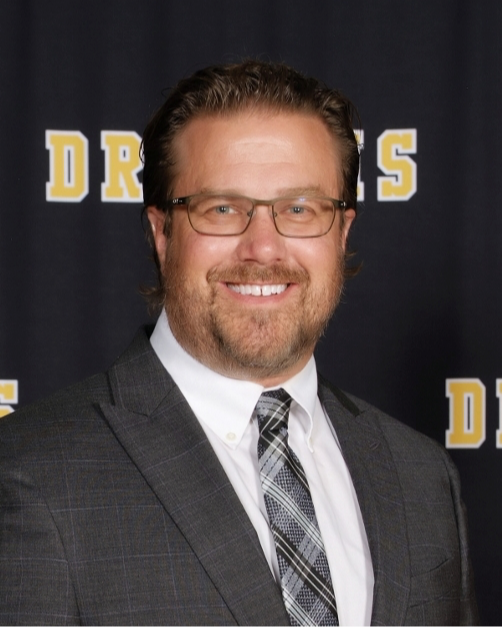
In what came as a surprise to much of the community of Cameron, MO, Cameron R-1 Schools Superintendent Dr. Matt Robinson has announced his resignation. No reason for the resignation was given beyond its effective date of June 30, 2026.
Dr. Matt Robinson, who has served as Superintendent of the Cameron School District since 2011, has announced his resignation effective June 30th, 2026.
Why is Matt Robinson resigning?
Excellent question. As you can see in yesterday’s press release from the school district, there is no stated reason for the resignation. We have requested comment from the district’s Communications Director and will update this story if and when we receive a comment.
The announcement of this resignation came less than 24 hours after the monthly school board meeting. The timing of this announcement and the lack of any explanation leads me to believe this may have been a disciplinary action taken by the school board.
Allegation of fentanyl in the Cameron High School
Two recent events within the Cameron R-1 School District drive my speculation. First on my speculative list is the allegation of fentanyl being distributed and used on school property and its possible cover-up. If true, failure to act and report this to the board could arguably be justification for demanding his resignation. Here is a video that gives an overview and timeline for the fentanyl allegations.
Previously, another incident was brought to the attention of the school board that they didn’t appear to know anything about. In this video from a previous board meeting, you can see the surprise on the faces of board members as they hear an account of what can be described as a wildly inappropriate assault that occurred at the elementary school. The board never commented, but it appears they didn’t know anything about this incident. The acts described in this video should have been reported to the board: they shouldn’t have heard about it from a member of the public.
Secretly Removing Books with Adult Content
In March, I approached current school board president Andi Lockridge at a school board candidate meet-and-greet event to discuss the ongoing “dirty book” issue. Specifically, I brought up concerns about the books that had been approved to keep by the district’s book review committee that were secretly being removed from the library. Mrs. Lockridge indicated she didn’t know anything about books being removed. Once again, it appears that Robinson was failing to inform the board of education.
Removal of these books without board approval is concerning. At the beginning of this fight over the explicit adult content, we met with Dr. Robinson to discuss solutions to the book issue. He told us repeatedly that to just remove books would potentially put the district, and more importantly the taxpayers, at risk of a lawsuit for First Amendment right-to-read violation allegations. The safe play was to keep these books with some form of restriction.
And that is initially what they did. A three-person book review committee was formed and reviewed these books. Once the vote was taken, the committee made a recommendation to the board. The last update I can find is from the June 2024 board meeting. You can find the list of books and recommendations in the June 2024 agenda under number 8, Non-Action Report, item A, Book Review. The board was told these books were being retained, with some being restricted. We can find no records indicating a vote to remove these books or that the board was informed of their removal.
The lack of records and the claim by Lockridge that she did not know about books being removed once again indicate the lack of communication with the board on an issue that could potentially lead to a lawsuit. Removing books without documented justification and board approval is akin to inviting lawsuits for viewpoint discrimination claims.
Currently, there are two pending lawsuits in Missouri relating to First Amendment claims against public schools for the removal of books. Both are lead by the ACLU. C.K.-W. v. Wentzville R-IV School District (2022-ongoing) and ACLU v. Independence School District (2022-pending). As seen in Wentzville, viewpoint discrimination lawsuits typically challenge districts that disproportionately remove books featuring diverse viewpoints, particularly those by and about communities of color and LGBTQ+ people. Is it possible the Cameron R-1 school district is at risk of being sued over these books being removed? I fear the answer is yes.
Take Steps Immediately to Mitigate Possible Lawsuits
While I detest the explicit content in these removed books being provided to children, I believe it is in the best interest of the taxpayers to take steps to avoid a lawsuit. Unfortunately, the only solution I see is to return those books to the shelves and renew the efforts to continue age restricting adult content. There isn’t a viewpoint discrimination claim if those books are in the library.
What Comes Next?
While I have no inside knowledge and the school board hasn’t told me their plans, it is safe to assume that they will advertise the job opening and prepare for interviews. But let’s be honest – how many applicants are going to be interested in stepping into this mess? Chances are good that potential applicants will find some of the articles on this site as well as the national coverage relating to the Dirty Book List. The applicant pool may be limited. There is good news, the search for a new superintendent will provide the community with opportunities.
The Opportunities this Resignation Provides
Most of us will agree that there is no small measure of conflict between the current administration and some of the local citizens. A new superintendent will provide an opportunity for a clean start for both the community and the district. The board will have the opportunity to ask the applicants how they would approach the issues of the last three years and hear new ideas on how to resolve these conflicts. New faces bring new ideas.
Discussions about the book issue could produce new ideas on how to deal with sexually explicit books while avoiding a lawsuit. I would suggest the board ask questions such as: Would it be possible to align the books in the library with the curriculum objectives of the school to remove some of the most problematic books while maintaining a view point neutral stance as outlined in Island Trees School District v. Pico.
Make Education the Priority
Nationally, grade-level proficiency is at an all-time low. Current figures for Cameron show reading proficiency at around 43 percent. Fifteen years ago, it was above 70 percent. ACT and SAT scores show similar trends to grade-level proficiency despite an all-time high in spending on public education. Even Ivy League schools like Harvard are having to offer remedial math classes to new students, according to this April 2025 New York Post article. This is an excellent opportunity to have important discussions on how Cameron can correct this downward trend. I would like to see Cameron in the top ten percent for the state of Missouri instead of marginally above average. Let’s have discussions about making education the priority.
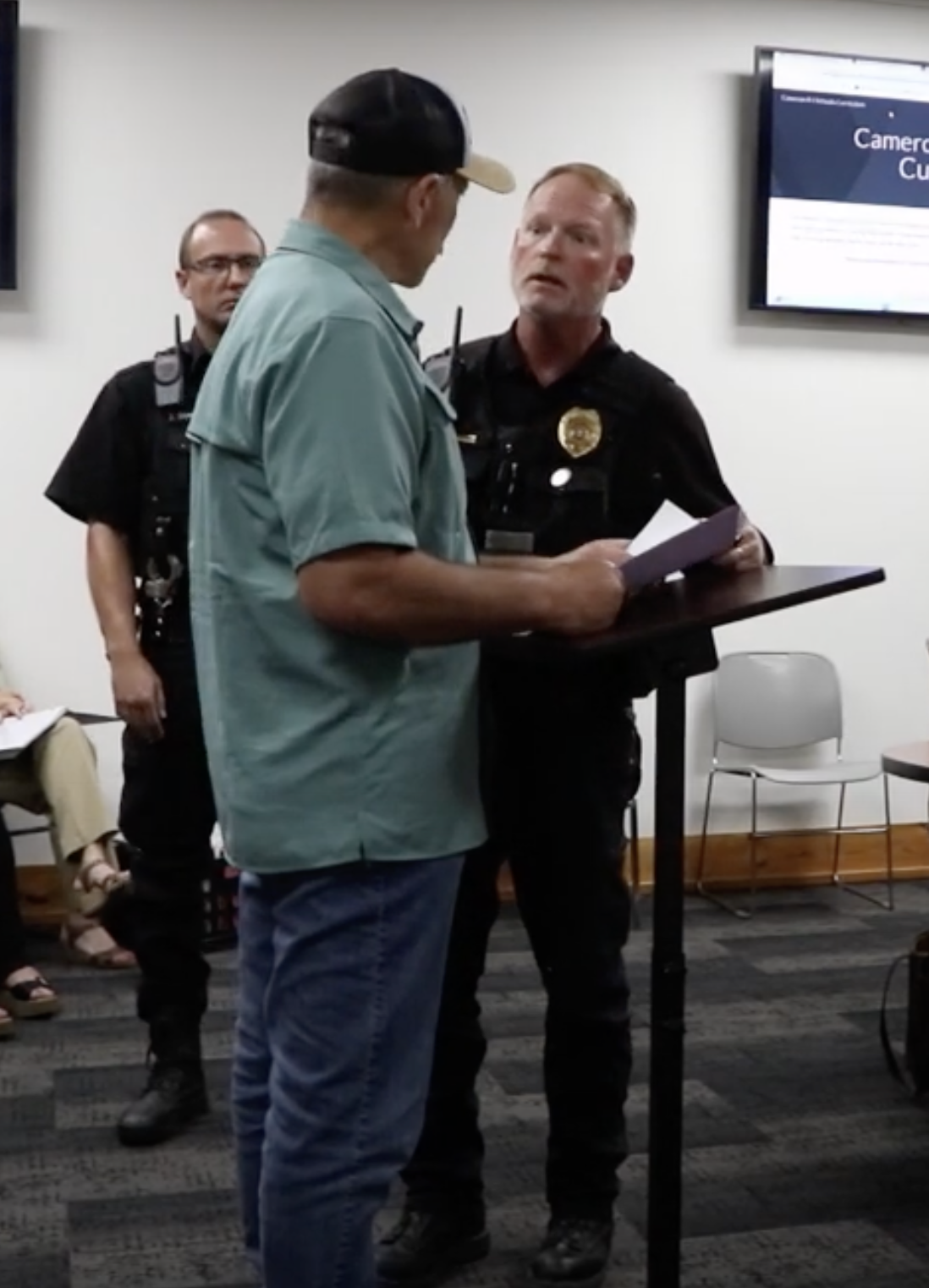
In the span of little more than a week, the Cameron R-1 school district has had three different videos released that should concern any red-blooded, Constitution-loving Americans. These videos raise concerns about our public education system and what is being taught about our God-given rights, which are defined and protected by the Constitution.
Cameron school district police department
The first video includes the entire Cameron school district police department and its lead officer, Palmer. It shows a brief conversation between SRO Palmer and resident Heath Gilbert. Gilbert asks Palmer if he will be arrested for speaking to staff—something school superintendent Matt Robinson ordered in a ban letter. Palmer appears to believe that his chief of police, school superintendent Matt Robinson, has the authority to deny First Amendment rights to freedom of speech and freedom of the press by decree through a ban order.
Why Palmer’s stance is so concerning
In addition to swearing an oath to support and defend the Constitution as a law enforcement officer, SRO Johnny Palmer has also sworn that oath as a 22 year veteran of Missouri Army National Guard. Palmer appears to not understand that the Fourteenth Amendment protects all our civil liberties and guarantees they can’t be denied without due process of law. Palmer has sworn that oath twice but doesn’t appear to understand or honor those oaths.
School board president Andi Lockridge restricts Landi’s 1st Amendment
In our second video, local resident Dan Landi is attempting to address the board of education about school curriculum. When Landi mentions the word “pornographic,” a reference to adult books used as CHS curriculum material, Lockridge was quick to interrupt his address. Landi pointedly asked why she was trying to restrict his First Amendment rights. Her response?
“Because you’re not staying on topic. “ – Cameron R-1 school board president Andi Lockridge
Several concerns with Lockridge’s silencing of Landi’s freedom of speech
In the complete Landi address video,
I see several civil rights concerns. There appear to be several attempts to force Landi to stop reading from his prepared notes and instead talk about a document that the district had displayed on the wall-mounted monitors. Those interactions have the ring of compelled speech.
The “cause” for the frequent interruptions during Landi’s address appears to be based on the assertion that Landi was getting off topic. The final straw for Lockridge, and what ultimately caused her to terminate the remainder of his designated public comment period, was his attempt to bring books into his curriculum topic. Since when are books not related to school curriculum?
The implied threat of being forcibly removed or arrested
If you begin watching Dan’s address video at the 5-minute and 5-second mark, you will see that SRO Palmer has approached Landi and confronted him to get Landi to stop speaking and to sit down. After several requests to sit down, Palmer states, “I am going to ask you one more time,” and Landi responds with, “Or else what?” Palmer responds by saying:
“You and I are going to go outside.” – SRO Palmer
While Palmer doesn’t say the words “you will be arrested,” I would argue that it was implied when he told Landi that they would be going outside if Landi didn’t stop and go sit down. Those words, and Palmer’s close proximity to Landi, were arguably enough to chill speech. That could be argued to be a First Amendment violation.
A Likely Defense from the District to Any Possible First Amendment Claim
In this video, you can repeatedly hear Lockridge say variations of things such as “please sit down” and “I am asking you to sit down.” The Cameron school district or their attorneys would likely argue that he was asked to sit down—he wasn’t forced. I see two problems with that argument. Back to the video: at the 4-minute and 55-second mark, look towards the right side of the screen to the man in the background. That is superintendent Matt Robinson, and he runs the timer. Watch as he reaches out and removes the timer from the table. It will be difficult to argue that Landi could have continued talking with the timer stopped and removed from the table.
Small chance they would have given Landi unlimited time to continue to talk about books. When you add Lockridge’s threat—”I am warning you, if you go off topic your time is over”—the removal of the timer is a clear indication that the Cameron school district carried out that warning. Combine the actions of SRO Palmer and I believe Landi has a very strong First Amendment claim.
Similar event in Lawrence led to lawsuit against Lawrence school district
To help support my claim that Landi has a legitimate complaint against the Cameron school district, I am going to reference some breaking news. In a recent Libs of TikTok post on X, we see a lawsuit filed against the Lawrence, Kansas USD 497 for accusations of First Amendment violations after that school board had a mother’s microphone shut off. I agree with Libs of TikTok: HOLD THEM ACCOUNTABLE. We will be following this federal lawsuit with great interest. Give them the business, Ms. Schmidt!
If you’re on X, please go show this post some love.
Resident Given Ban Despite Offering Proof Accusations Were False
The final video showing the Cameron school district has contempt for the Constitution is from a special hearing held to allow Heath Gilbert to appeal an indefinite ban. The discussion and vote can be seen in the following video clip. The full hearing video can be watched on the Show Me Transparency YouTube page, with the link taking you to that video. For an excellent summary of what is happening in this video, go read the write up from Hick Christian.
School board members are supposed to uphold the constitution
In the state of Missouri, elected school board members are required to swear an oath before they can begin to serve on the board. All Missouri school board members must take the oath prescribed by Article VII, Section 11 of the Missouri Constitution, which requires them to “take and subscribe an oath or affirmation to support the Constitution of the United States and of this state, and to demean themselves faithfully in office.”
I contend that the actions or inactions of these Cameron school board members are a violation of their oath of office. The board is elected to serve and safeguard the interests of the residents who make this school possible through significant taxes. Watching these videos leaves me with a very strong opinion: the Cameron R-1 school board members are captured and serve the school district, not the community. The board is in direct violation of their oath of office.

The Cameron R-1 school district has been fully embroiled in a book controversy with concerned parents and taxpayers over library books with content described as “adult” and “sexually explicit” since February 2023. During all these months since the first books were found, the Cameron R-1 school district has honored Missouri Sunshine Law requests and allowed inspection of library books and curriculum materials on school property. The school district now appears to refuse to allow further inspections and has provided instructions to instead go to a public library.
Recently, I was forwarded an email dated August 14 that originated from the Cameron school district. This email was in response to a verbal request to inspect books inside the Cameron High School library. Originally, a high school administrator had agreed to allow Landi access to the library on a day when no staff or students would be present. As you can see in this screenshot, the district seems to have indicated it will no longer comply with Missouri law and allow the inspection of books.
What laws allow inspections of these books?
First, the Missouri Sunshine Law, Missouri Revised Statutes Chapter 610, allows for the inspection of public records. Every one of our previous requests to inspect books required the Cameron school district to insist we submit a Sunshine Law request as a condition of being able to inspect those books. They complied with each records request and allowed us to inspect those books—until now.
Additionally, Missouri Revised Statute Section 170.231 specifically allows for inspection of curriculum materials. Arguably, any book that was used as part of classroom instruction and was required reading could be classified as “curriculum material.” Failure to allow the inspection of one of these books could potentially be a violation of this statute.
Consequences for failure to allow inspection of curriculum materials
Missouri Revised Statute Section 162.091 indicates that failure to comply with the inspection of curriculum materials could be considered a misdemeanor and punishable by a $500 fine OR imprisonment in county jail for up to one year.
This statute states: “Any county clerk, county treasurer, school board member, officer or employee, or other officer, who willfully neglects or refuses to perform any duty imposed upon him by chapters 160 to 168, 170, 171, 177 and 178, or who willfully violates any provision of these chapters, is guilty of a misdemeanor and on conviction shall be punished by a fine of not more than five hundred dollars or by imprisonment in the county jail not to exceed one year.”
Since the right to inspect curriculum materials is established under RSMo 170.231 (which falls under Chapter 170), any school official who “willfully neglects or refuses” to allow public inspection of curriculum materials as required by law would be committing a misdemeanor under Section 162.091.
What Cameron school district policies address sunshine law requests
According to Policy C-145-P: District Information and Records, the Cameron school district is obligated to comply with and fulfill Missouri Sunshine Law requests. The policy commits the district to ensuring public access to meetings, records, and votes as required by Missouri’s Sunshine Law, while recognizing that some records may be legally closed to the public.
This policy directly implements the district’s obligations under Missouri Revised Statutes Chapter 610 (the Missouri Sunshine Law) by establishing the framework for public records access and designating the responsible officials.
Considering the Cameron school district has treated all previous requests to inspect books and curriculum materials as Sunshine Law requests, refusal to allow additional requests to inspect books would appear to be a deliberate and willful act to ignore the law.
Policy C-105-P: District Rules and Guides
This policy broadly requires all staff to follow district rules, which include legal compliance:
- “All Board members, employees, students and patrons are required to follow the District’s rules and regulations.”
- “The Superintendent, administrators and District supervisors are required to implement and enforce District policies, the Administrative Manual, the Employee Manual, and the Student/Parent Handbook.”
Refusal to comply with policy or law is potentially a violation of the employment contract
In previous records requests, we had the opportunity to inspect a Cameron school district employee’s employment contract with the district. That contract required the then-school district employee to comply with all school district policy and laws. For a school district employee to knowingly not comply with board-approved policy or the law could be a violation of their contract and grounds for possible termination of their employment.
A superintendent instructing staff to not comply with Missouri law and district policy is problematic
As a general rule, the school superintendent is responsible for ensuring the law and district rules are both followed and enforced. He serves both the district and the community—their bosses—and should lead by example as he carries out that responsibility. To instruct staff to intentionally ignore school policy and state law is in itself a violation of policy.
The employees who are instructed to ignore requests to inspect books and curriculum are being set up for failure. They are caught between risking reprimand for ignoring the instructions of the superintendent or potentially violating the law. Regardless of which action the employee takes, they are risking possible job termination.
The school superintendent is supposed to lead by example. By instructing staff to violate law and policy he is creating a toxic work environment. It also undermines both respect and confidence of staff in the ability of their chief executive officer to be fair, impartial and unbiased.
Is it possible the intent of the district was misunderstood?
It’s possible, but I am highly skeptical. We have reached out for comment from the district and those details will follow. Reviewing the email, the text is quite specific.
After speaking with Dr. Robinson to verify up-to-date procedures, I was informed that we are no longer accommodating requests to come into the building to review books. If there are specific books that you have concerns with, please provide the list of titles to the district for the review committee to review. You are always welcome to visit the public library that is located at 312 N Chestnut St and review the books in person.
Had the district been willing to allow the inspection of books in other buildings, such as the central office, that would have been included in this email. There should also have been some instructions on submitting a records request. It wasn’t. The only mention of how to inspect physical books was a suggestion that Mr. Landi visit a public library. The intent behind this email appears to be that Mr. Landi can kick rocks. His days of trying to find and inform the district of sexually explicit books in its libraries are over.
What was his purpose behind inspecting the books
The district has been asked multiple times to police the books in their libraries for the arguably harmful content that isn’t appropriate for children. The school district refuses. Mr. Landi is among several concerned parents and taxpayers who have volunteered their time to identify books that contain sexually explicit content that may be harmful to minors. Because of the efforts of this group the district’s book review committee has identified and restricted more than 40 books. The district wouldn’t have known to review those books without his assistance. Those books and others he helped find are on our Cameron R-1 School’s Dirty Book List.
On the day he attended the district’s open house at the high school he was interested in getting a closer look at two books. One was a graphic novel by an author who has books restricted to adults only. The other he understood contained detailed descriptions of gang rape, murder, incest, explicit sex acts and necrophilia. Those don’t sound like very wholesome or family-values type reading. They should appreciate his efforts and welcome the free help from his group. Instead of being grateful for his assistance in protecting children from harmful material they’ve dismissed him. They told him to kick rocks.
What does the district have to say about this email and refusal to allow book inspections
We have submitted a request to Gina Bainum, the school district’s Communications Director, to ask for comment. We asked Mrs. Bainum the following: “Considering the school district required these book inspections occur through a Missouri Sunshine Law request, how does the school district justify the end of these inspections made through the Sunshine Law? Additionally, does this inspection refusal extend to books which are required reading in the classroom and mentioned on a class syllabus?”
Right before publishing this article, I heard back from the communications director in response to my request for comment. Mrs. Bainum had clarifying questions and indicated she wasn’t aware of the email sent to Mr. Landi. I have shared the screenshot from this article and am awaiting a response. If we receive any comment, this article will be updated.
At the May 2025 school board meeting the Cameron, MO board of eduction appeared to dismiss the concerns of local resident Heath Gilbert when he asserted the school district is violating the 1st Amendment protections for freedom of speech. Gilbert asserts the deviations from district policy requiring residents to make their home address and cell number a public record as a condition of addressing the board both compel and chill free speech.
In what could be described as a violation of their oath of office to the constitutions of Missouri and the United States, the entire board of education appear to have dismissed those concerns and showed support for the efforts by the district and Superintendent Matt Robinson. What are those new requirements and how do they violate the 1st Amendment?
The cause of this claim for 1st Amendment violations revolves around a “form” the district requires everyone to complete as a condition of being able to exercise ones right to address the board during a public meeting. We will discuss the form next.
Details about the districts “form”
When a member of the public makes the required request to address the board of eduction they are provided with a link to an online form. The school district requires this form to be completed as a condition of being granted permission to speak to the board. Failing to complete any portion of this form will result in a denial to address the school board.
The district requires residents provide their name, email address, cell phone number and home address before asking for details on what you want to discuss. They also require you to offer a solution to the stated issue.
Failure to complete any portion of the form, or to complete it accurately, will result in a denial of being added to the agenda to address the board.
Is the “form” part of school policy?
Absolutely not. The board policy and requirements for being added to the agenda to address the board are outlined in policy C-140-P. There is no mention of “form” in that policy or any requirement to make one’s name, address and phone number a public record as a condition of addressing the board.
The policy does require everyone to meet with the superintendent as a condition of addressing the board, but Superintendent Matt Robinson refuses to hold those meetings. The board ignores staff not following board policy and refuses to instruct him to follow policy and hold those meetings, as required in current policy.
Cameron schools compel speech of residents
As of December 2024, the Cameron school district began to compel anyone wishing to address the board to make their home address and cell phone numbers a public record as a condition of speaking to the board. Because of the Missouri sunshine law, any addresses, phone numbers or other information submitted to the district as a condition of speaking to the board becomes a public record.
The school district is required by law to make that personal information submitted via the “form” available to anyone who requests it. The school district and board of education are comfortable with making your personal information available to public. Requiring one to speak or telling them what they must say is compelled speech and a clear 1st Amendment violation.
Can public schools or governmental bodies compel speech?
Absolutely not. The Cameron school district and board of education are governmental bodies subject to compelled speech restrictions. Fortunately there are several Supreme Court cases where they have weighed in and offered opinions on compelled speech. Examples of these opinions include the infamous cake baker Jack Phillips out of Colorado. He was sued multiple times for refusing to bake various cakes which violated his religious belief. To force him to bake a cake would be compelled speech.
You can read examples of Supreme Court cases describing the dangers of compelled speech in this article by Neal Hardin. Compelled speech is dangerous and a violation of the 1st Amendment.
How is the Cameron school district chilling speech?
The same form and the requirement to disclose personal information can cause someone to not address the board out of fear of reprisal or retaliation. The Cameron school districts requirement to make personal information a public record can cause someone to not exercise their freedom of speech out of fear of reprisal or retaliation. That is chilled speech.
Here is a real life example. At the December 2023 school board meeting the book topic was on the school board meeting agenda here in Cameron. Concerned members of the public spoke against the books and their sexually explicit adult content being made available to children. Three school staff members addressed the board in favor of those books. One teacher referred to the efforts of the men who were leading the opposition of those books as a circus, implying they are clowns. She used strong language implying that racism, bigotry and misandry were the root causes of any issues with the books. Would she still be willing to call out those men and book review committee and once again make those same accusations knowing they could obtain her home address and cell phone number?
Or is it more likely that this teacher would be concerned one of those men would contact her on her cell phone or show up at her front door after implying they were clowns. Would she be willing to use the same language as she had previously back in December, or would she be compelled to use softer language or not mention them at all? The intellectually honest answer is anyone would likely soften their statements to the Cameron school board or choose not to address them at all out of concern of harassment or threats by someone who doesn’t like what they said.
This is what chilling speech looks like. And your Cameron R-1 schools board of education supports the actions of the district which compels speech, chills speech and does not align with school policy. They ban members of the public for not following policy but ignore and excuse when staff do the same.
What is the cause of these new restrictions on free speech?
We can only speculate as neither the district or board of education have explained the deviation from policy. To put it simply, they want to control what information is shared with the community at these board meetings about the school. This is an attempt to control or limit what is said.
A quick look at the new Rules of Decorum for the district and you will see that the district has granted itself the right to terminate the designated public forum time allotted for a member of the public if they bring up something that is not on their form. See the seconded bulleted item in number 2 of the Decorum Rules document.

To further speculate, I would guess it stems from the November 2024 board meeting where resident Heath Gilbert used the veil of body worn cameras to bring up alleged incidents of sexual assault of students at the elementary school and on a school bus. You can see that video below.
Final closing statement statement
Each Cameron school district board member swore an oath to the constitutions of the state of Missouri and these United States. The new requirement that forces residents, teachers and students to make their phone numbers and home address a public record is compelling speech. This practice can and has chilled speech because residents don’t want to make that information a public record. Chilled and compelled speech are both clear violations of the 1st Amendment. For the board members to support these blatant violations is also a clear violation of their oaths of office. How can we trust the actions and words of these board members if they don’t take one of our nations most sacred oaths seriously?
Please consider peacefully contacting your elected school board members and urge them to honor their oaths and stop this madness. The email address for the board can be found on their webpage or you can email the entire board directly at boardofeducation@cameronschools.org
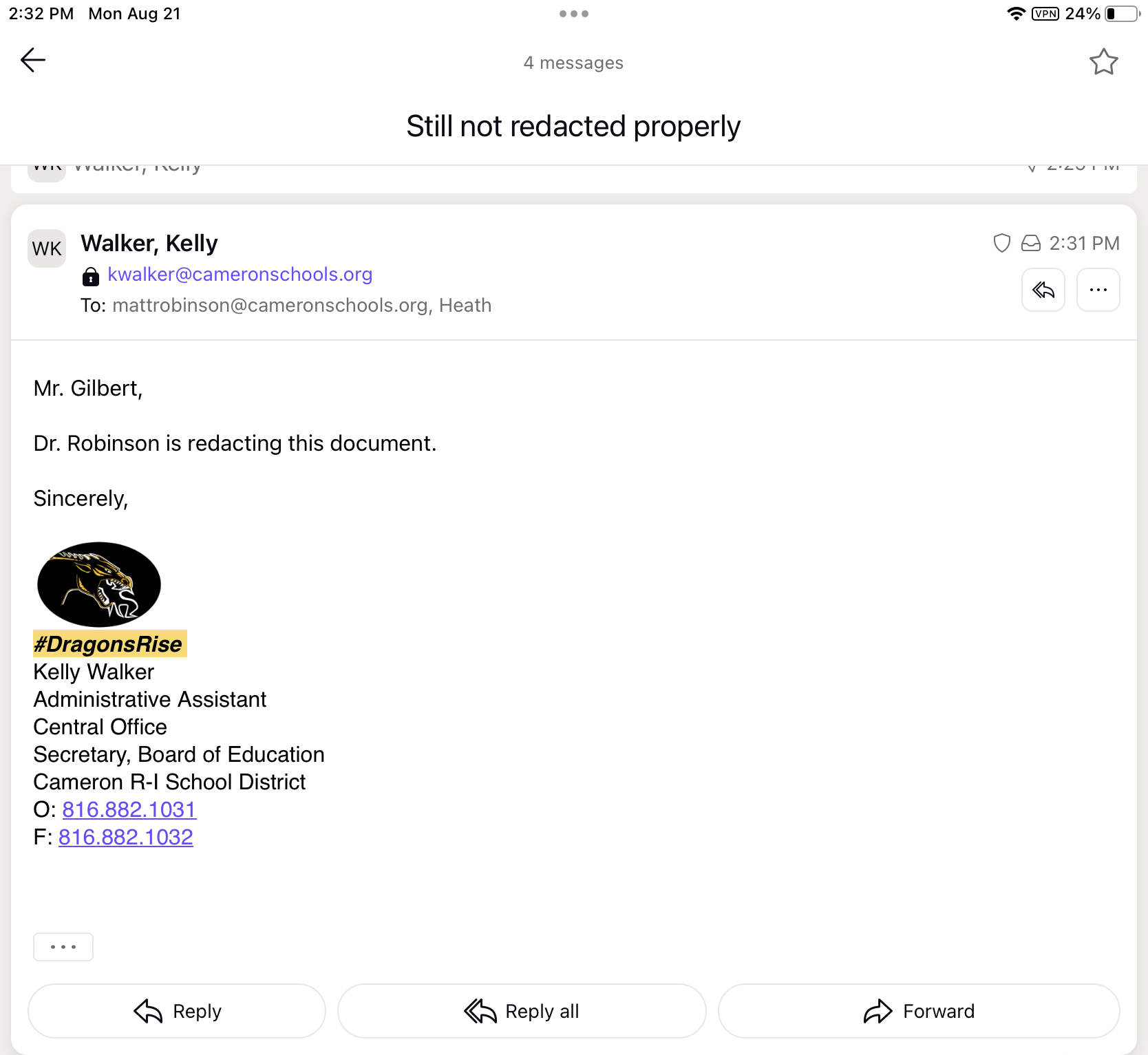
Last nights Cameron R-1 school districts board meeting we heard concern raised about possible unnecessary and wasteful spending in the district. Were these legitimate concerns about wasteful spending, or a veiled attempt by the district to discredit a local resident? Let’s flesh this out a little and allow you to draw your own conclusion.
The relevant discussion happened in the first few minutes of last nights meeting. School board vice president Ryan Murphy brought up a concern and started a discussion about a large bill for attorney services to redact records for a single Missouri Sunshine Law request. During the discussion about that bill, board member Pam Ice asks Superintendent Matt Robinson how much that specific records request cost the district to make redactions. Matt responded that it was $8200. That is unquestionably a lot of money.
You can watch that full exchange in the following video. But be sure to continue reading as we will provide additional and relevant details about likely reasons why attorneys are now making these redactions.
Can those redaction be made by school staff to save money?
That is the relevant question I would have liked one of the board members to have asked superintendent Robinson. Board members Peck, Ice and board president Lockridge all joined in the conversation to share concern about the cost for redactions. They were concerned about the cost, why were there no questions on how the district could reduce that cost?
I believe that both the district and school board have a fiduciary responsibility to the tax payers to spend our money wisely. Paying a law firm $200 plus dollars an hour to redact names from public records doesn’t seem like a good use of tax dollars IF those redactions can be made by the district.
Around the 2 minute and 45 second mark in the above YouTube video, Robinson mentions the district can only charge the individual requesting the records an amount equal to the lowest paid qualified staff member to complete that task. Robinson mentions that is around $20 an hour.
Why then isn’t the Cameron school district making their own redactions and saving tax payers $180 an hour? Of course hindsight is 20/20, but this would have been a good question for a member of the board to ask. I’d love to hear a cost reduction question at every board meeting!
Has the school district previously completed their own records redactions
That is another question I would have liked to hear a board member ask. And if the answer provided was “yes”, a follow on question to ask why the change from previous and cheaper in house redactions. The board didn’t ask those questions, but i can still provide an answer to that question.
Yes, the Cameron school district has made its own redactions in the past.
In this screenshot you will see an email response from the district where they state that the superintendent was personally redacting records requests previously. Why was the highest paid staff member for the district conducting this task?
This image is from one of my own Sunshine Law requests and the redactions being made were staff names, the same type of redactions made in the $8200 request mentioned at last nights May 20th board meeting. If the district was previously able of making redactions to protect the names of district employees, why outsource that task to a significantly more expensive law firm? Another good question I wish one of the board members had asked.
Why did the Cameron school district stop completing their own redactions for records request?
While it is typically frowned on to comment on such questions with mere speculation, in this instance my answer is based on irrefutable fact. Records we previously obtained through Sunshine Law requests pertaining to the dirty book fight appear to indicated unlawful redactions made by the district.
One of the redactions appears to be an attempt to avoid transparency and coverup proof of records the district previously said didn’t exist. We can show you that unlawful redaction.
 To the right in the attached screenshot you can see a record with a poorly made redaction. The link is to a google document of book votes taken by a book review committee. This is important because when I originally asked for records of these votes I was told that no records existed. This redaction appears to be an attempt made by the district to cover up the existence of public records. This is the exact opposite of transparency.
When did the district switch to using lawyers for redactions
If Mr Murphy were to extend his records request he shared with the board and made a public record at last nights meeting to around the time of my records request, I suspect we will find an uptick in the billable hours by Ed Council. It is my belief that it was around this time that found this unlawful redaction and attempt to avoid transparency that the district began outsourcing simple redaction duties to its law firm.
Was this a personal attack or legitimate concern about wasteful spending
Once again I can only speculate on this question. In the 2 plus years I have been attending these board meetings, last night was the first time I recall a monthly expense budget item being questioned during a meeting. If this was a one time event and we don’t hear similar questions in the future, we have our answer.
I hope that I am wrong. I hope this is a sincere concern about possible wasteful spending of our tax dollars in the Cameron R-1 school district. I hope to see additional concerns about expenses brought up at future meetings. Hopefully routine series of questions are developed and asked during those meetings to ensure our hard earned tax dollars are being spent responsibly and wisely.