
By Heath Gilbert | Cameron School District Exposed | March 25, 2026
A synthetic opioid described by state officials as a “hidden killer” has been detected in the wastewater of Cameron High School. Parents were not notified through any official district channel.
UPDATE — March 25, 2026
Since this article was published, two significant developments have emerged. First, the question of who deleted the original Facebook post has been answered. The group administrator of the Cameron Community Forum confirmed the post was not removed by admins. The original poster came forward herself, explaining she took it down after the school’s response made her look like she was spreading false information. In her own words, the school was “acting like they didn’t know what I was talking about” — and then turned around and released a public statement confirming everything she said.
That statement came in the form of a letter signed by Superintendent Dr. Matt Robinson and sent to Cameron R-1 families on March 25, 2026. In it, the district confirms that Cameron R-1 chose to participate in the voluntary DPS wastewater monitoring program — directly contradicting the earlier claim relayed through a school secretary that the district did not know the testing was occurring.
The district has announced a community informational presentation on April 8th at 6:00 p.m. in the Cameron R-1 Performing Arts Center, featuring Sergeant Hux of the Missouri Highway Patrol. That date is worth noting: it falls the day after the April 7th school board election. Cameron voters will go to the polls without the benefit of that presentation.
One final note: in an official letter to parents about one of the most dangerous synthetic opioids currently circulating in Missouri, the district misspelled the drug’s name — writing “Nitazine” rather than “Nitazene.” It is a small thing. But when a community is being asked to trust that its school district is on top of an emerging drug threat, attention to detail matters.
What We Know
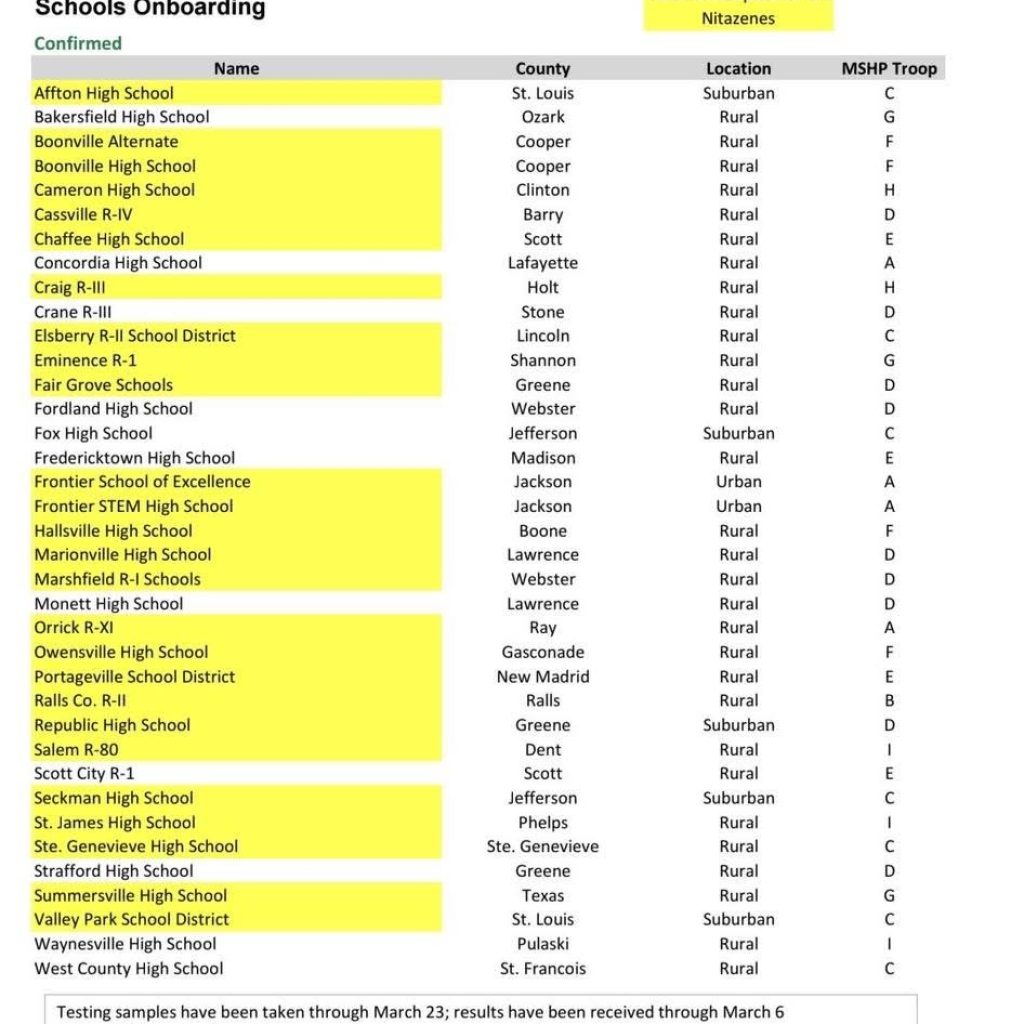
Cameron High School is among 26 Missouri schools that have tested positive for nitazenes through a voluntary wastewater monitoring program led by the Missouri Department of Public Safety (DPS), in coordination with the Department of Health and Senior Services (DHSS), the Department of Elementary and Secondary Education (DESE), and the Department of Mental Health (DMH). The results cover testing samples taken through March 23, 2026, with results received through March 6.
Nitazenes are a class of synthetic opioids that are five to ten times more potent than fentanyl. They have been found in counterfeit pills, illicit powders, unregulated cannabis products, and vape liquid — often without the user’s knowledge. Fourteen Missourians died from nitazene-related overdoses in 2024, more than triple the total recorded from 2019 through 2023 combined. Critically, standard drug tests do not detect nitazenes. A specific, targeted test is required to identify their presence.
Cameron High School appears on the official state list — confirmed positive — in Clinton County, Rural, under MSHP Troop H.
This story was first reported regionally by Fox4 and KMBC.
A Note on What Wastewater Testing Actually Means
Some community discussion has confused wastewater with drinking water. These are not the same thing. Wastewater is the water that exits through toilets, sinks, and drains — it is not water that anyone drinks. A positive nitazene result in the wastewater at Cameron High School means the substance was present in the bodily waste of people who used the bathrooms at that facility — students, staff, or anyone else who was inside that building and used those facilities. This is not a contaminated water supply issue. It is evidence that nitazenes were present in someone’s system while they were inside Cameron High School.
How This Story Came to Light — And Then Disappeared
I first learned about this story through a post in the Cameron Community Forum on Facebook. That post was subsequently deleted. I am unable to confirm whether the original author removed it or whether group administrators took it down.
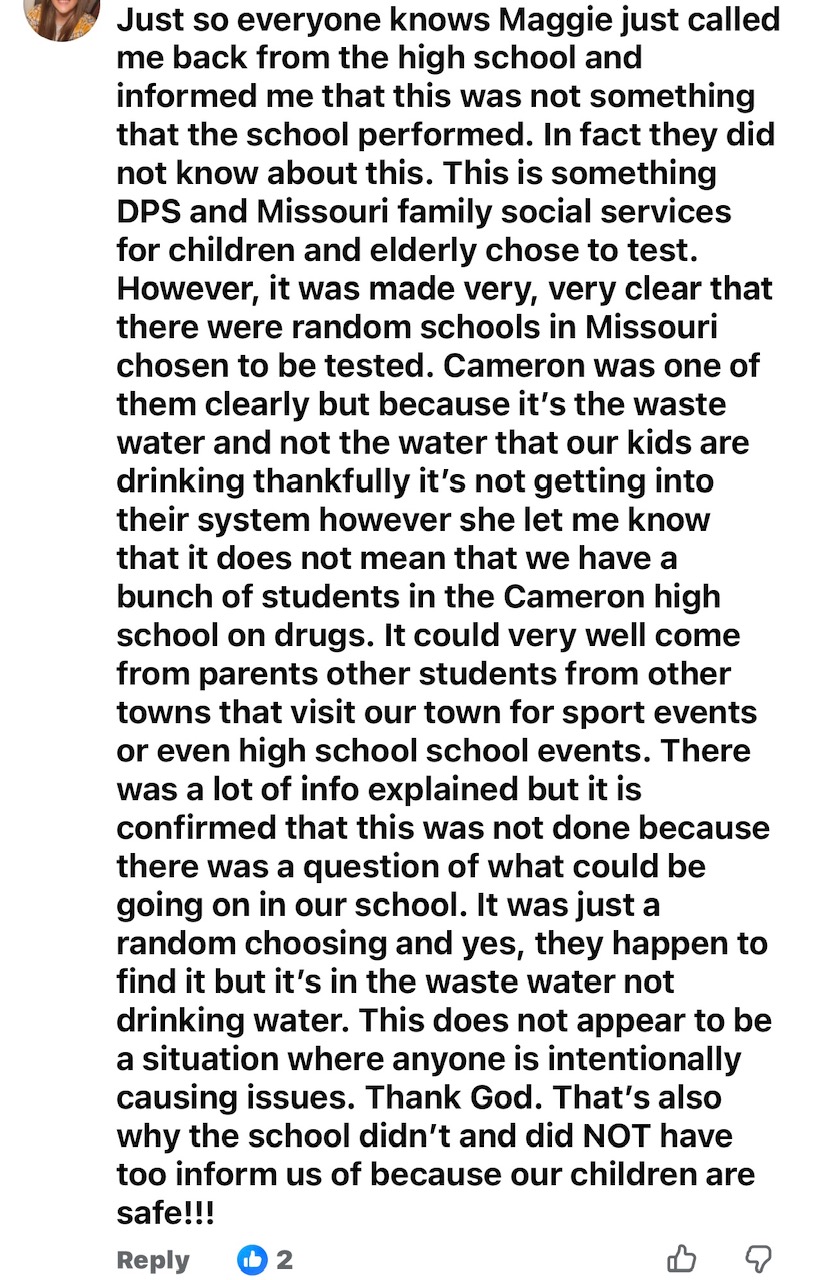
Before that post was removed, a parent posted a follow-up in the same group describing a phone call she made directly to Cameron High School. I captured screenshots of that post before it too was deleted. According to that post, a school secretary told the parent that the school did not perform the testing, did not know the testing was being conducted, and therefore had no obligation to notify parents. The post further relayed the school’s suggestion that the positive result could have come from visiting students or parents from other towns who used the school’s facilities during sporting events.
The school’s position, as reported through this community member: the children are safe, it’s wastewater not drinking water, and the district had no obligation to inform parents.
The Stories Don’t Add Up
According to multiple news outlets, this was a voluntary program — meaning Cameron R-1 had to opt in. An email from DPS Director Mark James to Missouri superintendents, obtained and reported by KCUR, invited schools to enroll and explicitly stated the program required “no additional responsibilities for your staff,” meaning outside personnel came to Cameron High School to collect the samples. Someone at the district level received that email, made a decision, and said yes. The school secretary’s claim that the school “did not know” this was happening does not hold up against that paper trail.
The “visiting teams and parents” explanation doesn’t hold up either. Stercus Bioanalytics, the contractor running this program, designs its methodology specifically to measure a school’s own population — not Friday night crowds. The entire point of the program, in Governor Kehoe’s own words, is to identify drug use in schools. Testing during a public event would make that data meaningless. The district should find out exactly when that sample was collected, check it against the school calendar, and tell parents what they find.
Questions the District Has Not Answered
Because of my documented history with Cameron R-1, I have little expectation that the district will respond to my inquiries. But the questions that need answering are straightforward, and any parent or community member has the right to ask them:
- Did Cameron R-1 voluntarily enroll in the DPS school wastewater monitoring program? If so, who authorized that participation, and when?
- When was the wastewater sample collected at Cameron High School — what day of the week, what time of day, and under what circumstances?
- Does the district’s current random drug testing program — administered to students participating in extracurricular activities — include tests capable of detecting nitazenes, fentanyl, or other synthetic opioids beyond the standard opioid panel?
- Now that the district is aware of a confirmed positive result, what specific steps is it taking in response?
- Why was no official communication sent to parents?
- Is the Board of Education aware that these tests were being conducted, and were they presented with the results?
We are also calling on the district and the Board of Education to release the full results of these wastewater tests as a public record. This testing was conducted in a public school, funded by public dollars, as part of a state program designed to protect the public. The community has a right to know exactly what was found in their school. Release the results.
With a school board election just two weeks away on April 7th, voters have a unique opportunity to put these questions directly to the seven candidates seeking seats on the Cameron R-1 Board of Education. How a candidate responds to a confirmed positive nitazene test in the school’s wastewater — and whether they believe parents deserved to be notified — tells you a great deal about how they would approach transparency and accountability if elected. These are not political questions. They are public safety questions, and every candidate should be prepared to answer them.
This Is Not the First Time
The Cameron R-1 School District’s reluctance to communicate openly with parents about drugs in its building is not new. In August 2024, I personally reported to Superintendent Dr. Matt Robinson that a student had obtained and used fentanyl inside Cameron High School. That report went nowhere. Records requests to both the Cameron Police Department and the Clinton County Sheriff’s Office returned the same answer: “no records exist.” I subsequently addressed the Cameron City Council directly about the fentanyl allegations and what appeared to be an institutional coverup — that address is on the public record and can be viewed here.
When I confronted Cameron High School’s assistant principal on video about why the district’s own school resource officer had no knowledge of students smoking marijuana on CHS property — the same building where nitazenes have now been detected in the wastewater — his response was telling. Rather than acknowledge the district’s mandatory reporting obligations under Missouri law, he asked: “What would somebody else’s definition of a drug problem be? Is one incident a drug problem? Is five?”
Missouri law does not ask how many incidents it takes to constitute a problem. RSMo 167.117 requires the principal to immediately report any controlled substance discovered on school premises to local law enforcement. One incident is enough. The law is not ambiguous.
The pattern here is consistent: drugs appear inside Cameron High School, the district minimizes, deflects, or goes silent, and parents are left to find out on their own — if they find out at all. The nitazene detection in the school’s wastewater is the latest chapter in that pattern.
What Should Happen Now
I want to be clear about something: if Cameron R-1 voluntarily participated in this monitoring program, that deserves credit. Wastewater surveillance is a legitimate and effective public health tool. It identifies drug trends anonymously at the community level, without targeting individual students, and it gives schools and law enforcement the information they need to act.
But participation in a program designed to protect students carries with it a responsibility to be honest with parents when the results come back positive for one of the most dangerous synthetic opioids ever identified. Nitazenes killed 14 Missourians last year. They cannot be detected by standard drug tests. They are showing up in products kids don’t even know are laced. This is not a situation where silence is an acceptable response.
Cameron parents were not notified through any official district channel. They found out through Facebook — and then those posts disappeared too.
The Board of Education meets once a month. The community has a right to answers. If the administration won’t provide them voluntarily, the board should demand them — and if the board won’t, the public should show up and ask directly.
This story is developing. If the district issues an official statement or provides clarifying information, this article will be updated to reflect it.
Heath Gilbert is the publisher of Cameron School District Exposed and Breach Holder on Substack. He has covered Cameron R-1 since September 2022.