
read more posts by
Cameron Exposed
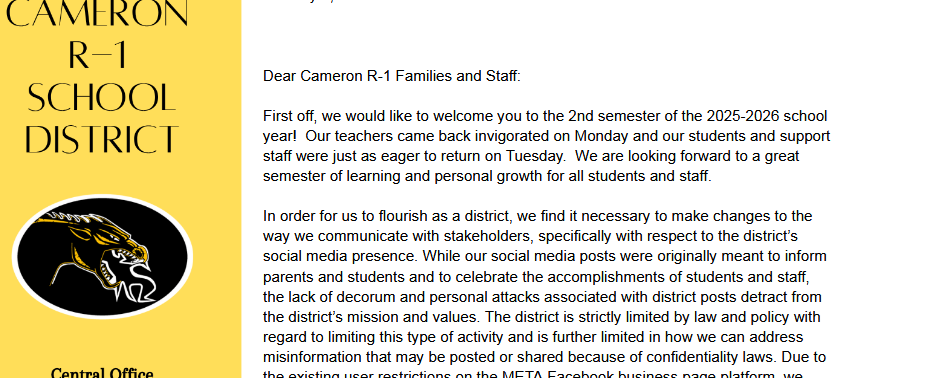
The Cameron R-1 School District announced on January 7, 2026, that it is suspending its Facebook and Instagram presence, citing concerns about “lack of decorum and personal attacks.” Translation: they can’t handle the truth being broadcast to the world, so they’re taking their ball and going home.
Community members aren’t buying the spin. Cameron resident Tawnya Cooke Stuedle captured what everyone’s thinking: “You realize you are one of the primary reasons they are doing this. Correct.” Her comment has garnered twenty likes and counting. The district can dress it up however they want, but everyone knows what this really is—a retreat from accountability.

Here’s what actually happened. For three years, citizens have documented school board meetings on social media, exposing systematic failures in district leadership. One video showing the board intentionally ignoring public questions has exceeded one million views. Multiple reels from the Rachel Barlow termination hearing have generated more than 100,000 combined views. These videos devastated the district’s image by doing nothing more than showing officials’ own actions—inconsistent policy enforcement, questionable judgment, and flat-out refusal to address legitimate concerns. Rather than fix the dysfunction, the district deleted its own social media accounts and ran for the hills. Problem solved, right? Wrong.
A Constitutional Contradiction (Or: How to Admit You Violated Rights Without Actually Admitting It)
The district’s January 7 announcement contains what lawyers call a “damning admission”: “The district is strictly limited by law and policy with regard to limiting this type of activity and is further limited in how we can address misinformation that may be posted or shared because of confidentiality laws.”
Read that again slowly. They’re admitting—in writing—that they are “strictly limited by law” from doing exactly what they’ve been doing. Government entities operating public forums cannot legally delete comments or ban users simply because they don’t like the message. Yet this admission comes just two months after the district banned disabled Navy veteran Vinzent Cooper from its Facebook page for 90 days—a man who served his country to protect the very constitutional rights the district violated.
Cooper’s November 3, 2025 ban letter cited “zero tolerance for cyberbullying” and “personal attacks on staff.” His actual offense? Comments on a post about the school musical that included: asking for an autographed signature from staff member Gina Bainum “who can’t tell time, lies & steals money” and references to staff members as “Oompa Loompa twins” while discussing issues including “porn in the library” and “proficiency grade levels of state recognized 43%.” He tagged another Facebook user, sarcastically noting “it’s wonderful to be violated” by “lying, thieving subversive oath breaking corrupt criminals of the CSD/BOE/staff.”
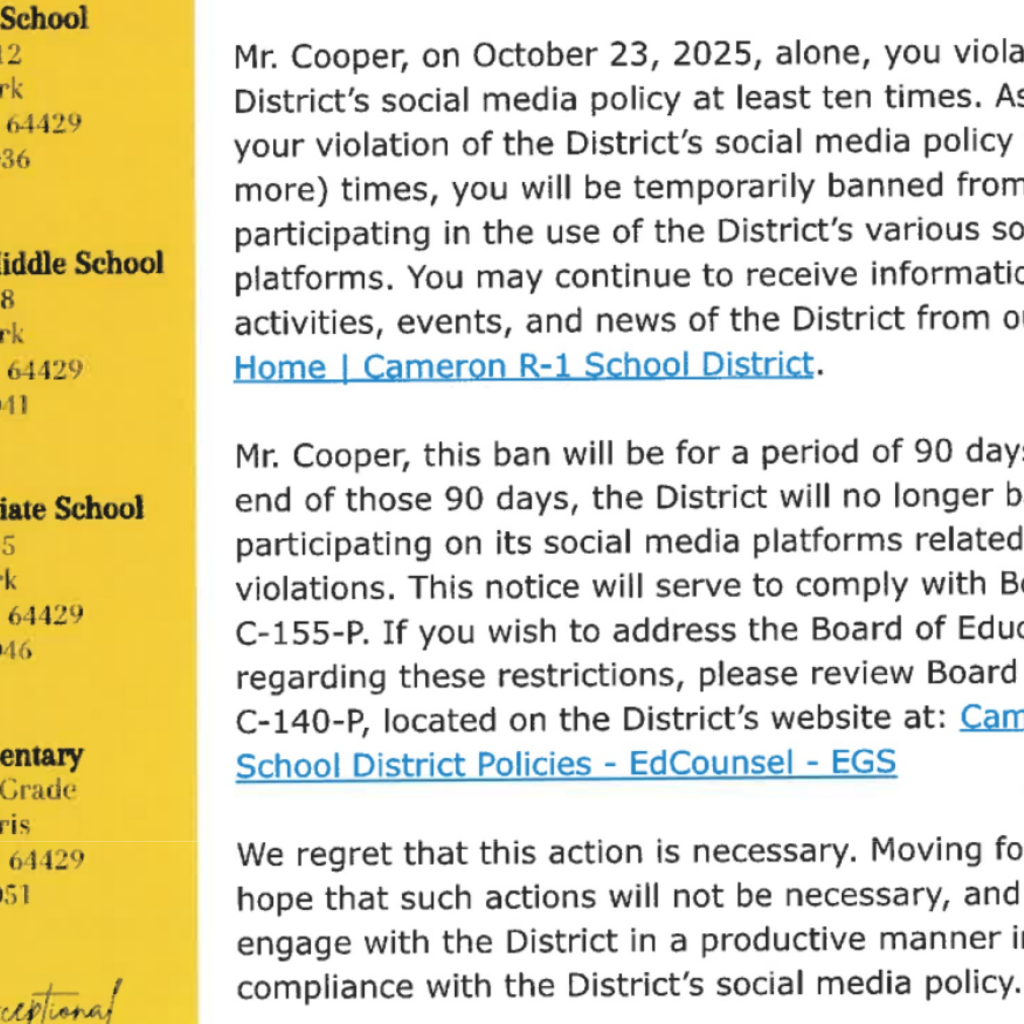
Cooper’s comments were harsh, sarcastic, and directly critical of named individuals—but they referenced real concerns about district performance and alleged misconduct. More importantly, they were constitutionally protected political speech. Yet the district banned him anyway, deleted his comments, and blocked his access. You know, the exact thing they just admitted is illegal.
The Silent Reversal (Or: How to Undo a Constitutional Violation Without Admitting It)
Cooper requested an appeal hearing within the required 10-day window. The district’s response? Radio silence. Then around mid-December, Cooper discovered by pure accident that his ban had been quietly lifted. No explanation. No acknowledgment. The district just pretended it never happened and hoped nobody would notice.
“They gave me no information on it,” Cooper said. “I just went on there out of curiosity. I’m like, wait a minute, I can actually comment. I mean, I was shocked.”
Does he believe the district recognized it violated his constitutional rights? “Oh, 100%. But they don’t care.”
And why would they admit it? An admission could be used against them in a lawsuit. Better to silently undo the ban, pretend it never happened, and hope Cooper doesn’t have a good attorney. Except now, with the district admitting in writing they are “strictly limited by law” from removing comments, they’ve essentially confessed to violating Cooper’s rights. Oops.
Viewpoint Discrimination (Or: We Only Want to Hear the Good Stuff)
Cooper nails the constitutional problem: “They only accept praises, but they can’t accept critical, constructive criticism. A lot of stuff that we’ve talked about, it’s not minor stuff. Pick the topic. Drugs? Heavy. Bullying? Heavy. Sexual assaults? Heavy. Not able to identify a firearm from a toy. I’m sorry, but that’s pretty heavy.”
He’s exactly right. The district didn’t ban anyone for posting heart emojis under student achievement announcements. They banned people for raising serious questions about serious problems. That’s textbook viewpoint discrimination—when government creates a public forum and then kicks out the people whose opinions they don’t like. The First Amendment exists specifically to prevent this kind of garbage.
The Problem For Banned Citizens (Or: How to Violate Your Own Ban Letters)
The social media shutdown creates a constitutional crisis for three community members banned from attending board meetings in person: Heath Gilbert, Vinzent Cooper, and Dan Landi. All three are military veterans. All three swore an oath to defend the Constitution. And all three received ban letters prohibiting physical attendance but explicitly “preserving” their First Amendment rights to observe meetings.
Gilbert’s September 3, 2025 ban letter states: “He may continue to view public board meetings via the district’s live video feed.” Landi’s September 26, 2025 letter contains identical language. This accommodation was supposed to solve the problem—banned citizens could watch the live stream and submit written comments via email.
Here’s the catch: the district’s live stream was hosted on Facebook. No social media means no Facebook. No Facebook means no live stream. No live stream means the three banned citizens cannot observe public meetings as their ban letters explicitly promised. In their rush to cover up one First Amendment violation—Cooper’s illegal ban—did they even stop to consider the ramifications for the three banned men? Or did their coverup just create another constitutional violation by denying access to the meetings they promised we could watch? That takes a special kind of incompetence—or maybe they just don’t care about constitutional rights at all.
The district says families will receive information “through the exclusive use of the ParentSquare App.” Great, except banned community members aren’t parents of current students. They’re taxpaying residents with the same right to be informed about what’s happening with their tax dollars. And there’s zero mention of how the district will live stream board meetings without social media. If they eliminate the Facebook live stream without providing an alternative, they’ve effectively nullified the First Amendment accommodation they promised in writing.
Transparency Lost (Or: Can’t Take the Heat, So They Left the Platform)
Social media provided real-time updates about school events, emergencies, and schedule changes. Parents could ask questions publicly. Taxpayers without children in schools could stay informed about how their money was spent. All gone now.
Cooper articulated the loss perfectly: “By shutting down the Facebook page itself, they’re escaping. They’re escaping public interaction. They’re not allowing the public to engage. Me, you, anyone. Oh, wow, I can’t wait to try the cookies at the Cameron Dragonettes cheerleaders’ cookie sale. And someone else might say, yeah, they were really good. And someone might say, yeah, the last year they were pretty dry and crumbly. So they can’t take the heat of negative responses.”
Or praise, for that matter. Community members who wanted to celebrate teachers or thank staff also lose that platform. The district’s brilliant solution eliminates criticism AND praise, accountability AND celebration. The real issue is that the district “can’t take the heat of negative responses.” But here’s the thing about government officials: you don’t get to silence critics simply because criticism hurts your feelings. That’s not how any of this works.
The Real Motive (Or: The Receipts Don’t Lie)
The district claims social media management “has also taken a great deal of staff member effort.” Translation: responding to legitimate questions from taxpayers is too much work. This frames public accountability as a burden rather than a core responsibility of operating a taxpayer-funded institution.
The letter also complains they cannot “remove tags”—meaning they can’t stop citizens from tagging the district in personal posts about district issues. Citizens tagged Cameron R-1 when sharing board meeting videos, driving hundreds of thousands of people to content documenting dysfunction. The district couldn’t prevent tagging without violating Facebook’s terms, so they did the only thing they could think of: shut down their own social media accounts and walked away. If you can’t win the game, flip the board over and storm off.
Community members recognize this for what it is. The district isn’t protecting students—the viral videos show officials’ own behavior, not attacks on kids. They’re avoiding accountability, running from critics, trying to control the narrative by abandoning the platform where citizens were documenting their failures. As Tawnya Cooke Stuedle observed, everyone knows what’s really happening. The knuckleheads running the district just proved all their critics right.
The Spin Game
Make no mistake about what’s happening here: the district is deliberately mischaracterizing the content critics post on social media. By framing legitimate accountability journalism and protected political speech as “personal attacks” and threats to “decorum,” they’re attempting to paint themselves as victims of mean-spirited bullies rather than public officials facing justified scrutiny. It’s a calculated public relations strategy—gain sympathy, manufacture public support against the “mean men,” and distract from the actual issue: their repeated First Amendment violations.
The district’s January 7 letter complains about “lack of decorum and personal attacks associated with district posts” as if the problem is tone rather than substance. The letter also references their inability to address “misinformation that may be posted or shared because of confidentiality laws.” Let’s be clear about whose information is actually false.
The critics post unedited videos of board meetings. That’s not misinformation—that’s primary source documentation. The critics quote directly from district documents and ban letters. That’s not misinformation—that’s evidence. The critics point out when the district violates its own policies or constitutional rights. That’s not misinformation—that’s accountability.
You know what IS misinformation? The district claiming they’re “strictly limited by law” from deleting comments while simultaneously having deleted Cooper’s comments and banned him for 90 days. The district claiming to “preserve First Amendment rights” in ban letters while eliminating the livestream access those letters promised. The district claiming social media was shut down to “protect students and staff” when the viral videos show officials’ own behavior, not attacks on children or employees.
If the district wants to talk about misinformation, they should start by looking in the mirror. The critics have the receipts: unedited video, official documents, and the district’s own contradictory statements. What does the district have? Vague accusations, shifting explanations, and a pattern of running from scrutiny.
By shutting down social media and blaming it on critics, the district gets to play the victim while simultaneously burying the evidence of their constitutional violations. Cooper’s illegal ban? Gone from public view. The admission that they can’t legally delete comments? Buried in a press release that will be forgotten. The pattern of silencing dissent? Conveniently eliminated along with the platform.
It’s a neat trick: violate someone’s rights, get caught, then eliminate the platform where you got caught and blame the people who documented your violations. The knuckleheads running the district apparently believe if they can control the narrative by removing the platform, they can make their constitutional problems disappear.
They’re wrong.
What Happens Next
Several urgent questions demand answers: How will the district livestream board meetings for the three banned citizens? How will it provide information to taxpayers who aren’t parents? Will it acknowledge violating Cooper’s rights? What happens in the next crisis when the district has abandoned its fastest communication method?
Spoiler alert: they won’t answer any of these questions. That’s not how they operate.
For three years, concerned citizens have documented what they witnessed at board meetings. They used social media not to attack the district, but to let officials’ own actions speak for themselves. Those videos reached millions because they revealed something true about how Cameron R-1 operates. The district’s response? Ban the messengers. Silence the critics. Delete their own social media accounts and run away. At every step, when faced with criticism, officials chose suppression over self-reflection. That choice reveals everything you need to know about their priorities.
The community sees it. Tawnya Cooke Stuedle sees it. Vinzent Cooper sees it. And thanks to videos that reached far beyond Cameron, Missouri, the rest of the country is starting to see it too. The knuckleheads running this district just handed their critics the biggest win possible: proof that everything we’ve been saying about them is true.
There’s a bitter irony here: three military veterans who swore an oath to support and defend the Constitution are now fighting to protect those very rights against a school district that seems to view constitutional protections as obstacles to be circumvented rather than principles to be upheld. The district banned veterans from meetings, promised them live stream access, then eliminated the live stream. These men defended the Constitution overseas. Now they’re forced to defend it at home—against their own school district.
Running from critics doesn’t make problems go away. It just proves the critics were right all along.
Heath Gilbert is an independent journalist and founder of Cameron School District Exposed. He has attended and documented Cameron R-1 School District board meetings for more than three years. He was banned from district property in September 2025 but continues to cover district operations through public records requests, live stream observation, and community interviews.

Editor’s Note: Quotes in this article are transcribed from the Cameron R-1 School District’s live stream recording of board meetings. Due to poor audio quality, some quotes may contain transcription errors.
On December 19, 2025, the Cameron R-1 School Board sat through a 30-minute presentation from Superintendent Matt Robinson about the district’s need for a tax levy increase. Robinson indicated the levy would need to be between 75 and 90 cents, which would generate approximately $525,000 to $630,000 annually from a community where 40% of residents live at or below the poverty line.
Not one board member asked what this would cost the average household.
Not one board member asked if there were places to cut spending.
Not one board member asked why the district needed to jump straight to 75 to 90 cents instead of a smaller incremental increase.
But four months earlier, in August 2025, someone had asked those questions. Me.
The Request They Ignored
At the August tax rate hearing, I stood before the board and made a simple request: form a budget committee. Include both supporters and critics of current spending levels. Review the budget systematically. Look for waste. Find places to cut. Give taxpayers some relief.
“Every month when the electricity and water bill come due for Cameron residents, there’s somebody in there talking about how much more expensive it is,” I told them, referring to the Cameron Community Forum on Facebook where residents regularly discuss rising costs. “40% of the people who live in [Cameron] are below the poverty line… Our families are having difficulty making ends meet… People are putting food on credit cards because they don’t have enough money to get by.”
I pointed out that while the tax rate was technically decreasing, assessed values had jumped—meaning every taxpayer’s actual tax liability was going up.
I even gave them an example of what a budget committee might catch. Scrolling through budget documents, I found that the district was listing $438,000 in healthcare costs under “Superintendent – Dues and Membership” instead of under employee healthcare where it belonged.
When I asked about it, Robinson interrupted to explain it was insurance costs. But here’s the real problem: not one board member asked why employee healthcare costs were being listed under the superintendent’s dues and membership. Not one questioned why the budget was organized in a way that makes it impossible for taxpayers to understand where their money goes. They just accepted Robinson’s explanation and moved on.
The irony? Just months earlier, this same board had been “apoplectic” about spending $8,500—not on school operations, but on hiring attorneys to redact public records for Sunshine Law requests. But they directed their anger at the citizen who requested transparency, not at the unnecessary expense of hiring attorneys to do redactions that staff could have done in-house. Not one board member asked: “Why are we paying attorneys for this instead of having staff do it?” They were upset about the cost of transparency, not upset about wasting money on unnecessary attorney fees.
The board obsessed over $8,500 spent because a citizen wanted transparency while never questioning why $438,000 in healthcare costs were hidden under the wrong budget category.
I ended my testimony with a simple plea: “Surely the school district can find places where they can cut from the budget. I ask that you form a committee and look into these.”
The board voted to set the tax rate that night in August.
They never responded to my request for a budget committee.
Four Months of Silence
Between August and December, the board held regular monthly meetings.
No budget committee was formed. No public call for citizens to participate. No systematic examination of expenditures. No discussion about where cuts could be made. No coverage by the local newspaper about the budget committee request or the need for budget review.
The August request simply disappeared into silence.
Meanwhile, enrollment continued declining. Robinson would later admit the district had “added positions with kind of a declining to steady enrollment”—though nobody asked him to clarify what that actually meant.
By December, the board was ready to discuss asking taxpayers for more money. But they’d never asked themselves—or allowed the public to help them ask—whether they could get by with less.
December: The Questions They Didn’t Ask
On December 19, 2025, Robinson presented his case for a 75 to 90 cent levy. To be clear: as of this writing, the board has not proposed or approved any levy to be added to the ballot. No timeline has been set. No decisions have been made. This article examines the December discussion and the questions that weren’t asked.
Board members asked some questions during the presentation—mostly about timing, amounts, and comparisons to other districts. But they never asked the hard questions.
Robinson opened by saying the budget is “very, very tight” because “revenue is not keeping up with expenses.”
But nobody asked: What does “very, very tight” actually mean? Is there enough money for the current school year? How long will reserves last? Is this urgent, or is there time to wait for new leadership?
Robinson listed rising costs: transportation up 15% initially, then 5% annually. Food costs up. Utilities up. Insurance costs rising.
Nobody asked: You say transportation costs jumped 15% and keep going up 5% every year—have we looked for ways to reduce those costs?
Robinson mentioned Senate Bill 190, the senior tax freeze that’s “costing” the district $25,253 this year and will continue to grow as more residents turn 62.
But here’s the thing: Robinson and the board knew about this law a year ago. It was discussed at board meetings in late 2024. If they knew it was coming, why weren’t they planning for it? Why weren’t they adjusting the budget to offset the known revenue loss?
Nobody asked.
Robinson said enrollment has “slight downward steady trends” but “we’ve added positions with kind of a declining to steady enrollment.”
What does that mean? Are we adding new positions or just filling vacancies? If enrollment is declining, shouldn’t costs be declining too? Could we save money by leaving some positions unfilled? Should we be eliminating positions to save money?
Nobody asked for clarification.
Then Robinson dropped the big number: Cameron hasn’t raised its tax levy since 1998. Twenty-seven years without an increase. Now they’re discussing 75 to 90 cents, which would generate roughly $525,000 to $630,000 annually.
Board member Ryan Murphy made an important point: “This isn’t something you can go back to… we need to make sure that it’s beneficial.”
Robinson agreed completely. You don’t want to keep going back to voters.
But if that’s true, why did the district wait 27 years? Why not 25 cents in 2005, another 25 cents in 2015, and work up gradually? Why let it build to a point where they’re discussing 75 to 90 cents all at once?
Nobody asked.
The Revenue Sources Nobody Mentioned
Here’s what’s stunning: the board discussed needing $525,000 to $630,000 more from taxpayers without ever asking about new revenue sources.
Cameron has both a marijuana dispensary and a growing facility within the district. Missouri voters legalized recreational marijuana with tax revenue designated for education. Nobody asked: How much marijuana tax revenue does the district receive? Has it increased? Could it offset any need for a tax increase?
Sports betting launched in Missouri on December 1, 2025—just 18 days before this meeting. Voters approved it specifically to fund education. Nobody asked: How will Cameron R-1 receive this money? What’s our projected share? Should we wait to see actual revenue before asking for a tax increase?
Casino revenue has been generating education funding for years. Nobody asked about that either.
These aren’t theoretical revenue streams. They’re real money designated by voters to fund schools. Before asking taxpayers for $525,000 to $630,000 more annually, shouldn’t the board at least know how much the district receives from these sources?
The Superintendent Who’s Leaving
Robinson had announced his resignation back in September, effective June 30, 2026. So by December, everyone knew he was leaving.
Now he’s pushing for a 75 to 90 cent levy—money he won’t be around to manage. At one point he said: “I do want to leave the next person in a good financial standing.”
But here’s a question nobody asked: Should this levy decision be left to the new superintendent?
The board is conducting interviews this week for Robinson’s replacement. Wouldn’t it make sense to ask candidates: “Can you find ways to work within the current budget?” “What spending cuts would you make?” “Do you think a 75 to 90 cent levy is necessary?”
A new superintendent might bring fresh eyes to the budget. They might see inefficiencies Robinson missed—like why $438,000 in healthcare costs are listed under “Superintendent – Dues and Membership.” They might have experience cutting costs without cutting quality.
But if the board pursues a levy before the new superintendent even starts, they’ve eliminated that option.
Nobody asked about waiting for new leadership to weigh in.
The “Necessary Evil” Nobody Challenged
Robinson wrapped up by saying: “Nobody wants to pay taxes, but it may become a necessary evil.”
Think about that. Robinson just told seven elected board members—representatives chosen by Cameron taxpayers—that “nobody wants to pay taxes.”
And not a single one of those seven knuckleheads asked: “So what can we do to reduce the tax burden instead?”
They just nodded along. Because these board members don’t serve the community that elected them. They serve Matt Robinson. And what Robinson wants is a 75 to 90 cent levy to make his successor’s job easier before he walks out the door in June.
A board that serves taxpayers would have responded to “nobody wants to pay taxes” by demanding proof that an increase to the levy was actually needed and that every possible spending cut had been explored first.
But this board? They accepted “necessary evil” as the final word and moved on to discussing when to schedule a levy election.
A Crisis of Confidence in Leadership
This isn’t just about a tax levy discussion. This is about a crisis of confidence in the leadership of the Cameron R-1 School Board.
Over three years of attending board meetings, I’ve seen the same pattern: lack of transparency, lack of planning, lack of oversight, and ignoring the community.
Healthcare costs buried under wrong budget categories. The board “apoplectic” about $8,500 for attorneys to redact public records, but nobody asking if staff could do it in-house for less. Problems they knew about a year ago presented as sudden crises. Reasonable requests from taxpayers simply ignored.
This pattern creates a crisis of confidence. How can taxpayers trust a board that repeatedly fails to provide basic oversight? How can residents believe their voices matter when reasonable requests disappear into silence?
The December levy discussion proved it again: this board doesn’t ask hard questions. They accept the superintendent’s framing. They nod along. They move toward his conclusion.
When Robinson said the budget is “very, very tight,” nobody demanded concrete numbers. When he mentioned problems they knew about a year ago, nobody asked why they didn’t plan for it. When he discussed needing more money, nobody asked about new revenue sources or spending cuts.
They’re not representatives of the taxpayers. They’re an audience for the superintendent’s presentations.
What This Means for You
If a 75 to 90 cent levy eventually goes to voters, here’s what it means:
Property owners pay their share. Businesses pay their share—then pass those costs to consumers. Landlords pass costs to renters (more than half of Cameron residents rent). Every service and product in town becomes more expensive.
And Cameron residents are already being squeezed from every direction. Water costs have doubled for infrastructure voters rejected twice at the ballot box—a $12 million project that’s ballooned to nearly $50 million. City Councilman John Feighert warned on December 22, 2025: “We will run people out of Cameron with these prices.”
Add to that 45% inflation over five years and families already putting food on credit cards. Now the school district wants to layer on another $525,000 to $630,000 annually from the community.
And you’re not getting alternatives explored first. The board has not:
- Formed a budget committee to review spending
- Conducted a systematic search for spending cuts
- Explored new revenue sources (sports betting, marijuana, casino)
- Planned for known revenue losses
- Waited to hear from the next superintendent
- Asked how to reduce costs that grow faster than inflation
What Happens Next
As of now, no decisions have been made. No timeline has been set. No ballot measure has been approved.
This is the time for taxpayers to make their voices heard. Attend board meetings. Ask the questions the board didn’t ask. Demand to see the budget review that should have happened.
And if a levy eventually comes to a vote, remember: you’re not just voting on whether to pay more taxes. You’re voting on whether to reward a board that refused to look for alternatives first.
Four months after I asked them to form a budget committee, they proved exactly why one is needed. The December discussion is just the latest example of this crisis of confidence in school board leadership.
It won’t be the last—unless voters demand better.

Who Really Runs Cameron?
Not the people you elected.
Have you considered that someone who isn’t an elected official is making decisions on how Cameron runs? Someone who never campaigns. Someone who never faces voters. Someone who operates from the shadows using money as a weapon.
Call this person what they are: the puppet master.
You see the puppet master’s work everywhere in Cameron. You just don’t see the puppet master.
The Evidence
When Jamey Honeycutt owned the Clinton County Leader, he published sexually explicit passages from books found in Cameron High School libraries. The articles were scathing—calling out the school and its leadership for making these materials available to students.
The puppet master didn’t like it.
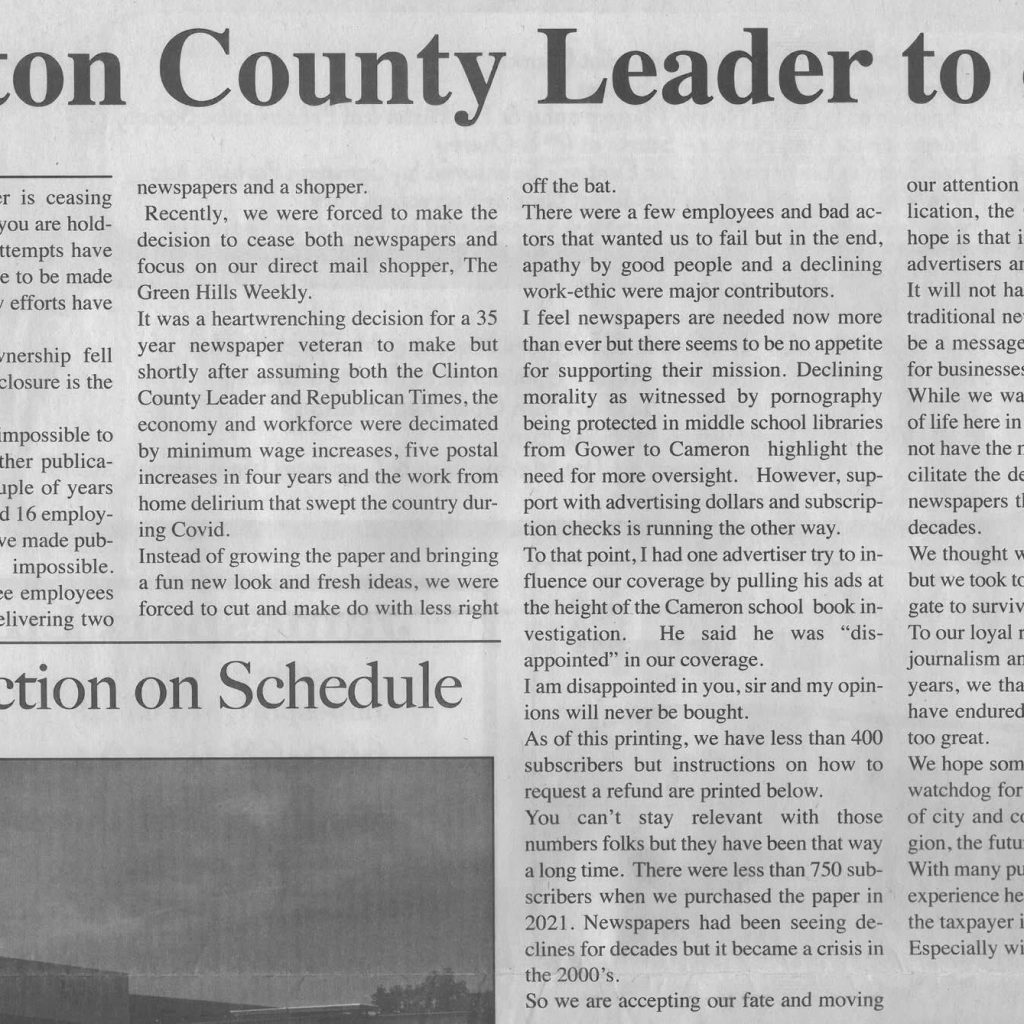
Honeycutt described what happened next: “I had one advertiser try to influence our coverage by pulling his ads at the height of the Cameron school book investigation. He said he was ‘disappointed’ in our coverage.”
Honeycutt’s response: “I am disappointed in you, sir and my opinions will never be bought.”
Honeycutt upheld his journalistic standards. He refused to cave to the puppet master’s threats. He ultimately sold the paper rather than compromise his integrity.
Around the same time, Mark McLaughlin edited the Cameron Citizen-Observer. McLaughlin faced similar pressure. He later admitted: “I had a conversation with my publisher. There was a strong sentiment arising from the community that wanted this to go away. There was a veiled statement that not doing so would result in a loss of advertising revenue.”
McLaughlin explained his publisher’s directive came from “discomfort of local business people and advertisers.”
Before the pressure, McLaughlin had written supportively. He called citizens who documented school district problems “bell-ringers”—watchmen standing guard and warning the community. He wrote that dismissing their concerns “would be a danger to all of us.”
After the pressure?
The Citizen-Observer stopped covering the book issue. It stopped covering other serious concerns that arose relating to the school district. McLaughlin’s supportive language disappeared.
The paper refused to print about an order of protection that a school district employee took out against a citizen documenting board issues. They also refused to print when that protection order was dismissed with prejudice in a court of law.
When the puppet master says make it “go away,” even court rulings favorable to citizens don’t get reported.
The accountability journalism didn’t just diminish. It disappeared.
Was it the same man who pressured both newspapers? Did the puppet master’s “discomfort” change McLaughlin’s language?
Two newspapers. Two editors. Same pressure. Same timeline. One refused and lost his paper. The other complied and kept his job.
Cameron’s city council moved forward with a water line project connecting to St. Joseph’s water supply. Voters reportedly rejected this project twice at the ballot box.
The council proceeded anyway.
The original estimate was $12 million with 27 cities participating. Current city council member John Feighert posted on December 22, 2025, in the Cameron Community Forum that he’s “guessing it will end up around $49-50 million.” That’s more than four times the original estimate.
Feighert added: “We will run people out of Cameron with these prices. I know a lot of seasoned citizens that cannot afford this and it will be a large burden on our businesses which means……. higher costs to us there as well or they just close down.”
Residents now pay double or more for water and sewer—for infrastructure they voted against twice. And the final bill keeps climbing.
Who benefits when voter referendums get ignored?
The Cameron R-1 School Board terminated middle school teacher Rachel Barlow in 2025. The board voted 4-1 to uphold her termination for allegedly failing to comply with an administrative directive. Two board members were not present.
Other employees violated similar or more serious directives. They kept their jobs.
Who decides which employees get fired and which get protected?
Citizens who document school board problems face escalating retaliation. They’re banned from school property. Prohibited from attending public meetings. Subjected to character assassination.
Public records requests meet systematic delay and resistance. Constitutional rights to record public meetings get restricted.
Dan Miller, the police chief, currently serves as Cameron’s interim city manager. The community has been vocal—multiple newspaper articles and numerous community forum posts call for his permanent hiring.
Yet months pass. The position remains “interim.” Despite overwhelming public support for a candidate already doing the job successfully, the city council hesitates.
What are they waiting for? Whose approval do they need?
The Pattern
These aren’t isolated incidents. This is a pattern.
When newspapers face financial pressure for accountability journalism.
When voters reject projects that proceed anyway.
When teachers get selectively terminated.
When citizens face retaliation for documentation.
When hiring decisions ignore overwhelming public support.
Someone is pulling strings.
The puppet master doesn’t attend board meetings. Doesn’t speak during public comment. Doesn’t need to.
The puppets already know what’s expected.
Why “Go Away”?
Remember McLaughlin’s admission? The puppet master wanted school district coverage to “go away.”
Not because the reporting was false.
Not because the concerns weren’t legitimate.
The school district never claimed the documented problems weren’t true. The community never disputed the facts.
The puppet master wanted it to “go away” because it was inconvenient. Because some knucklehead with money thinks accountability threatens his control. Because transparency exposes influence.
Truth doesn’t matter to puppet masters. Only compliance matters.
Why Does the Puppet Master Do This?
Money. Power. Control. Secrets. Ideology.
Maybe all of the above.
But here’s what matters: None of these justify using financial pressure to override democracy.
When one person determines what newspapers publish, which projects proceed despite voter rejection, who gets fired and who gets protected, and who gets hired—democracy becomes theater.
Elections become meaningless when the puppet master picks the puppets.
The April Choice
Three school board seats. Two city council seats. April election.
The city council seats matter too. One became available after Gina Reed resigned. Her resignation letter gave no reason, but the timing suggests it was related to her Third Street properties—a train wreck that left taxpayers responsible for tearing down buildings on her property.
Dan Miller, the police chief currently serving as interim city manager, has overwhelming community support for the permanent position. Citizens wore “Team Dan” shirts to city council meetings. Newspaper articles documented the support. The Cameron Community Forum is flooded with posts supporting Miller.
Yet the council hesitates. The community is left without knowing why Dan was passed over for the job. What are they waiting for? Whose approval do they need?
Voters can choose representatives who dance on command for the puppet master who doesn’t answer to voters. Or they can elect leaders who cut the strings.
Cameron can change this pattern. But only if voters demand candidates who state clear positions before election. Who commit to answering constituent questions. Who investigate rather than accommodate.
What questions should voters ask candidates before April?
Here are some examples:
For all candidates:
Will you commit to answering constituent questions after election?
Will you prioritize transparency over administrative convenience?
Do you have ties to the puppet master? Will you serve constituents or someone who never faces voters?
For school board candidates:
Do you believe citizens have a constitutional right to record public meetings?
Will you vote to investigate retaliation against citizens who document school board issues?
Do you support selective enforcement—firing some employees while protecting others who commit similar violations?
Who do you believe the school board serves—administrators or constituents?
For city council candidates:
Will you support Dan Miller’s permanent appointment as city manager based on overwhelming community support?
Will you explain why decisions get made behind closed doors without public input?
Will you commit to following voter referendums even when they conflict with other interests?
What questions do you think candidates should answer? These are just examples. Cameron voters should demand clear positions before election day.
Candidates who refuse to answer have already told you whose strings they’ll dance on.
April Will Tell the Story
Three school board seats. Two city council seats. One election.
The puppet master is counting on voters to choose candidates who won’t ask hard questions. Who won’t demand accountability. Who value “getting along” over transparency. Candidates who will make problems “go away.”
The puppet master is counting on voters to forget about Jamey Honeycutt’s newspaper. To ignore the water line voters rejected twice. To overlook the retaliation against citizens who document problems.
Maybe the puppet master is right. Maybe Cameron voters will keep electing knuckleheads who serve the man with money instead of constituents.
Or maybe enough residents are tired of watching their town get run by someone they never elected and can’t vote out.
April will tell the story.
The choice is simple: elect puppets or cut the strings.
Questions for Cameron
Does the community want puppet masters making decisions for them behind closed doors? Ignoring the will of the people?
Is there just one man pulling strings? Or are there several?
What drives them to make these decisions on our behalf? Money? Power? Control? Protecting secrets?
These are questions Cameron residents must answer for themselves.
A Challenge to Cameron’s Newspapers
The Cameron Citizen-Observer and the Clinton County Leader both know who threatened to pull advertising dollars if they didn’t make the school district problems “go away.”
Both papers have the facts. Both papers know the puppet master’s identity.
We challenge both newspapers to uphold their journalistic integrity. Share the facts. Let the community form their own opinions.
Reveal who used financial pressure to silence accountability journalism.
That way voters can ask candidates directly: Do you have ties to the puppet master? Will you serve constituents or the man who controls the strings?
But here’s the harder question for Cameron residents: Can you trust newspapers that decide what stories to print based on what their advertisers want?
When money determines coverage, is it still a newspaper? Or is it just another advertising platform?
Real journalism serves readers, not advertisers. Real journalism asks uncomfortable questions. Real journalism publishes truth even when it costs revenue.
McLaughlin admitted his publisher told him to make it “go away” because of advertiser pressure. He complied.
That’s not journalism. That’s public relations for whoever pays the bills.
The community deserves to know who really runs Cameron before they cast their votes in April.
For the past three years, I’ve attended Cameron R-1 School District board meetings, documenting decisions and requesting public records under Missouri’s Sunshine Law. During that time, I’ve witnessed firsthand how the school board uses complicated procedures to silence responsive public comment. Meanwhile, just down the street, Cameron’s city council allows citizens to sign up and speak on the night of the meeting—after seeing what’s on the agenda.
Why can the city council handle same-day public comment, but the school board refuses to allow it? The answer reveals an uncomfortable truth: school boards are either misinterpreting the law or deliberately restricting participation.
The Impossible Timeline
Missouri law creates a catch-22 that effectively silences citizens who want to participate in school board governance. Here’s how it works:
Missouri Revised Statute § 162.058 requires citizens to request agenda items at least five business days before a meeting. But the Missouri Sunshine Law (§ 610.020) only requires school boards to post their agendas 24 hours in advance.
Do the math. Citizens must predict what will be discussed four to five days before they can possibly know what’s on the agenda.
This isn’t just inconvenient—it’s an impossible standard that defeats the entire purpose of transparency. You cannot respond to specific board actions, proposals, or agenda items you learn about from the posted agenda. You must be clairvoyant.
What the Law Actually Says
Here’s what many school boards either don’t understand or deliberately ignore: § 162.058 only governs formal agenda items—not general public comment.
The statute creates a process for residents to “have an item placed on the agenda.” This means adding a new topic that guarantees the resident can present their concerns to the board—not that the board must take action or even respond. It does not prohibit boards from allowing same-day public comment on items already on the agenda.
Yet Cameron R-1 and many other Missouri school boards treat the five-day requirement as a blanket prohibition on all public participation. They’ve created a First Amendment-free zone where responsive speech is impossible.
Missouri Districts That Get It Right
Not all Missouri school boards misinterpret the law. Liberty Public Schools allows citizens to fill out request forms and submit them before the meeting starts—the same day. North Kansas City Schools lets people sign up at the “Visitors’ Comments” agenda item. Park Hill School District opens online sign-up 48 hours before meetings.
These districts comply with § 162.058 while still allowing responsive public participation. They’ve figured out what Cameron R-1 apparently cannot: you can have orderly meetings without silencing the public.
The Cameron Comparison
Here’s where it gets interesting. Cameron’s city council allows same-day sign-up for public comment at two points during meetings—once at the beginning and again after the council has discussed public business. This second opportunity lets citizens respond to what they’ve just heard discussed. Citizens can show up, see what’s on the agenda, listen to the council’s deliberations, and then speak directly to those specific discussions.
The city doesn’t descend into chaos. Meetings don’t become unmanageable. The sky doesn’t fall.
The Cameron R-1 School Board, meanwhile, expressly forbids this kind of interaction. They don’t claim they can’t handle it—they simply refuse to allow it. If city council members can manage responsive public comment after hearing citizen reactions to their deliberations, what makes school board members unwilling to do the same?
The answer is simple: choice. School boards choose not to allow same-day comment because advance notice gives them control. They want to know what’s coming. They want time to prepare counter-narratives. They want the ability to contact citizens before meetings to “discuss concerns.”
Most importantly, they don’t want citizens responding to surprise agenda items.
The Excuses Don’t Hold Up
When pressed, school boards offer various justifications for restrictive policies. None withstand scrutiny.
“We need advance notice to prepare responses.” City councils handle same-day comments without preparation. Besides, boards aren’t required to respond during meetings. They can take matters under advisement.
“We need to manage meeting length.” Legitimate concern, but easily addressed through content-neutral time limits. Three minutes per speaker, first-come first-served. That’s what city councils do.
“The law requires five days notice.” Wrong. That’s a misreading of § 162.058. The statute governs formal agenda items, not public comment periods.
“We need to screen comments for inappropriate content.” Constitutionally problematic. You cannot engage in advance censorship based on content. Boards can establish decorum rules and stop disruptive speakers in real-time.
The real reason? Control.
First Amendment Problems
When government creates a forum for public comment, restrictions must be content-neutral, reasonable, and narrowly tailored to serve a legitimate interest. The five-day advance requirement, combined with 24-hour agenda posting, fails this test.
Recent federal court decisions support more permissive public comment policies. In Ison v. Madison Local School District, the Sixth Circuit struck down overly restrictive board policies. In Moms for Liberty v. Brevard County, the Eleventh Circuit ruled that boards’ vague and restrictive policies violated the First Amendment.
A complete ban on same-day responsive comment is more restrictive than the policies struck down in those cases. Missouri school boards are legally vulnerable.
What Needs to Change
The Missouri General Assembly should clarify the law. Here’s how:
First, amend § 162.058 to make clear it doesn’t prohibit general public comment periods. Add language stating: “Nothing in this section shall be construed to prohibit school boards from establishing public comment periods at board meetings where residents may comment on agenda items without advance notice, subject to reasonable time, place, and manner restrictions.”
Second, extend the Sunshine Law notice period for school boards from 24 hours to 72 hours for regular meetings. Emergency exceptions would remain in place, allowing boards to meet with less notice when genuine emergencies require immediate action. This aligns Missouri with California, Texas, and other states that give citizens adequate time to review agendas and prepare comments.
Third, reduce the agenda request period from five days to 48 hours. This gives boards reasonable notice while allowing citizens to respond to posted agendas.
These reforms would restore meaningful public participation while maintaining orderly meetings.
A Two-Tier Solution
Until the legislature acts, school boards should adopt two-tier public participation policies:
Tier One: Citizen-requested agenda items following § 162.058. Five days notice, meeting with superintendent required, formal presentation time.
Tier Two: Responsive public comment period. Sign-up sheet available 30 minutes before meeting, first-come first-served, three minutes per speaker, 30-minute maximum. May comment on agenda items or other district matters.
This balances the board’s need for orderly meetings with citizens’ constitutional right to responsive speech.
The Bottom Line
Missouri school boards can allow same-day public comment. They just refuse to.
Cameron’s city council proves it works. Liberty Public Schools, North Kansas City Schools, and Park Hill School District prove Missouri school boards can do it while complying with state law.
The five-day advance requirement was never intended to silence responsive participation. It was meant to give boards notice when citizens want to add formal items to the agenda. School boards have twisted it into a blanket prohibition on public comment—not because they must, but because they choose to.
This isn’t about maintaining order. It’s about control. It’s about administrators and board members who are uncomfortable with criticism and prefer to preview—and prepare for—anything the public might say.
The question for Cameron and every other Missouri community is this: Do we want school boards that serve the public, or school boards that expect the public to serve them?
A Direct Appeal to Board President Lockridge
Andi Lockridge, as president of the Cameron R-1 Board of Education, you have the power to change this today. You don’t need to wait for the legislature. You took an oath to uphold the Constitution—including the First Amendment.
You can introduce a policy allowing same-day public comment. You can establish a two-tier system that complies with state law while respecting citizens’ constitutional rights. You can prove that Cameron’s school board is as capable of handling responsive public participation as Cameron’s city council.
The law doesn’t require you to silence your critics. That’s a choice you and your board are making. You can make a different choice.
Will you honor your oath of office and protect the First Amendment rights of the citizens you serve? Or will you continue hiding behind procedural barriers that serve no legitimate purpose beyond avoiding accountability?
The choice is yours. Make it count.
In April, three seats on the Cameron R-1 Board of Education are up for election. Voters should ask candidates whether they’ll support policies that encourage public participation or continue hiding behind procedural barriers.
Public education belongs to the public. School boards that forget this deserve to be replaced.
Heath is an independent journalist and government accountability advocate based in Cameron, Missouri. He has attended and documented Cameron R-1 School District board meetings for over three years.

Decision Follows November Appeal Hearing
CAMERON, Mo. — The Cameron R-1 Board of Education voted to terminate middle school teacher Rachel Barlow during a closed session meeting on November 26, following her appeal hearing held November 13.
During the public appeal hearing, two primary issues emerged from sworn testimony: Barlow’s admission that she used the phrase “anal beads” in conversation with a high school student, and what district administrators characterized as her refusal to comply with an administrative directive to write a statement about the incident. However, the board’s actual reasoning for the termination decision remains unknown, as their deliberations and vote occurred in closed session as required by law for personnel matters.
A Question of Credibility
While we cannot know what the board discussed in closed session, the competing accounts presented at the public hearing suggest they faced a fundamental credibility determination: who to believe when the principal’s testimony conflicted with Barlow’s.
The principal testified that Barlow began writing a statement but crumpled up the paper and refused to complete it. Barlow testified that she requested the opportunity to speak with her union representative before making a statement, but was not allowed to do so. The principal said he does not recall such a request.
What makes the board’s apparent decision to credit the administrators over Barlow particularly noteworthy is testimony from Superintendent Matt Robinson, who stated under oath that Barlow had never been a disciplinary issue prior to this incident. If Barlow had a clean disciplinary record and no history of insubordination, why did the board apparently find the principal’s account more credible than hers?
What Wasn’t Considered
During the appeal hearing, the majority of Barlow’s defense focused on alleged policy violations by other district staff members who retained their positions—violations that testimony suggested were far more serious, frequent, and even sexually explicit than Barlow’s single comment about “anal beads.”
However, testimony was carefully controlled under Missouri Sunshine Law requirements to protect employee privacy. Witnesses were not permitted to name other employees or students involved in these comparative examples, making it difficult to establish the full pattern of disparate treatment.
Because the board’s deliberations and vote occurred in closed session as required by law, it remains unclear what weight, if any, these examples of allegedly worse conduct carried in the final decision. The outcome suggests the board either did not find these comparisons credible, or determined that staff retention for more serious violations should not prevent termination in Barlow’s case.
Potential Legal Response
The termination of a tenured teacher who, according to her testimony, requested to speak with a union representative before making a statement about conduct that could lead to discipline could create legal exposure for the district on several fronts:
Union Representation Rights: If Barlow can demonstrate she requested union representation before being questioned about conduct that could lead to discipline, and that request was denied, this could potentially violate her rights under Missouri’s public sector collective bargaining laws. While Missouri teachers have constitutional rights to collective bargaining under the Missouri Constitution (Article I, Section 29) as confirmed by the Missouri Supreme Court in Independence NEA vs. Independence School District (2007), the specific question of whether principles similar to Weingarten rights—which guarantee union representation during investigatory interviews in the private sector—apply to Missouri public school employees remains legally uncertain. Nevertheless, denial of a union member’s request for representation during a disciplinary investigation could form the basis of a legal challenge.
Disparate Treatment: If Barlow can establish that other employees who violated policies or directives were treated more leniently, she may have grounds for a discrimination or disparate treatment claim.
Due Process: Depending on the specific circumstances and her tenure status, questions could arise about whether she received adequate due process before termination.
Whether Barlow will pursue such action remains to be seen.
A Crisis of Confidence
This termination decision exemplifies a troubling pattern in Cameron R-1 Board of Education decision-making over the past few years—a pattern that has created a genuine crisis of confidence in the board’s judgment.
The board faced a credibility dispute with no objective evidence: the principal says Barlow never asked for union representation; Barlow says she did. There is no proof either way. In such circumstances, why didn’t the board choose the safer option that would avoid risking a lawsuit for wrongful termination—reinstating Barlow with a strong reprimand on her employee record?
The middle ground would have:
- Held Barlow accountable for her inappropriate comment
- Avoided the appearance of disparate treatment when other staff allegedly committed worse violations
- Protected taxpayers from potential expensive legal battles
- Demonstrated prudent governance
Instead, the board chose the path of maximum risk. They chose to credit the administrators’ account despite Barlow’s clean disciplinary record and the superintendent’s testimony about her unblemished history. They chose termination despite testimony about staff retention for allegedly more serious conduct.
And critically: the board won’t be using their personal money to defend this decision if Barlow sues. They will be using taxpayer money.
This is the fundamental problem with the current board’s pattern of decision-making. When faced with difficult choices that could expose the district to legal liability, they consistently choose the aggressive path rather than the prudent one. The community is left to wonder: are these decisions truly in “the best interests of our students” as the district’s statement claims, or are they driven by other factors we cannot see from outside the closed session doors?
Taxpayers deserve a board that weighs legal risks carefully and chooses paths that protect both students and the public treasury. Instead, we have a board whose pattern of controversial decisions over the past few years has created widespread concern about their judgment and priorities.
The Barlow termination is not an isolated incident—it’s the latest example of a board that appears unwilling or unable to take the cautious, fiscally responsible approach when faced with credibility disputes and potential legal exposure.
Editor’s Note: This article is based on public testimony from the November 13 appeal hearing. The board’s deliberations on November 26 were conducted in closed session as required by Missouri law for personnel matters.

A few-second Facebook reel video has now been viewed over 936,000 times. In it, Cameron resident Dan Landi asks a simple question at his own appeal hearing—a hearing where the school board was deciding whether to ban him from attending public meetings. He’d heard that public comments had been disabled on the live stream. Board member Pam Ice, leading the hearing that night, clearly heard him. She chose not to answer. Instead, she simply reconvened the meeting and moved forward as if he’d never spoken.
The video’s reach far exceeds our small following. I believe it resonates because it captures something Americans are tired of: elected officials who forget whom they serve.
For three years, residents have attended Cameron R-1 School Board meetings with legitimate questions about district decisions. Before each meeting, they’ve raised concerns about transparency, accountability, and the district’s compliance with state and federal law. In response, they’ve received silence, deflection, or—in Dan Landi’s case—a ban from future meetings.
This pattern isn’t unique to the school board. It extends to other local governing bodies where officials seem more interested in protecting their authority than serving their constituents. When Dan Miller applied for a city manager position and made it to the final two candidates, the city council chose neither finalist. Instead, they reopened the application process for a second round. The city council hasn’t commented on why both finalists were passed over or what criteria they’re now using. Voters who trusted these officials with this important hiring decision deserve to know how that authority is being exercised.
The problem begins before Election Day. In Cameron, candidates routinely campaign without taking clear positions on controversial issues. They’ll talk about how long they’ve lived in Cameron, their local businesses, their children in district schools. They’ll emphasize their roots in the community while avoiding any discussion of actual issues. What they won’t do is take clear positions on controversial questions or commit to specific governance principles.
Cameron deserves better from those seeking public office. Candidates for school board, city council, and other local positions should participate in public debates before elections. These debates would give voters the opportunity to hear candidates answer the same questions, compare their approaches to governance, and understand their priorities. A candidate forum where competing candidates must articulate and defend their positions would reveal far more about how they’ll govern than any campaign literature or yard sign. Voters could ask directly about controversial decisions facing the district or city and hear substantive responses. This isn’t an unreasonable expectation—it’s a basic standard that communities across the country employ to ensure informed voting.
Voters are left to choose based on familiarity and likability rather than governance philosophy or policy positions. We elect popularity, not principle. We select people based on who they are, not what they’ll do once in office.
This approach has predictable consequences. When we elect people without knowing how they’ll govern, we get officials who govern without consulting the people—or who only consult those who are politically connected or have some form of influence or power. When candidates don’t have to articulate positions during campaigns, elected officials don’t feel obligated to defend decisions once in office. The lack of accountability during elections creates officials who see no need for accountability while serving.
The 936,000 views on that Facebook reel tell us something important: people everywhere recognize what’s happening in Cameron because it’s happening in their communities too. They’ve watched their own questions ignored at school board meetings. They’ve seen their own city councils override voter preferences. They’ve experienced their own officials treating public accountability as an optional courtesy rather than a fundamental obligation of public service.
Voters deserve better. We deserve candidates who will answer questions before election day and after taking office. We deserve officials who justify decisions affecting our children, our tax dollars, and our community’s future. We deserve representatives who remember that “public servant” isn’t just a ceremonial title—it’s a commitment to transparency, responsiveness, and accountability to the people who elected them.
When Dan Landi asked whether public comments had been disabled on his own hearing’s live stream and received only silence before being banned from future meetings, he experienced in concentrated form what Cameron residents face routinely. The real question isn’t why that Facebook reel went viral. It’s why we keep electing people who think ignoring constituents is acceptable governance, and what we’re going to do about it this filing season.

Thursday night’s special school board meeting laid bare the depth of dysfunction in Cameron R-1 School District leadership. Allegations emerged of staff touching students inappropriately and routinely using vulgar, sexually explicit language around children. Even more disturbing: evidence suggests the board and administrators were aware of these problems. When confronted, the district’s attorneys implied a mother and her daughter weren’t genuinely concerned about inappropriate touching because they waited two days to report it. This victim-blaming response exemplifies everything wrong with current leadership.
The recent resignation of Superintendent Dr. Matt Robinson compounds this crisis. However, the problems plaguing our schools extend far beyond one administrator. The school board itself has failed in its duty to provide effective oversight and accountability.
For over three years, I’ve attended board meetings and witnessed a troubling pattern: a board more concerned with controlling public criticism than addressing legitimate concerns. Rather than embracing transparency, board members have worked to silence dissent, banned community members from meetings, and violated both state and federal law, including Missouri’s Sunshine Law and basic constitutional rights.
District officials have systematically retaliated against citizens exercising their First Amendment rights, violated ADA accommodations for disabled veterans, and ignored public records requests while spending taxpayer dollars on legal fees to avoid transparency. This isn’t governance—it’s damage control.
Meanwhile, our children’s education suffers. Cameron R-1 performs marginally above average when it should achieve excellence. Instead of focusing on academic outcomes, the board manages controversies of its own making and treats concerned parents as adversaries.
The board and the community would like me to settle down and take a break from the school district. A new superintendent provides a good opportunity for a reset. But that isn’t quite enough. There needs to be new leadership on the school board too. There are three seats up for election in April. It is now up to the community. Do we have a reset and positive change, or do we continue in this rut with the status quo?
A school board’s primary responsibility is ensuring students receive a quality education in a safe, well-managed environment. That requires accountability, not defensiveness. It requires transparency, not obstruction. It requires leadership that sees public engagement as a strength, not a threat.
The next board election offers Cameron voters a critical choice. We can continue down this path of conflict and mediocrity, or we can elect new leaders committed to full compliance with state and federal law, respect for constitutional rights and public participation, honest financial management, academic excellence, and professional accountability for all district employees.
Our community deserves better. Our children deserve better. Cameron has the potential to be an educational model for rural Missouri, but we’ll never reach that goal with a board that views accountability as optional and transparency as negotiable.
It’s time for new leadership—leadership that understands public service means serving the public, not managing it. The upcoming election is our opportunity to demand the change Cameron schools desperately need.

It was another big week for the Cameron R-1 School District, but not in a good way. During a 4-hour appeal hearing for a Cameron Veterans Middle School teacher who claims she is being wrongfully terminated, we heard a lot of testimony. One of those who testified was of particular interest to us, mother and Cameron High School librarian Tonya O’Boyle. She was rightfully concerned that her son was exposed to sexually explicit and vulgar language while on the high school football team. Watch the video, and then let’s discuss why this is of interest. Content warning, there is graphic descriptive language in this video.
Allegations Made by O’Boyle
Mrs. O’Boyle claims that during an “extra-curricular activity” at school events, she has personally witnessed the use of foul language on school grounds. She says she has been to events where vulgar music was played as part of those school events. Mrs. O’Boyle stated that the vulgar language she overheard was “student choice” and included the “N-word.” Her stated concern for the choice in that music was: “Promoted as a family event. There were toddlers there. There were grandparents there.”
When asked if there were other school-sponsored events where she witnessed foul language being used ,she responded, “Yes.” She confirmed it happened during this current semester. She heard the coach, another school district employee, use those foul words which were directed at her child. When asked what was said, she responded, “You are the fucking reason we are losing this fucking game.”
Why This Testimony is of Interest
This website was started in part because of our fight with the Cameron R-1 School District relating to the extensive collection of vulgar and explicit books found in Mrs. O’Boyle’s high school library. You can find a partial list of those books on our Dirty Book List page.
During O’Boyle’s time as the librarian at the high school, a vast majority of those books were added to her library. According to district policy and public records requests, she added the majority of those books. Just two of the books on that list, The Hate U Give and Juliet Takes a Breath include the F-word 198 times. The book Juliet Takes a Breath is one you can see her receiving in an unboxing video she posted to her personal social media account. It uses that word she didn’t like 100 times.
The Books Get Far Worse Than Just Using Profanity
Many of those books on the Dirty Book List for the Cameron High School include graphic, sexually explicit descriptions. If Mrs. O’Boyle takes issue with her child hearing two vulgar words at football practice and functions, surely she would also be opposed to graphic descriptions of incest and pedophilia. The book Identical, found in her library, includes both pedophilia and incest. Passages from that book were read to the Cameron R-1 School District’s Board of Education at a previous board meeting. Extreme content warning in that video, but HERE is the link.
Why are the Words Wrong but Books Acceptable?
That’s the million dollar question. If vulgar words used in the presence of high school children are immoral and socially taboo, why then are all of these graphic books available for the same high school kids to read? Mrs. O’Boyle, please explain it for me. Why are you willing to hand my children and my neighbors’ children that book which uses the word you don’t like 100 times? You wrote an essay to get that book donated to the school. Now that your child has been exposed to such language, have you changed your opinion on the books in your library? Help me, help all of us, to understand the hypocrisy between your anger at your child being exposed to these words while you hand our children books with far more graphic content.
An Open Letter to the Cameron School Board
On Thursday night, we heard multiple accounts from mothers, a father, and school teachers about how upset they were about the language used by your staff member in his capacity as football coach. They are right – it was wrong and is a violation of policy. Why, then, do you fire one staff member for using inappropriate language while you protect the other? If it is wrong for a staff member to use a single vulgar word around students, especially when that language is directed at a student, how is it acceptable to put books in that same child’s hand that have dozens or hundreds of those profane words? And if a single profane word is not acceptable, how on earth are graphic descriptions of pedophilia and incest acceptable? Let me say the thing you don’t have the courage to say. It isn’t acceptable.
Final Closing Thoughts About Thursday’s Hearing
The district has a serious transparency and accountability issue. This book topic is one of the many glaring, self-imposed black eyes the Cameron School District received on Thursday night. There are serious problems at the district and in the leadership at the central office. There needs to be a full investigation revolving around the accusations made that night. Someone also needs to look into why your administrators couldn’t answer the questions from the respondent’s lawyers. “I do not know” is not an acceptable answer to those questions from top-tier administrators.
Previously we have written about the Cameron R-1 school district and Their Contempt for the Constitution. Despite the criticism, they appear to have doubled down and provided more examples of how they do not respect citizens and their civil rights.
First Amendment Auditors Visited the Cameron R-1 Schools
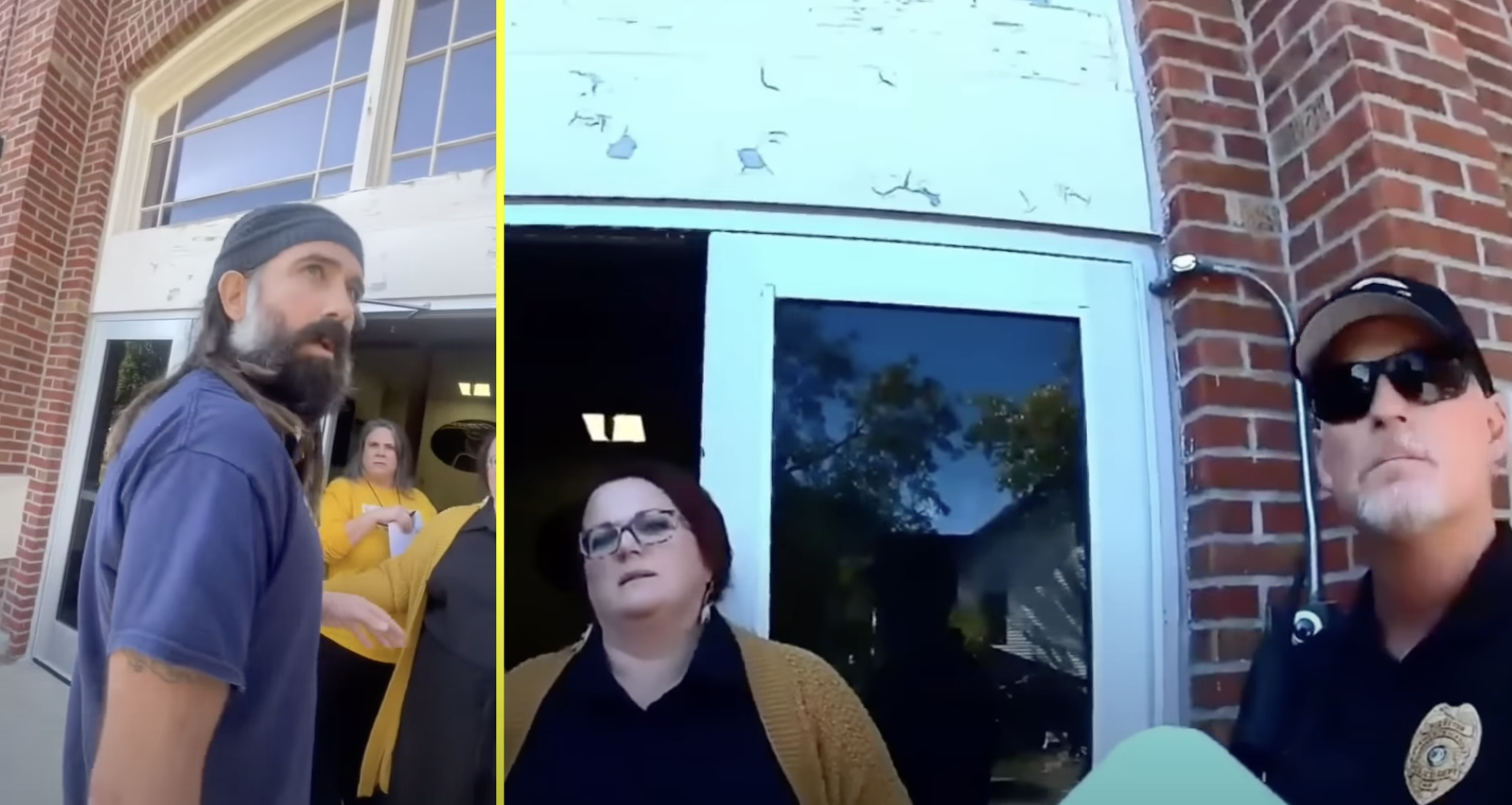
On the afternoon of Friday, October 10, 2025, two First Amendment auditors documented a visit to the Cameron school district central office. In the video from the Lawrence Accountability YouTube page, shared below, you can watch as Michael (Lawrence Accountability) and Justin (The DReaded Rabble Rouser) state they wanted to make requests for public records. Instead of allowing them access to a public building their tax dollars help fund, Assistant Superintendent Dr. Angie Ormsby and the Custodian of Records Gina Bainum stand in the doorway and block their access to the public building. Dr. Ormsby is heard saying “We’re done” and “I would like for you to leave” after Justin asks to go inside to write out his records request. You can see this interaction around the 9-minute mark.
Allegations of Assault by School Resource Officer Palmer
Shortly after Dr. Ormsby tells School Resource Officer Johnny Palmer she would like for Justin to leave you can watch as Palmer steps to Justin and is just inches away. Palmer moves closer and makes contact with Justin in an effort to force him out of the doorway. That interaction and the chaos begin around the 9-minute and 50 second mark. Be sure to continue to watch as two Cameron Police Department officers and two Missouri Highway Patrol troopers responded to the “disturbance”.
More Details to Follow
So far, only the Lawrence Accountability YouTube channel has posted the lengthy video of this interaction with the Cameron R-1 School district and the local law enforcement. We can clearly see Justin from The DReaded Rabble Rouser channel has a recording device in his hand. We are confident his video will have different conversations not easily heard or seen in this video. If and when that video is made available, we will add it to this page.

Earlier this week, the board of education held a special board meeting to approve one of three different proposals for an outside agency to help find a new superintendent for the Cameron R-1 school district. During this special meeting, the board discussed the three different proposals and ultimately voted unanimously to approve the proposal from the Missouri School Board Association.
Cameron R-1 School districts “small town values”
Prior to Monday’s vote to approve the proposal from the MSBA, the board discussed different pros and cons from the three different proposals. When school board Vice President Ryan Murphy brought up the importance of “small town values” during that discussion. He mentioned the importance of getting someone (a new superintendent) here that represents that.
Considering that the fight with the Cameron R-1 School District over the vulgar and sexually explicit books has been raging since February of 2023, perhaps it is prudent to ask the district and the board of education to define “small town values”. What qualities are they looking for in the Cameron R-1 School District’s next superintendent? Considering the way the school district and board has handled the deeply concerning book issue, it is important that we define some of these terms.
The following video shows clips from Monday’s special meeting and a previous board meeting from a few months ago where passages were read from one of the books the book committee voted to keep. Warning, you will hear content that includes both pedophilia and incest. How is this “small town values”? You can watch the full address to the board of education and their complete lack of outrage with this link.
The Search Begins for the Next Cameron R-1 School Superintendent
The board of education has approved the proposal from the MSBA, and the search should begin shortly. Beyond the details of what is provided in the MSBA proposal, we do not know much about the process. The proposal provides a sample timeline which begins in September, with the final interviews and hiring occurring in January. The timeline for Cameron is not yet known.
The MSBA proposal does ask the board to provide a copy of our current Comprehensive School Improvement Plan (CSIP), the current superintendent’s contract, and a job description so that the MSBA can get started. The job description is going to be important and will arguably define how the district moves forward. What will the board put in the job description and qualifications are they seeking?
What Can the Community Expect in the Months Ahead?
It has been 15 years since the Cameron R-1 School District last hired a school superintendent. That was well before I was paying any attention to the district or attending board meetings – this is all new to me too. But much of this process is protected under Missouri Sunshine Law and cannot lawfully be shared with the public.
The board can tell us non-specific details such as the number of possible candidates who will be interviewed. Specific details about who is being interviewed will not be made available to the public, as outlined in the Missouri Sunshine Law. The interviews and eventual vote to hire the new superintendent will all be done in an executive session.
We Could See a Community Engagement Meeting to Discuss the Superintendent Position
Page three of the MSBA proposal covers “Community Engagement” and will it be up to the board to decide what we might see. Community engagement, according to the proposal, can range from surveys to in person forums, or both. It will be up to the board to decide what they want and to direct the MSBA. We will have to wait and see.
Previously, the Cameron R-1 School Board has been hesitant to hold community engagement meetings. Considering the allegations surrounding the resignation of Superintendent Matt Robinson, it is likely the board will avoid a public community engagement meeting where those topics might come up. They will either avoid a public engagement meeting entirely or structure it in such a way as to limit certain topics.
This will be a developing story. As we get more information, we will publish additional articles.