
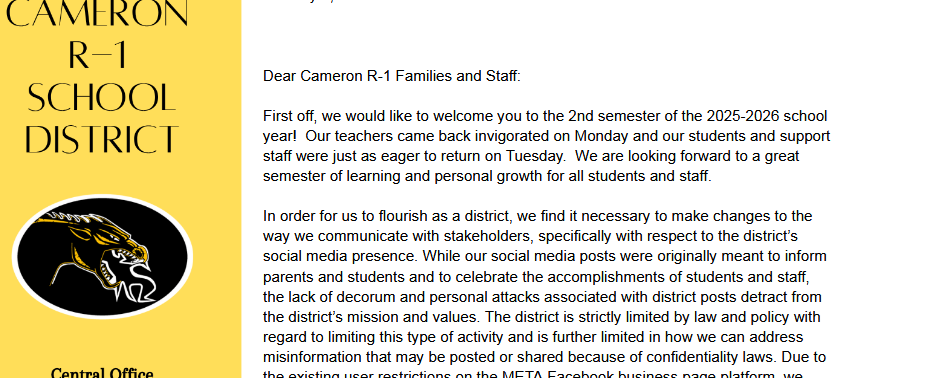
The Cameron R-1 School District announced on January 7, 2026, that it is suspending its Facebook and Instagram presence, citing concerns about “lack of decorum and personal attacks.” Translation: they can’t handle the truth being broadcast to the world, so they’re taking their ball and going home.
Community members aren’t buying the spin. Cameron resident Tawnya Cooke Stuedle captured what everyone’s thinking: “You realize you are one of the primary reasons they are doing this. Correct.” Her comment has garnered twenty likes and counting. The district can dress it up however they want, but everyone knows what this really is—a retreat from accountability.

Here’s what actually happened. For three years, citizens have documented school board meetings on social media, exposing systematic failures in district leadership. One video showing the board intentionally ignoring public questions has exceeded one million views. Multiple reels from the Rachel Barlow termination hearing have generated more than 100,000 combined views. These videos devastated the district’s image by doing nothing more than showing officials’ own actions—inconsistent policy enforcement, questionable judgment, and flat-out refusal to address legitimate concerns. Rather than fix the dysfunction, the district deleted its own social media accounts and ran for the hills. Problem solved, right? Wrong.
A Constitutional Contradiction (Or: How to Admit You Violated Rights Without Actually Admitting It)
The district’s January 7 announcement contains what lawyers call a “damning admission”: “The district is strictly limited by law and policy with regard to limiting this type of activity and is further limited in how we can address misinformation that may be posted or shared because of confidentiality laws.”
Read that again slowly. They’re admitting—in writing—that they are “strictly limited by law” from doing exactly what they’ve been doing. Government entities operating public forums cannot legally delete comments or ban users simply because they don’t like the message. Yet this admission comes just two months after the district banned disabled Navy veteran Vinzent Cooper from its Facebook page for 90 days—a man who served his country to protect the very constitutional rights the district violated.
Cooper’s November 3, 2025 ban letter cited “zero tolerance for cyberbullying” and “personal attacks on staff.” His actual offense? Comments on a post about the school musical that included: asking for an autographed signature from staff member Gina Bainum “who can’t tell time, lies & steals money” and references to staff members as “Oompa Loompa twins” while discussing issues including “porn in the library” and “proficiency grade levels of state recognized 43%.” He tagged another Facebook user, sarcastically noting “it’s wonderful to be violated” by “lying, thieving subversive oath breaking corrupt criminals of the CSD/BOE/staff.”
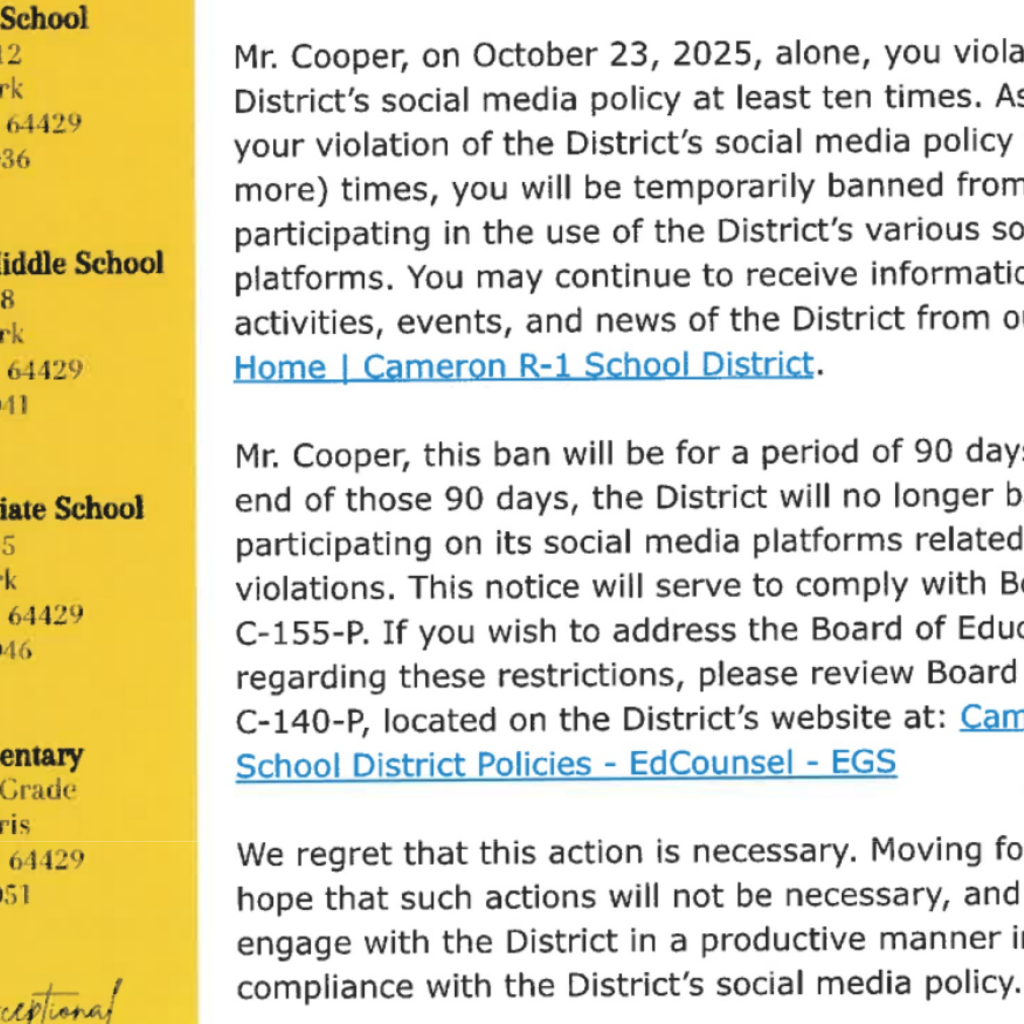
Cooper’s comments were harsh, sarcastic, and directly critical of named individuals—but they referenced real concerns about district performance and alleged misconduct. More importantly, they were constitutionally protected political speech. Yet the district banned him anyway, deleted his comments, and blocked his access. You know, the exact thing they just admitted is illegal.
The Silent Reversal (Or: How to Undo a Constitutional Violation Without Admitting It)
Cooper requested an appeal hearing within the required 10-day window. The district’s response? Radio silence. Then around mid-December, Cooper discovered by pure accident that his ban had been quietly lifted. No explanation. No acknowledgment. The district just pretended it never happened and hoped nobody would notice.
“They gave me no information on it,” Cooper said. “I just went on there out of curiosity. I’m like, wait a minute, I can actually comment. I mean, I was shocked.”
Does he believe the district recognized it violated his constitutional rights? “Oh, 100%. But they don’t care.”
And why would they admit it? An admission could be used against them in a lawsuit. Better to silently undo the ban, pretend it never happened, and hope Cooper doesn’t have a good attorney. Except now, with the district admitting in writing they are “strictly limited by law” from removing comments, they’ve essentially confessed to violating Cooper’s rights. Oops.
Viewpoint Discrimination (Or: We Only Want to Hear the Good Stuff)
Cooper nails the constitutional problem: “They only accept praises, but they can’t accept critical, constructive criticism. A lot of stuff that we’ve talked about, it’s not minor stuff. Pick the topic. Drugs? Heavy. Bullying? Heavy. Sexual assaults? Heavy. Not able to identify a firearm from a toy. I’m sorry, but that’s pretty heavy.”
He’s exactly right. The district didn’t ban anyone for posting heart emojis under student achievement announcements. They banned people for raising serious questions about serious problems. That’s textbook viewpoint discrimination—when government creates a public forum and then kicks out the people whose opinions they don’t like. The First Amendment exists specifically to prevent this kind of garbage.
The Problem For Banned Citizens (Or: How to Violate Your Own Ban Letters)
The social media shutdown creates a constitutional crisis for three community members banned from attending board meetings in person: Heath Gilbert, Vinzent Cooper, and Dan Landi. All three are military veterans. All three swore an oath to defend the Constitution. And all three received ban letters prohibiting physical attendance but explicitly “preserving” their First Amendment rights to observe meetings.
Gilbert’s September 3, 2025 ban letter states: “He may continue to view public board meetings via the district’s live video feed.” Landi’s September 26, 2025 letter contains identical language. This accommodation was supposed to solve the problem—banned citizens could watch the live stream and submit written comments via email.
Here’s the catch: the district’s live stream was hosted on Facebook. No social media means no Facebook. No Facebook means no live stream. No live stream means the three banned citizens cannot observe public meetings as their ban letters explicitly promised. In their rush to cover up one First Amendment violation—Cooper’s illegal ban—did they even stop to consider the ramifications for the three banned men? Or did their coverup just create another constitutional violation by denying access to the meetings they promised we could watch? That takes a special kind of incompetence—or maybe they just don’t care about constitutional rights at all.
The district says families will receive information “through the exclusive use of the ParentSquare App.” Great, except banned community members aren’t parents of current students. They’re taxpaying residents with the same right to be informed about what’s happening with their tax dollars. And there’s zero mention of how the district will live stream board meetings without social media. If they eliminate the Facebook live stream without providing an alternative, they’ve effectively nullified the First Amendment accommodation they promised in writing.
Transparency Lost (Or: Can’t Take the Heat, So They Left the Platform)
Social media provided real-time updates about school events, emergencies, and schedule changes. Parents could ask questions publicly. Taxpayers without children in schools could stay informed about how their money was spent. All gone now.
Cooper articulated the loss perfectly: “By shutting down the Facebook page itself, they’re escaping. They’re escaping public interaction. They’re not allowing the public to engage. Me, you, anyone. Oh, wow, I can’t wait to try the cookies at the Cameron Dragonettes cheerleaders’ cookie sale. And someone else might say, yeah, they were really good. And someone might say, yeah, the last year they were pretty dry and crumbly. So they can’t take the heat of negative responses.”
Or praise, for that matter. Community members who wanted to celebrate teachers or thank staff also lose that platform. The district’s brilliant solution eliminates criticism AND praise, accountability AND celebration. The real issue is that the district “can’t take the heat of negative responses.” But here’s the thing about government officials: you don’t get to silence critics simply because criticism hurts your feelings. That’s not how any of this works.
The Real Motive (Or: The Receipts Don’t Lie)
The district claims social media management “has also taken a great deal of staff member effort.” Translation: responding to legitimate questions from taxpayers is too much work. This frames public accountability as a burden rather than a core responsibility of operating a taxpayer-funded institution.
The letter also complains they cannot “remove tags”—meaning they can’t stop citizens from tagging the district in personal posts about district issues. Citizens tagged Cameron R-1 when sharing board meeting videos, driving hundreds of thousands of people to content documenting dysfunction. The district couldn’t prevent tagging without violating Facebook’s terms, so they did the only thing they could think of: shut down their own social media accounts and walked away. If you can’t win the game, flip the board over and storm off.
Community members recognize this for what it is. The district isn’t protecting students—the viral videos show officials’ own behavior, not attacks on kids. They’re avoiding accountability, running from critics, trying to control the narrative by abandoning the platform where citizens were documenting their failures. As Tawnya Cooke Stuedle observed, everyone knows what’s really happening. The knuckleheads running the district just proved all their critics right.
The Spin Game
Make no mistake about what’s happening here: the district is deliberately mischaracterizing the content critics post on social media. By framing legitimate accountability journalism and protected political speech as “personal attacks” and threats to “decorum,” they’re attempting to paint themselves as victims of mean-spirited bullies rather than public officials facing justified scrutiny. It’s a calculated public relations strategy—gain sympathy, manufacture public support against the “mean men,” and distract from the actual issue: their repeated First Amendment violations.
The district’s January 7 letter complains about “lack of decorum and personal attacks associated with district posts” as if the problem is tone rather than substance. The letter also references their inability to address “misinformation that may be posted or shared because of confidentiality laws.” Let’s be clear about whose information is actually false.
The critics post unedited videos of board meetings. That’s not misinformation—that’s primary source documentation. The critics quote directly from district documents and ban letters. That’s not misinformation—that’s evidence. The critics point out when the district violates its own policies or constitutional rights. That’s not misinformation—that’s accountability.
You know what IS misinformation? The district claiming they’re “strictly limited by law” from deleting comments while simultaneously having deleted Cooper’s comments and banned him for 90 days. The district claiming to “preserve First Amendment rights” in ban letters while eliminating the livestream access those letters promised. The district claiming social media was shut down to “protect students and staff” when the viral videos show officials’ own behavior, not attacks on children or employees.
If the district wants to talk about misinformation, they should start by looking in the mirror. The critics have the receipts: unedited video, official documents, and the district’s own contradictory statements. What does the district have? Vague accusations, shifting explanations, and a pattern of running from scrutiny.
By shutting down social media and blaming it on critics, the district gets to play the victim while simultaneously burying the evidence of their constitutional violations. Cooper’s illegal ban? Gone from public view. The admission that they can’t legally delete comments? Buried in a press release that will be forgotten. The pattern of silencing dissent? Conveniently eliminated along with the platform.
It’s a neat trick: violate someone’s rights, get caught, then eliminate the platform where you got caught and blame the people who documented your violations. The knuckleheads running the district apparently believe if they can control the narrative by removing the platform, they can make their constitutional problems disappear.
They’re wrong.
What Happens Next
Several urgent questions demand answers: How will the district livestream board meetings for the three banned citizens? How will it provide information to taxpayers who aren’t parents? Will it acknowledge violating Cooper’s rights? What happens in the next crisis when the district has abandoned its fastest communication method?
Spoiler alert: they won’t answer any of these questions. That’s not how they operate.
For three years, concerned citizens have documented what they witnessed at board meetings. They used social media not to attack the district, but to let officials’ own actions speak for themselves. Those videos reached millions because they revealed something true about how Cameron R-1 operates. The district’s response? Ban the messengers. Silence the critics. Delete their own social media accounts and run away. At every step, when faced with criticism, officials chose suppression over self-reflection. That choice reveals everything you need to know about their priorities.
The community sees it. Tawnya Cooke Stuedle sees it. Vinzent Cooper sees it. And thanks to videos that reached far beyond Cameron, Missouri, the rest of the country is starting to see it too. The knuckleheads running this district just handed their critics the biggest win possible: proof that everything we’ve been saying about them is true.
There’s a bitter irony here: three military veterans who swore an oath to support and defend the Constitution are now fighting to protect those very rights against a school district that seems to view constitutional protections as obstacles to be circumvented rather than principles to be upheld. The district banned veterans from meetings, promised them live stream access, then eliminated the live stream. These men defended the Constitution overseas. Now they’re forced to defend it at home—against their own school district.
Running from critics doesn’t make problems go away. It just proves the critics were right all along.
Heath Gilbert is an independent journalist and founder of Cameron School District Exposed. He has attended and documented Cameron R-1 School District board meetings for more than three years. He was banned from district property in September 2025 but continues to cover district operations through public records requests, live stream observation, and community interviews.
For the past three years, I’ve attended Cameron R-1 School District board meetings, documenting decisions and requesting public records under Missouri’s Sunshine Law. During that time, I’ve witnessed firsthand how the school board uses complicated procedures to silence responsive public comment. Meanwhile, just down the street, Cameron’s city council allows citizens to sign up and speak on the night of the meeting—after seeing what’s on the agenda.
Why can the city council handle same-day public comment, but the school board refuses to allow it? The answer reveals an uncomfortable truth: school boards are either misinterpreting the law or deliberately restricting participation.
The Impossible Timeline
Missouri law creates a catch-22 that effectively silences citizens who want to participate in school board governance. Here’s how it works:
Missouri Revised Statute § 162.058 requires citizens to request agenda items at least five business days before a meeting. But the Missouri Sunshine Law (§ 610.020) only requires school boards to post their agendas 24 hours in advance.
Do the math. Citizens must predict what will be discussed four to five days before they can possibly know what’s on the agenda.
This isn’t just inconvenient—it’s an impossible standard that defeats the entire purpose of transparency. You cannot respond to specific board actions, proposals, or agenda items you learn about from the posted agenda. You must be clairvoyant.
What the Law Actually Says
Here’s what many school boards either don’t understand or deliberately ignore: § 162.058 only governs formal agenda items—not general public comment.
The statute creates a process for residents to “have an item placed on the agenda.” This means adding a new topic that guarantees the resident can present their concerns to the board—not that the board must take action or even respond. It does not prohibit boards from allowing same-day public comment on items already on the agenda.
Yet Cameron R-1 and many other Missouri school boards treat the five-day requirement as a blanket prohibition on all public participation. They’ve created a First Amendment-free zone where responsive speech is impossible.
Missouri Districts That Get It Right
Not all Missouri school boards misinterpret the law. Liberty Public Schools allows citizens to fill out request forms and submit them before the meeting starts—the same day. North Kansas City Schools lets people sign up at the “Visitors’ Comments” agenda item. Park Hill School District opens online sign-up 48 hours before meetings.
These districts comply with § 162.058 while still allowing responsive public participation. They’ve figured out what Cameron R-1 apparently cannot: you can have orderly meetings without silencing the public.
The Cameron Comparison
Here’s where it gets interesting. Cameron’s city council allows same-day sign-up for public comment at two points during meetings—once at the beginning and again after the council has discussed public business. This second opportunity lets citizens respond to what they’ve just heard discussed. Citizens can show up, see what’s on the agenda, listen to the council’s deliberations, and then speak directly to those specific discussions.
The city doesn’t descend into chaos. Meetings don’t become unmanageable. The sky doesn’t fall.
The Cameron R-1 School Board, meanwhile, expressly forbids this kind of interaction. They don’t claim they can’t handle it—they simply refuse to allow it. If city council members can manage responsive public comment after hearing citizen reactions to their deliberations, what makes school board members unwilling to do the same?
The answer is simple: choice. School boards choose not to allow same-day comment because advance notice gives them control. They want to know what’s coming. They want time to prepare counter-narratives. They want the ability to contact citizens before meetings to “discuss concerns.”
Most importantly, they don’t want citizens responding to surprise agenda items.
The Excuses Don’t Hold Up
When pressed, school boards offer various justifications for restrictive policies. None withstand scrutiny.
“We need advance notice to prepare responses.” City councils handle same-day comments without preparation. Besides, boards aren’t required to respond during meetings. They can take matters under advisement.
“We need to manage meeting length.” Legitimate concern, but easily addressed through content-neutral time limits. Three minutes per speaker, first-come first-served. That’s what city councils do.
“The law requires five days notice.” Wrong. That’s a misreading of § 162.058. The statute governs formal agenda items, not public comment periods.
“We need to screen comments for inappropriate content.” Constitutionally problematic. You cannot engage in advance censorship based on content. Boards can establish decorum rules and stop disruptive speakers in real-time.
The real reason? Control.
First Amendment Problems
When government creates a forum for public comment, restrictions must be content-neutral, reasonable, and narrowly tailored to serve a legitimate interest. The five-day advance requirement, combined with 24-hour agenda posting, fails this test.
Recent federal court decisions support more permissive public comment policies. In Ison v. Madison Local School District, the Sixth Circuit struck down overly restrictive board policies. In Moms for Liberty v. Brevard County, the Eleventh Circuit ruled that boards’ vague and restrictive policies violated the First Amendment.
A complete ban on same-day responsive comment is more restrictive than the policies struck down in those cases. Missouri school boards are legally vulnerable.
What Needs to Change
The Missouri General Assembly should clarify the law. Here’s how:
First, amend § 162.058 to make clear it doesn’t prohibit general public comment periods. Add language stating: “Nothing in this section shall be construed to prohibit school boards from establishing public comment periods at board meetings where residents may comment on agenda items without advance notice, subject to reasonable time, place, and manner restrictions.”
Second, extend the Sunshine Law notice period for school boards from 24 hours to 72 hours for regular meetings. Emergency exceptions would remain in place, allowing boards to meet with less notice when genuine emergencies require immediate action. This aligns Missouri with California, Texas, and other states that give citizens adequate time to review agendas and prepare comments.
Third, reduce the agenda request period from five days to 48 hours. This gives boards reasonable notice while allowing citizens to respond to posted agendas.
These reforms would restore meaningful public participation while maintaining orderly meetings.
A Two-Tier Solution
Until the legislature acts, school boards should adopt two-tier public participation policies:
Tier One: Citizen-requested agenda items following § 162.058. Five days notice, meeting with superintendent required, formal presentation time.
Tier Two: Responsive public comment period. Sign-up sheet available 30 minutes before meeting, first-come first-served, three minutes per speaker, 30-minute maximum. May comment on agenda items or other district matters.
This balances the board’s need for orderly meetings with citizens’ constitutional right to responsive speech.
The Bottom Line
Missouri school boards can allow same-day public comment. They just refuse to.
Cameron’s city council proves it works. Liberty Public Schools, North Kansas City Schools, and Park Hill School District prove Missouri school boards can do it while complying with state law.
The five-day advance requirement was never intended to silence responsive participation. It was meant to give boards notice when citizens want to add formal items to the agenda. School boards have twisted it into a blanket prohibition on public comment—not because they must, but because they choose to.
This isn’t about maintaining order. It’s about control. It’s about administrators and board members who are uncomfortable with criticism and prefer to preview—and prepare for—anything the public might say.
The question for Cameron and every other Missouri community is this: Do we want school boards that serve the public, or school boards that expect the public to serve them?
A Direct Appeal to Board President Lockridge
Andi Lockridge, as president of the Cameron R-1 Board of Education, you have the power to change this today. You don’t need to wait for the legislature. You took an oath to uphold the Constitution—including the First Amendment.
You can introduce a policy allowing same-day public comment. You can establish a two-tier system that complies with state law while respecting citizens’ constitutional rights. You can prove that Cameron’s school board is as capable of handling responsive public participation as Cameron’s city council.
The law doesn’t require you to silence your critics. That’s a choice you and your board are making. You can make a different choice.
Will you honor your oath of office and protect the First Amendment rights of the citizens you serve? Or will you continue hiding behind procedural barriers that serve no legitimate purpose beyond avoiding accountability?
The choice is yours. Make it count.
In April, three seats on the Cameron R-1 Board of Education are up for election. Voters should ask candidates whether they’ll support policies that encourage public participation or continue hiding behind procedural barriers.
Public education belongs to the public. School boards that forget this deserve to be replaced.
Heath is an independent journalist and government accountability advocate based in Cameron, Missouri. He has attended and documented Cameron R-1 School District board meetings for over three years.
Previously we have written about the Cameron R-1 school district and Their Contempt for the Constitution. Despite the criticism, they appear to have doubled down and provided more examples of how they do not respect citizens and their civil rights.
First Amendment Auditors Visited the Cameron R-1 Schools
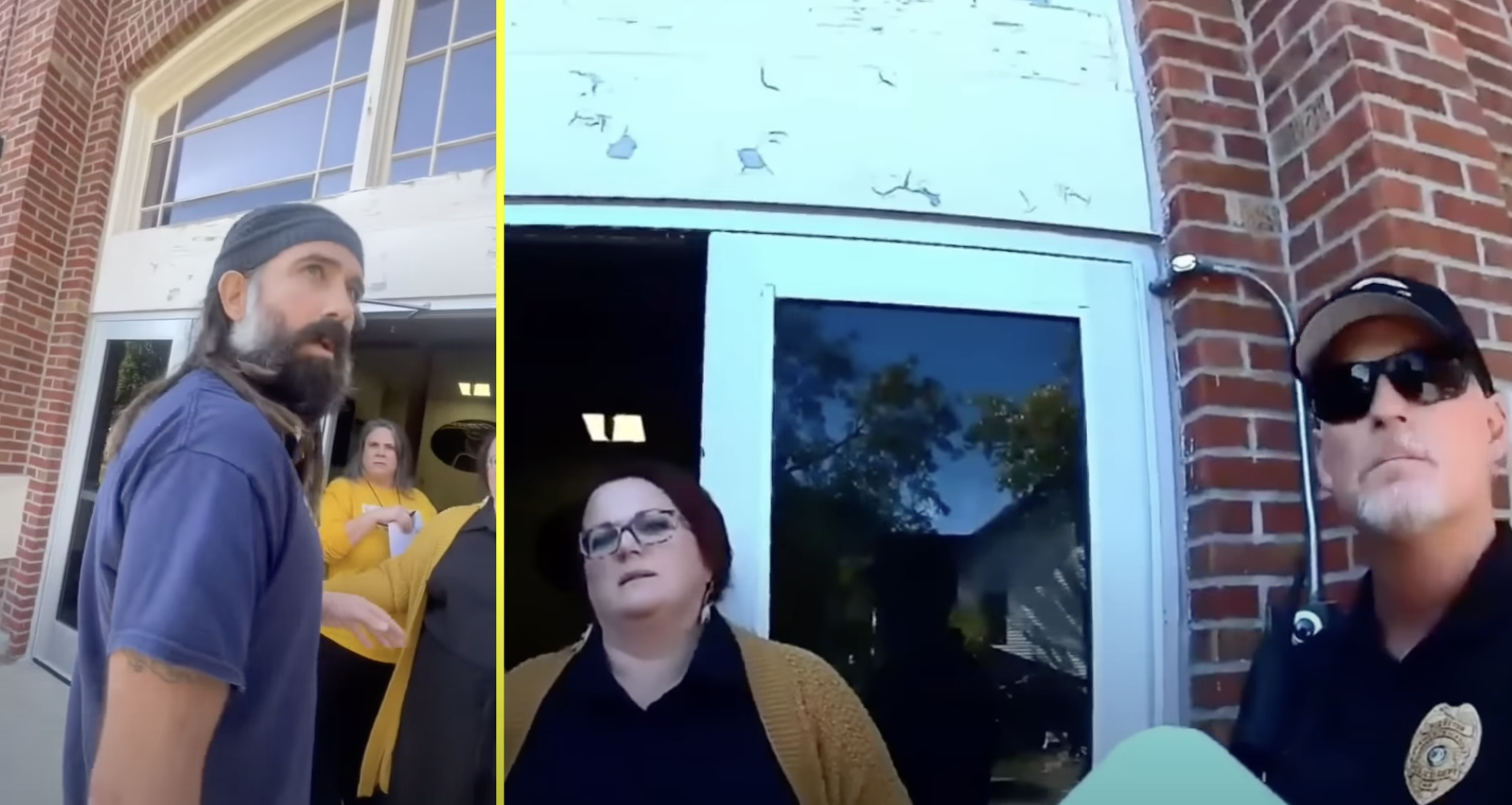
On the afternoon of Friday, October 10, 2025, two First Amendment auditors documented a visit to the Cameron school district central office. In the video from the Lawrence Accountability YouTube page, shared below, you can watch as Michael (Lawrence Accountability) and Justin (The DReaded Rabble Rouser) state they wanted to make requests for public records. Instead of allowing them access to a public building their tax dollars help fund, Assistant Superintendent Dr. Angie Ormsby and the Custodian of Records Gina Bainum stand in the doorway and block their access to the public building. Dr. Ormsby is heard saying “We’re done” and “I would like for you to leave” after Justin asks to go inside to write out his records request. You can see this interaction around the 9-minute mark.
Allegations of Assault by School Resource Officer Palmer
Shortly after Dr. Ormsby tells School Resource Officer Johnny Palmer she would like for Justin to leave you can watch as Palmer steps to Justin and is just inches away. Palmer moves closer and makes contact with Justin in an effort to force him out of the doorway. That interaction and the chaos begin around the 9-minute and 50 second mark. Be sure to continue to watch as two Cameron Police Department officers and two Missouri Highway Patrol troopers responded to the “disturbance”.
More Details to Follow
So far, only the Lawrence Accountability YouTube channel has posted the lengthy video of this interaction with the Cameron R-1 School district and the local law enforcement. We can clearly see Justin from The DReaded Rabble Rouser channel has a recording device in his hand. We are confident his video will have different conversations not easily heard or seen in this video. If and when that video is made available, we will add it to this page.
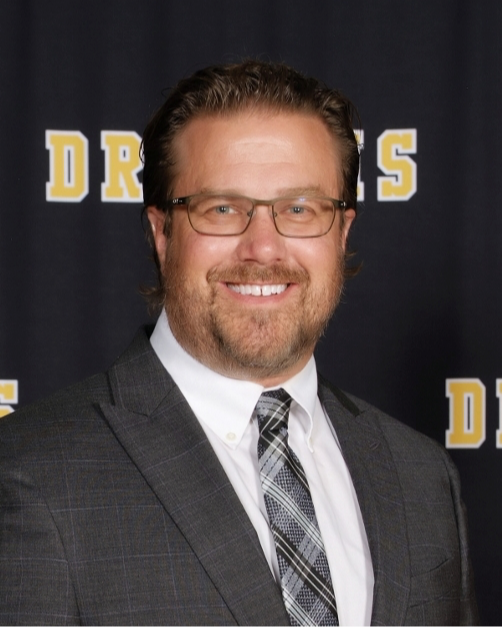
In what came as a surprise to much of the community of Cameron, MO, Cameron R-1 Schools Superintendent Dr. Matt Robinson has announced his resignation. No reason for the resignation was given beyond its effective date of June 30, 2026.
Dr. Matt Robinson, who has served as Superintendent of the Cameron School District since 2011, has announced his resignation effective June 30th, 2026.
Why is Matt Robinson resigning?
Excellent question. As you can see in yesterday’s press release from the school district, there is no stated reason for the resignation. We have requested comment from the district’s Communications Director and will update this story if and when we receive a comment.
The announcement of this resignation came less than 24 hours after the monthly school board meeting. The timing of this announcement and the lack of any explanation leads me to believe this may have been a disciplinary action taken by the school board.
Allegation of fentanyl in the Cameron High School
Two recent events within the Cameron R-1 School District drive my speculation. First on my speculative list is the allegation of fentanyl being distributed and used on school property and its possible cover-up. If true, failure to act and report this to the board could arguably be justification for demanding his resignation. Here is a video that gives an overview and timeline for the fentanyl allegations.
Previously, another incident was brought to the attention of the school board that they didn’t appear to know anything about. In this video from a previous board meeting, you can see the surprise on the faces of board members as they hear an account of what can be described as a wildly inappropriate assault that occurred at the elementary school. The board never commented, but it appears they didn’t know anything about this incident. The acts described in this video should have been reported to the board: they shouldn’t have heard about it from a member of the public.
Secretly Removing Books with Adult Content
In March, I approached current school board president Andi Lockridge at a school board candidate meet-and-greet event to discuss the ongoing “dirty book” issue. Specifically, I brought up concerns about the books that had been approved to keep by the district’s book review committee that were secretly being removed from the library. Mrs. Lockridge indicated she didn’t know anything about books being removed. Once again, it appears that Robinson was failing to inform the board of education.
Removal of these books without board approval is concerning. At the beginning of this fight over the explicit adult content, we met with Dr. Robinson to discuss solutions to the book issue. He told us repeatedly that to just remove books would potentially put the district, and more importantly the taxpayers, at risk of a lawsuit for First Amendment right-to-read violation allegations. The safe play was to keep these books with some form of restriction.
And that is initially what they did. A three-person book review committee was formed and reviewed these books. Once the vote was taken, the committee made a recommendation to the board. The last update I can find is from the June 2024 board meeting. You can find the list of books and recommendations in the June 2024 agenda under number 8, Non-Action Report, item A, Book Review. The board was told these books were being retained, with some being restricted. We can find no records indicating a vote to remove these books or that the board was informed of their removal.
The lack of records and the claim by Lockridge that she did not know about books being removed once again indicate the lack of communication with the board on an issue that could potentially lead to a lawsuit. Removing books without documented justification and board approval is akin to inviting lawsuits for viewpoint discrimination claims.
Currently, there are two pending lawsuits in Missouri relating to First Amendment claims against public schools for the removal of books. Both are lead by the ACLU. C.K.-W. v. Wentzville R-IV School District (2022-ongoing) and ACLU v. Independence School District (2022-pending). As seen in Wentzville, viewpoint discrimination lawsuits typically challenge districts that disproportionately remove books featuring diverse viewpoints, particularly those by and about communities of color and LGBTQ+ people. Is it possible the Cameron R-1 school district is at risk of being sued over these books being removed? I fear the answer is yes.
Take Steps Immediately to Mitigate Possible Lawsuits
While I detest the explicit content in these removed books being provided to children, I believe it is in the best interest of the taxpayers to take steps to avoid a lawsuit. Unfortunately, the only solution I see is to return those books to the shelves and renew the efforts to continue age restricting adult content. There isn’t a viewpoint discrimination claim if those books are in the library.
What Comes Next?
While I have no inside knowledge and the school board hasn’t told me their plans, it is safe to assume that they will advertise the job opening and prepare for interviews. But let’s be honest – how many applicants are going to be interested in stepping into this mess? Chances are good that potential applicants will find some of the articles on this site as well as the national coverage relating to the Dirty Book List. The applicant pool may be limited. There is good news, the search for a new superintendent will provide the community with opportunities.
The Opportunities this Resignation Provides
Most of us will agree that there is no small measure of conflict between the current administration and some of the local citizens. A new superintendent will provide an opportunity for a clean start for both the community and the district. The board will have the opportunity to ask the applicants how they would approach the issues of the last three years and hear new ideas on how to resolve these conflicts. New faces bring new ideas.
Discussions about the book issue could produce new ideas on how to deal with sexually explicit books while avoiding a lawsuit. I would suggest the board ask questions such as: Would it be possible to align the books in the library with the curriculum objectives of the school to remove some of the most problematic books while maintaining a view point neutral stance as outlined in Island Trees School District v. Pico.
Make Education the Priority
Nationally, grade-level proficiency is at an all-time low. Current figures for Cameron show reading proficiency at around 43 percent. Fifteen years ago, it was above 70 percent. ACT and SAT scores show similar trends to grade-level proficiency despite an all-time high in spending on public education. Even Ivy League schools like Harvard are having to offer remedial math classes to new students, according to this April 2025 New York Post article. This is an excellent opportunity to have important discussions on how Cameron can correct this downward trend. I would like to see Cameron in the top ten percent for the state of Missouri instead of marginally above average. Let’s have discussions about making education the priority.
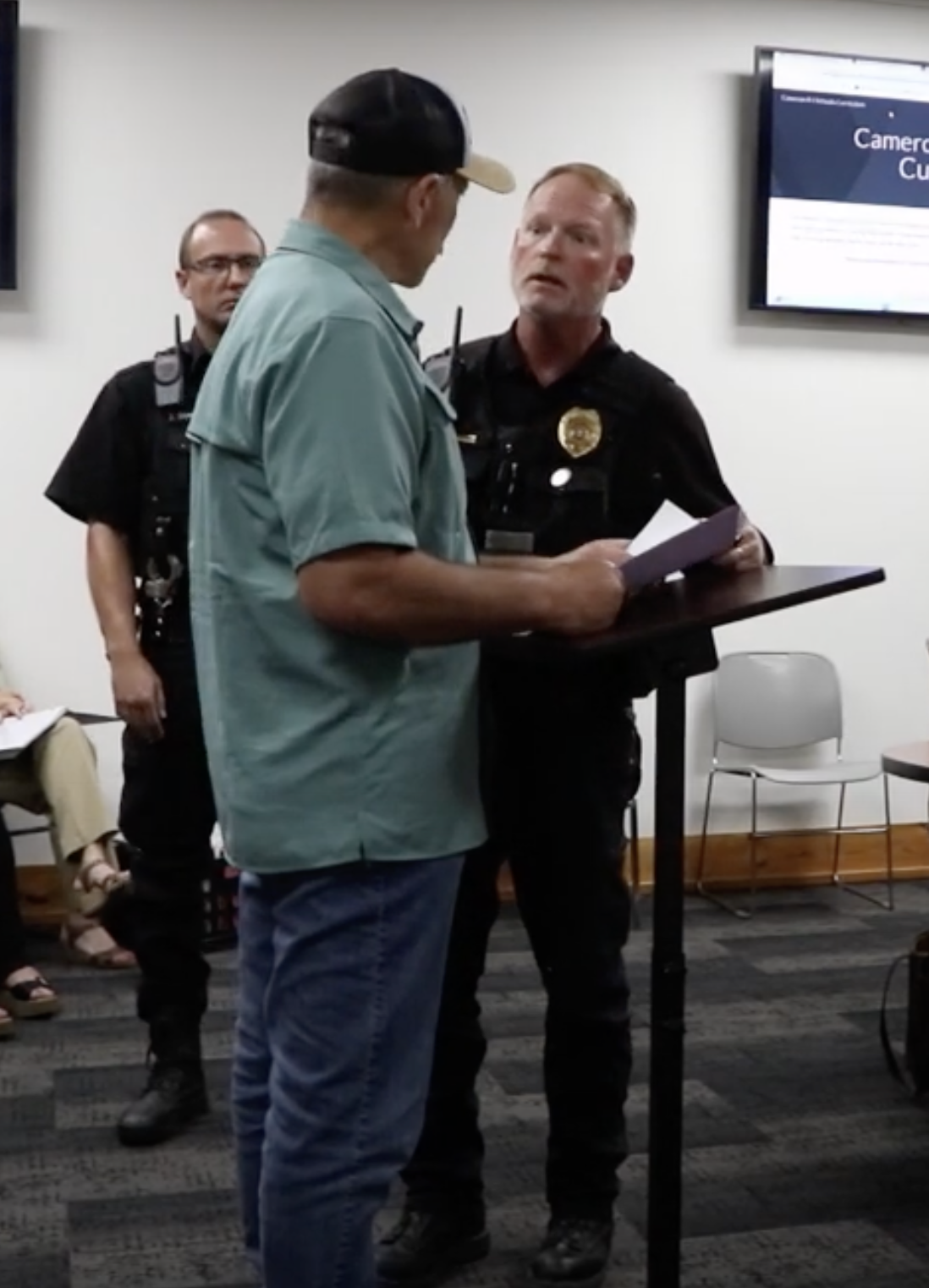
In the span of little more than a week, the Cameron R-1 school district has had three different videos released that should concern any red-blooded, Constitution-loving Americans. These videos raise concerns about our public education system and what is being taught about our God-given rights, which are defined and protected by the Constitution.
Cameron school district police department
The first video includes the entire Cameron school district police department and its lead officer, Palmer. It shows a brief conversation between SRO Palmer and resident Heath Gilbert. Gilbert asks Palmer if he will be arrested for speaking to staff—something school superintendent Matt Robinson ordered in a ban letter. Palmer appears to believe that his chief of police, school superintendent Matt Robinson, has the authority to deny First Amendment rights to freedom of speech and freedom of the press by decree through a ban order.
Why Palmer’s stance is so concerning
In addition to swearing an oath to support and defend the Constitution as a law enforcement officer, SRO Johnny Palmer has also sworn that oath as a 22 year veteran of Missouri Army National Guard. Palmer appears to not understand that the Fourteenth Amendment protects all our civil liberties and guarantees they can’t be denied without due process of law. Palmer has sworn that oath twice but doesn’t appear to understand or honor those oaths.
School board president Andi Lockridge restricts Landi’s 1st Amendment
In our second video, local resident Dan Landi is attempting to address the board of education about school curriculum. When Landi mentions the word “pornographic,” a reference to adult books used as CHS curriculum material, Lockridge was quick to interrupt his address. Landi pointedly asked why she was trying to restrict his First Amendment rights. Her response?
“Because you’re not staying on topic. “ – Cameron R-1 school board president Andi Lockridge
Several concerns with Lockridge’s silencing of Landi’s freedom of speech
In the complete Landi address video,
I see several civil rights concerns. There appear to be several attempts to force Landi to stop reading from his prepared notes and instead talk about a document that the district had displayed on the wall-mounted monitors. Those interactions have the ring of compelled speech.
The “cause” for the frequent interruptions during Landi’s address appears to be based on the assertion that Landi was getting off topic. The final straw for Lockridge, and what ultimately caused her to terminate the remainder of his designated public comment period, was his attempt to bring books into his curriculum topic. Since when are books not related to school curriculum?
The implied threat of being forcibly removed or arrested
If you begin watching Dan’s address video at the 5-minute and 5-second mark, you will see that SRO Palmer has approached Landi and confronted him to get Landi to stop speaking and to sit down. After several requests to sit down, Palmer states, “I am going to ask you one more time,” and Landi responds with, “Or else what?” Palmer responds by saying:
“You and I are going to go outside.” – SRO Palmer
While Palmer doesn’t say the words “you will be arrested,” I would argue that it was implied when he told Landi that they would be going outside if Landi didn’t stop and go sit down. Those words, and Palmer’s close proximity to Landi, were arguably enough to chill speech. That could be argued to be a First Amendment violation.
A Likely Defense from the District to Any Possible First Amendment Claim
In this video, you can repeatedly hear Lockridge say variations of things such as “please sit down” and “I am asking you to sit down.” The Cameron school district or their attorneys would likely argue that he was asked to sit down—he wasn’t forced. I see two problems with that argument. Back to the video: at the 4-minute and 55-second mark, look towards the right side of the screen to the man in the background. That is superintendent Matt Robinson, and he runs the timer. Watch as he reaches out and removes the timer from the table. It will be difficult to argue that Landi could have continued talking with the timer stopped and removed from the table.
Small chance they would have given Landi unlimited time to continue to talk about books. When you add Lockridge’s threat—”I am warning you, if you go off topic your time is over”—the removal of the timer is a clear indication that the Cameron school district carried out that warning. Combine the actions of SRO Palmer and I believe Landi has a very strong First Amendment claim.
Similar event in Lawrence led to lawsuit against Lawrence school district
To help support my claim that Landi has a legitimate complaint against the Cameron school district, I am going to reference some breaking news. In a recent Libs of TikTok post on X, we see a lawsuit filed against the Lawrence, Kansas USD 497 for accusations of First Amendment violations after that school board had a mother’s microphone shut off. I agree with Libs of TikTok: HOLD THEM ACCOUNTABLE. We will be following this federal lawsuit with great interest. Give them the business, Ms. Schmidt!
If you’re on X, please go show this post some love.
Resident Given Ban Despite Offering Proof Accusations Were False
The final video showing the Cameron school district has contempt for the Constitution is from a special hearing held to allow Heath Gilbert to appeal an indefinite ban. The discussion and vote can be seen in the following video clip. The full hearing video can be watched on the Show Me Transparency YouTube page, with the link taking you to that video. For an excellent summary of what is happening in this video, go read the write up from Hick Christian.
School board members are supposed to uphold the constitution
In the state of Missouri, elected school board members are required to swear an oath before they can begin to serve on the board. All Missouri school board members must take the oath prescribed by Article VII, Section 11 of the Missouri Constitution, which requires them to “take and subscribe an oath or affirmation to support the Constitution of the United States and of this state, and to demean themselves faithfully in office.”
I contend that the actions or inactions of these Cameron school board members are a violation of their oath of office. The board is elected to serve and safeguard the interests of the residents who make this school possible through significant taxes. Watching these videos leaves me with a very strong opinion: the Cameron R-1 school board members are captured and serve the school district, not the community. The board is in direct violation of their oath of office.
At the May 2025 school board meeting the Cameron, MO board of eduction appeared to dismiss the concerns of local resident Heath Gilbert when he asserted the school district is violating the 1st Amendment protections for freedom of speech. Gilbert asserts the deviations from district policy requiring residents to make their home address and cell number a public record as a condition of addressing the board both compel and chill free speech.
In what could be described as a violation of their oath of office to the constitutions of Missouri and the United States, the entire board of education appear to have dismissed those concerns and showed support for the efforts by the district and Superintendent Matt Robinson. What are those new requirements and how do they violate the 1st Amendment?
The cause of this claim for 1st Amendment violations revolves around a “form” the district requires everyone to complete as a condition of being able to exercise ones right to address the board during a public meeting. We will discuss the form next.
Details about the districts “form”
When a member of the public makes the required request to address the board of eduction they are provided with a link to an online form. The school district requires this form to be completed as a condition of being granted permission to speak to the board. Failing to complete any portion of this form will result in a denial to address the school board.
The district requires residents provide their name, email address, cell phone number and home address before asking for details on what you want to discuss. They also require you to offer a solution to the stated issue.
Failure to complete any portion of the form, or to complete it accurately, will result in a denial of being added to the agenda to address the board.
Is the “form” part of school policy?
Absolutely not. The board policy and requirements for being added to the agenda to address the board are outlined in policy C-140-P. There is no mention of “form” in that policy or any requirement to make one’s name, address and phone number a public record as a condition of addressing the board.
The policy does require everyone to meet with the superintendent as a condition of addressing the board, but Superintendent Matt Robinson refuses to hold those meetings. The board ignores staff not following board policy and refuses to instruct him to follow policy and hold those meetings, as required in current policy.
Cameron schools compel speech of residents
As of December 2024, the Cameron school district began to compel anyone wishing to address the board to make their home address and cell phone numbers a public record as a condition of speaking to the board. Because of the Missouri sunshine law, any addresses, phone numbers or other information submitted to the district as a condition of speaking to the board becomes a public record.
The school district is required by law to make that personal information submitted via the “form” available to anyone who requests it. The school district and board of education are comfortable with making your personal information available to public. Requiring one to speak or telling them what they must say is compelled speech and a clear 1st Amendment violation.
Can public schools or governmental bodies compel speech?
Absolutely not. The Cameron school district and board of education are governmental bodies subject to compelled speech restrictions. Fortunately there are several Supreme Court cases where they have weighed in and offered opinions on compelled speech. Examples of these opinions include the infamous cake baker Jack Phillips out of Colorado. He was sued multiple times for refusing to bake various cakes which violated his religious belief. To force him to bake a cake would be compelled speech.
You can read examples of Supreme Court cases describing the dangers of compelled speech in this article by Neal Hardin. Compelled speech is dangerous and a violation of the 1st Amendment.
How is the Cameron school district chilling speech?
The same form and the requirement to disclose personal information can cause someone to not address the board out of fear of reprisal or retaliation. The Cameron school districts requirement to make personal information a public record can cause someone to not exercise their freedom of speech out of fear of reprisal or retaliation. That is chilled speech.
Here is a real life example. At the December 2023 school board meeting the book topic was on the school board meeting agenda here in Cameron. Concerned members of the public spoke against the books and their sexually explicit adult content being made available to children. Three school staff members addressed the board in favor of those books. One teacher referred to the efforts of the men who were leading the opposition of those books as a circus, implying they are clowns. She used strong language implying that racism, bigotry and misandry were the root causes of any issues with the books. Would she still be willing to call out those men and book review committee and once again make those same accusations knowing they could obtain her home address and cell phone number?
Or is it more likely that this teacher would be concerned one of those men would contact her on her cell phone or show up at her front door after implying they were clowns. Would she be willing to use the same language as she had previously back in December, or would she be compelled to use softer language or not mention them at all? The intellectually honest answer is anyone would likely soften their statements to the Cameron school board or choose not to address them at all out of concern of harassment or threats by someone who doesn’t like what they said.
This is what chilling speech looks like. And your Cameron R-1 schools board of education supports the actions of the district which compels speech, chills speech and does not align with school policy. They ban members of the public for not following policy but ignore and excuse when staff do the same.
What is the cause of these new restrictions on free speech?
We can only speculate as neither the district or board of education have explained the deviation from policy. To put it simply, they want to control what information is shared with the community at these board meetings about the school. This is an attempt to control or limit what is said.
A quick look at the new Rules of Decorum for the district and you will see that the district has granted itself the right to terminate the designated public forum time allotted for a member of the public if they bring up something that is not on their form. See the seconded bulleted item in number 2 of the Decorum Rules document.

To further speculate, I would guess it stems from the November 2024 board meeting where resident Heath Gilbert used the veil of body worn cameras to bring up alleged incidents of sexual assault of students at the elementary school and on a school bus. You can see that video below.
Final closing statement statement
Each Cameron school district board member swore an oath to the constitutions of the state of Missouri and these United States. The new requirement that forces residents, teachers and students to make their phone numbers and home address a public record is compelling speech. This practice can and has chilled speech because residents don’t want to make that information a public record. Chilled and compelled speech are both clear violations of the 1st Amendment. For the board members to support these blatant violations is also a clear violation of their oaths of office. How can we trust the actions and words of these board members if they don’t take one of our nations most sacred oaths seriously?
Please consider peacefully contacting your elected school board members and urge them to honor their oaths and stop this madness. The email address for the board can be found on their webpage or you can email the entire board directly at boardofeducation@cameronschools.org