
Running From Critics: Cameron R-1 Deletes Social Media After Viral Videos Expose Dysfunction
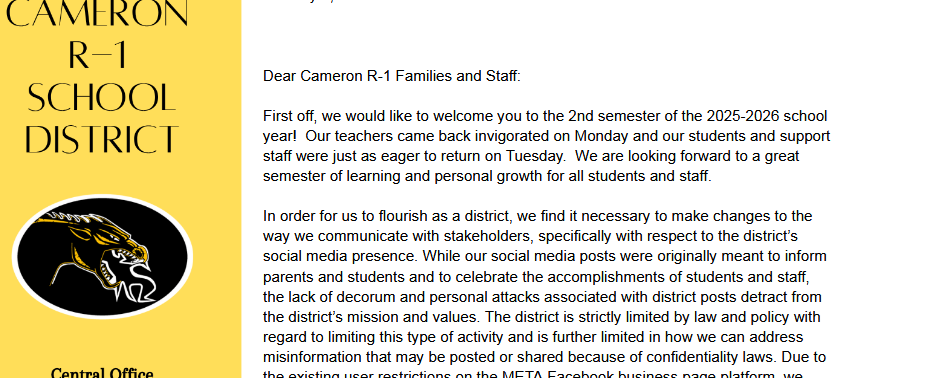
The Cameron R-1 School District announced on January 7, 2026, that it is suspending its Facebook and Instagram presence, citing concerns about “lack of decorum and personal attacks.” Translation: they can’t handle the truth being broadcast to the world, so they’re taking their ball and going home.
Community members aren’t buying the spin. Cameron resident Tawnya Cooke Stuedle captured what everyone’s thinking: “You realize you are one of the primary reasons they are doing this. Correct.” Her comment has garnered twenty likes and counting. The district can dress it up however they want, but everyone knows what this really is—a retreat from accountability.

Here’s what actually happened. For three years, citizens have documented school board meetings on social media, exposing systematic failures in district leadership. One video showing the board intentionally ignoring public questions has exceeded one million views. Multiple reels from the Rachel Barlow termination hearing have generated more than 100,000 combined views. These videos devastated the district’s image by doing nothing more than showing officials’ own actions—inconsistent policy enforcement, questionable judgment, and flat-out refusal to address legitimate concerns. Rather than fix the dysfunction, the district deleted its own social media accounts and ran for the hills. Problem solved, right? Wrong.
A Constitutional Contradiction (Or: How to Admit You Violated Rights Without Actually Admitting It)
The district’s January 7 announcement contains what lawyers call a “damning admission”: “The district is strictly limited by law and policy with regard to limiting this type of activity and is further limited in how we can address misinformation that may be posted or shared because of confidentiality laws.”
Read that again slowly. They’re admitting—in writing—that they are “strictly limited by law” from doing exactly what they’ve been doing. Government entities operating public forums cannot legally delete comments or ban users simply because they don’t like the message. Yet this admission comes just two months after the district banned disabled Navy veteran Vinzent Cooper from its Facebook page for 90 days—a man who served his country to protect the very constitutional rights the district violated.
Cooper’s November 3, 2025 ban letter cited “zero tolerance for cyberbullying” and “personal attacks on staff.” His actual offense? Comments on a post about the school musical that included: asking for an autographed signature from staff member Gina Bainum “who can’t tell time, lies & steals money” and references to staff members as “Oompa Loompa twins” while discussing issues including “porn in the library” and “proficiency grade levels of state recognized 43%.” He tagged another Facebook user, sarcastically noting “it’s wonderful to be violated” by “lying, thieving subversive oath breaking corrupt criminals of the CSD/BOE/staff.”
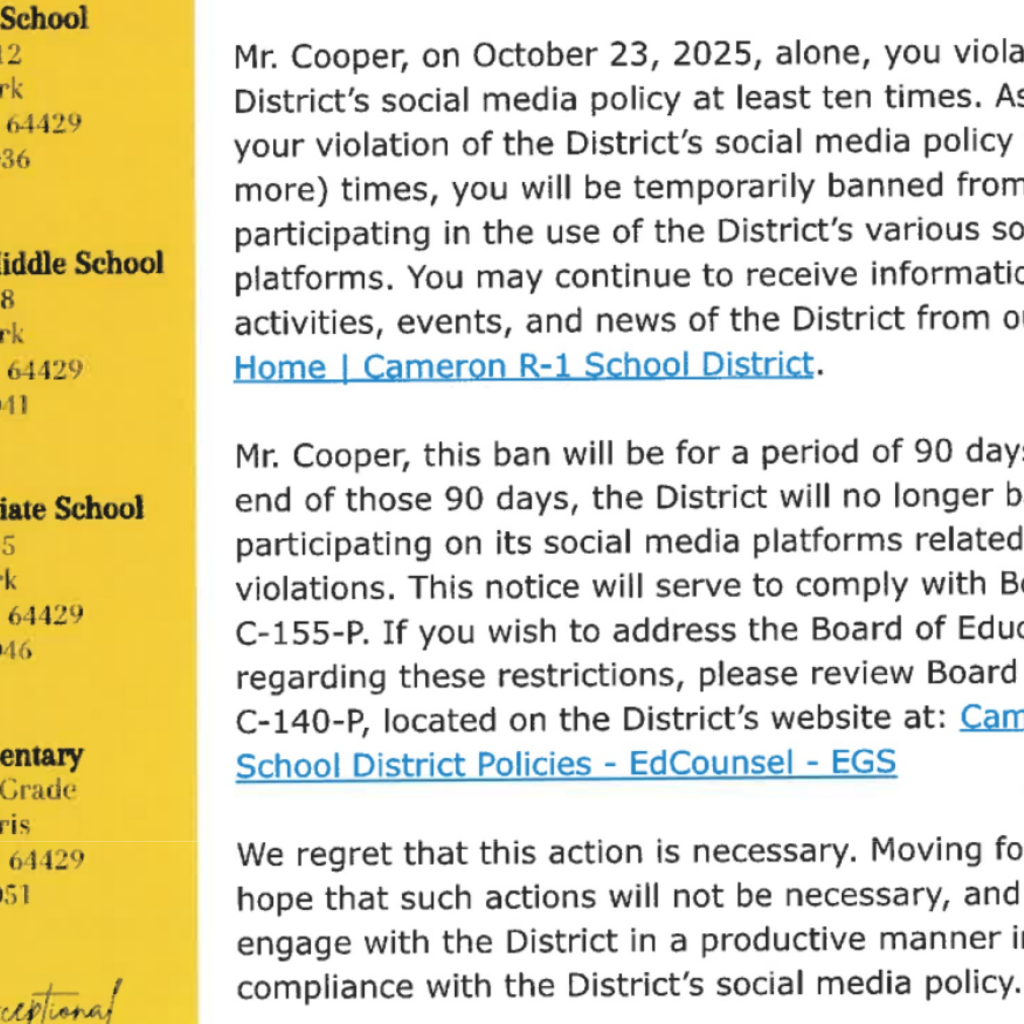
Cooper’s comments were harsh, sarcastic, and directly critical of named individuals—but they referenced real concerns about district performance and alleged misconduct. More importantly, they were constitutionally protected political speech. Yet the district banned him anyway, deleted his comments, and blocked his access. You know, the exact thing they just admitted is illegal.
The Silent Reversal (Or: How to Undo a Constitutional Violation Without Admitting It)
Cooper requested an appeal hearing within the required 10-day window. The district’s response? Radio silence. Then around mid-December, Cooper discovered by pure accident that his ban had been quietly lifted. No explanation. No acknowledgment. The district just pretended it never happened and hoped nobody would notice.
“They gave me no information on it,” Cooper said. “I just went on there out of curiosity. I’m like, wait a minute, I can actually comment. I mean, I was shocked.”
Does he believe the district recognized it violated his constitutional rights? “Oh, 100%. But they don’t care.”
And why would they admit it? An admission could be used against them in a lawsuit. Better to silently undo the ban, pretend it never happened, and hope Cooper doesn’t have a good attorney. Except now, with the district admitting in writing they are “strictly limited by law” from removing comments, they’ve essentially confessed to violating Cooper’s rights. Oops.
Viewpoint Discrimination (Or: We Only Want to Hear the Good Stuff)
Cooper nails the constitutional problem: “They only accept praises, but they can’t accept critical, constructive criticism. A lot of stuff that we’ve talked about, it’s not minor stuff. Pick the topic. Drugs? Heavy. Bullying? Heavy. Sexual assaults? Heavy. Not able to identify a firearm from a toy. I’m sorry, but that’s pretty heavy.”
He’s exactly right. The district didn’t ban anyone for posting heart emojis under student achievement announcements. They banned people for raising serious questions about serious problems. That’s textbook viewpoint discrimination—when government creates a public forum and then kicks out the people whose opinions they don’t like. The First Amendment exists specifically to prevent this kind of garbage.
The Problem For Banned Citizens (Or: How to Violate Your Own Ban Letters)
The social media shutdown creates a constitutional crisis for three community members banned from attending board meetings in person: Heath Gilbert, Vinzent Cooper, and Dan Landi. All three are military veterans. All three swore an oath to defend the Constitution. And all three received ban letters prohibiting physical attendance but explicitly “preserving” their First Amendment rights to observe meetings.
Gilbert’s September 3, 2025 ban letter states: “He may continue to view public board meetings via the district’s live video feed.” Landi’s September 26, 2025 letter contains identical language. This accommodation was supposed to solve the problem—banned citizens could watch the live stream and submit written comments via email.
Here’s the catch: the district’s live stream was hosted on Facebook. No social media means no Facebook. No Facebook means no live stream. No live stream means the three banned citizens cannot observe public meetings as their ban letters explicitly promised. In their rush to cover up one First Amendment violation—Cooper’s illegal ban—did they even stop to consider the ramifications for the three banned men? Or did their coverup just create another constitutional violation by denying access to the meetings they promised we could watch? That takes a special kind of incompetence—or maybe they just don’t care about constitutional rights at all.
The district says families will receive information “through the exclusive use of the ParentSquare App.” Great, except banned community members aren’t parents of current students. They’re taxpaying residents with the same right to be informed about what’s happening with their tax dollars. And there’s zero mention of how the district will live stream board meetings without social media. If they eliminate the Facebook live stream without providing an alternative, they’ve effectively nullified the First Amendment accommodation they promised in writing.
Transparency Lost (Or: Can’t Take the Heat, So They Left the Platform)
Social media provided real-time updates about school events, emergencies, and schedule changes. Parents could ask questions publicly. Taxpayers without children in schools could stay informed about how their money was spent. All gone now.
Cooper articulated the loss perfectly: “By shutting down the Facebook page itself, they’re escaping. They’re escaping public interaction. They’re not allowing the public to engage. Me, you, anyone. Oh, wow, I can’t wait to try the cookies at the Cameron Dragonettes cheerleaders’ cookie sale. And someone else might say, yeah, they were really good. And someone might say, yeah, the last year they were pretty dry and crumbly. So they can’t take the heat of negative responses.”
Or praise, for that matter. Community members who wanted to celebrate teachers or thank staff also lose that platform. The district’s brilliant solution eliminates criticism AND praise, accountability AND celebration. The real issue is that the district “can’t take the heat of negative responses.” But here’s the thing about government officials: you don’t get to silence critics simply because criticism hurts your feelings. That’s not how any of this works.
The Real Motive (Or: The Receipts Don’t Lie)
The district claims social media management “has also taken a great deal of staff member effort.” Translation: responding to legitimate questions from taxpayers is too much work. This frames public accountability as a burden rather than a core responsibility of operating a taxpayer-funded institution.
The letter also complains they cannot “remove tags”—meaning they can’t stop citizens from tagging the district in personal posts about district issues. Citizens tagged Cameron R-1 when sharing board meeting videos, driving hundreds of thousands of people to content documenting dysfunction. The district couldn’t prevent tagging without violating Facebook’s terms, so they did the only thing they could think of: shut down their own social media accounts and walked away. If you can’t win the game, flip the board over and storm off.
Community members recognize this for what it is. The district isn’t protecting students—the viral videos show officials’ own behavior, not attacks on kids. They’re avoiding accountability, running from critics, trying to control the narrative by abandoning the platform where citizens were documenting their failures. As Tawnya Cooke Stuedle observed, everyone knows what’s really happening. The knuckleheads running the district just proved all their critics right.
The Spin Game
Make no mistake about what’s happening here: the district is deliberately mischaracterizing the content critics post on social media. By framing legitimate accountability journalism and protected political speech as “personal attacks” and threats to “decorum,” they’re attempting to paint themselves as victims of mean-spirited bullies rather than public officials facing justified scrutiny. It’s a calculated public relations strategy—gain sympathy, manufacture public support against the “mean men,” and distract from the actual issue: their repeated First Amendment violations.
The district’s January 7 letter complains about “lack of decorum and personal attacks associated with district posts” as if the problem is tone rather than substance. The letter also references their inability to address “misinformation that may be posted or shared because of confidentiality laws.” Let’s be clear about whose information is actually false.
The critics post unedited videos of board meetings. That’s not misinformation—that’s primary source documentation. The critics quote directly from district documents and ban letters. That’s not misinformation—that’s evidence. The critics point out when the district violates its own policies or constitutional rights. That’s not misinformation—that’s accountability.
You know what IS misinformation? The district claiming they’re “strictly limited by law” from deleting comments while simultaneously having deleted Cooper’s comments and banned him for 90 days. The district claiming to “preserve First Amendment rights” in ban letters while eliminating the livestream access those letters promised. The district claiming social media was shut down to “protect students and staff” when the viral videos show officials’ own behavior, not attacks on children or employees.
If the district wants to talk about misinformation, they should start by looking in the mirror. The critics have the receipts: unedited video, official documents, and the district’s own contradictory statements. What does the district have? Vague accusations, shifting explanations, and a pattern of running from scrutiny.
By shutting down social media and blaming it on critics, the district gets to play the victim while simultaneously burying the evidence of their constitutional violations. Cooper’s illegal ban? Gone from public view. The admission that they can’t legally delete comments? Buried in a press release that will be forgotten. The pattern of silencing dissent? Conveniently eliminated along with the platform.
It’s a neat trick: violate someone’s rights, get caught, then eliminate the platform where you got caught and blame the people who documented your violations. The knuckleheads running the district apparently believe if they can control the narrative by removing the platform, they can make their constitutional problems disappear.
They’re wrong.
What Happens Next
Several urgent questions demand answers: How will the district livestream board meetings for the three banned citizens? How will it provide information to taxpayers who aren’t parents? Will it acknowledge violating Cooper’s rights? What happens in the next crisis when the district has abandoned its fastest communication method?
Spoiler alert: they won’t answer any of these questions. That’s not how they operate.
For three years, concerned citizens have documented what they witnessed at board meetings. They used social media not to attack the district, but to let officials’ own actions speak for themselves. Those videos reached millions because they revealed something true about how Cameron R-1 operates. The district’s response? Ban the messengers. Silence the critics. Delete their own social media accounts and run away. At every step, when faced with criticism, officials chose suppression over self-reflection. That choice reveals everything you need to know about their priorities.
The community sees it. Tawnya Cooke Stuedle sees it. Vinzent Cooper sees it. And thanks to videos that reached far beyond Cameron, Missouri, the rest of the country is starting to see it too. The knuckleheads running this district just handed their critics the biggest win possible: proof that everything we’ve been saying about them is true.
There’s a bitter irony here: three military veterans who swore an oath to support and defend the Constitution are now fighting to protect those very rights against a school district that seems to view constitutional protections as obstacles to be circumvented rather than principles to be upheld. The district banned veterans from meetings, promised them live stream access, then eliminated the live stream. These men defended the Constitution overseas. Now they’re forced to defend it at home—against their own school district.
Running from critics doesn’t make problems go away. It just proves the critics were right all along.
Heath Gilbert is an independent journalist and founder of Cameron School District Exposed. He has attended and documented Cameron R-1 School District board meetings for more than three years. He was banned from district property in September 2025 but continues to cover district operations through public records requests, live stream observation, and community interviews.
About The Author

Cameron Exposed
Related Posts
Missouri Legislature Created First Amendment Dead Zone in Schools—Let’s Fix It
For the past three years, I’ve attended Cameron R-1 School District board meetings, documenting decisions …
December 17, 2025
Cameron R-1 School Superintendent Announces Resignation
In what came as a surprise to much of the community of Cameron, MO, Cameron …
September 18, 2025