
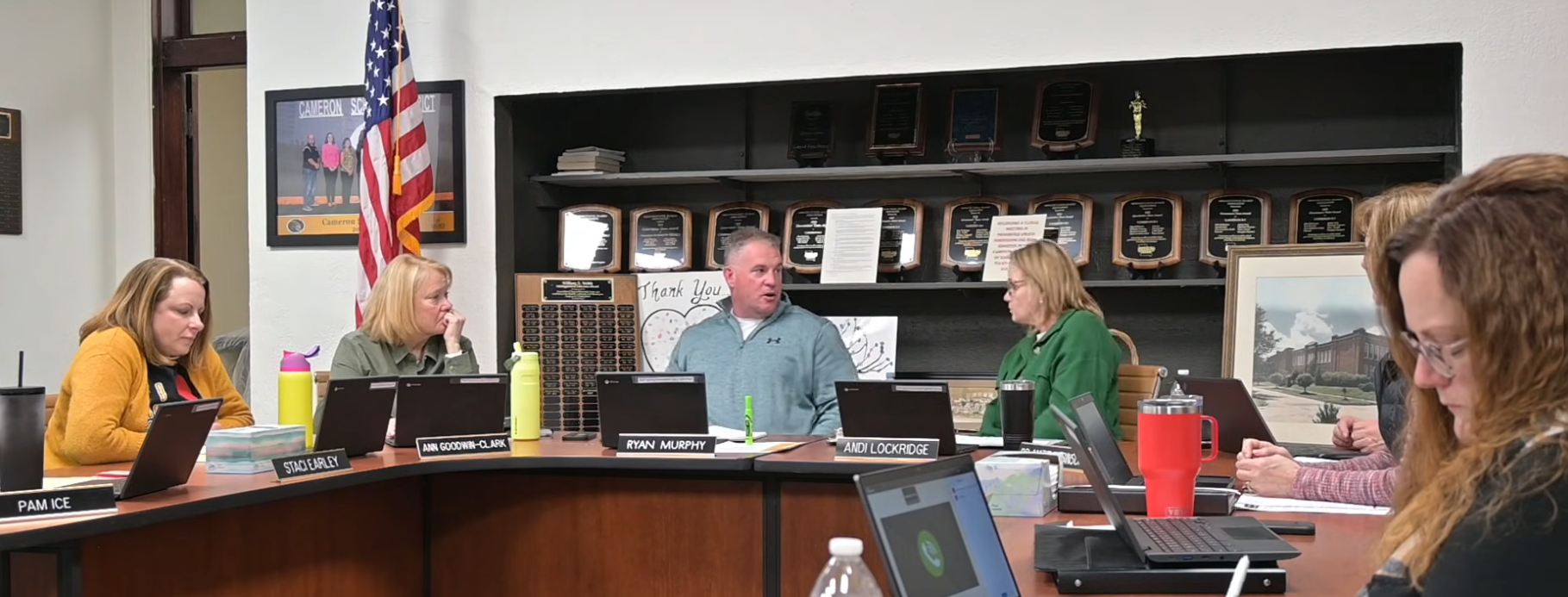
Board Discusses and Approves Contract Not Listed on Agenda While Demanding Public “Follow Our Policies”
By Heath Gilbert
Cameron School District Exposed
January 23, 2026
They understand the law. They’ve been trained on it. Board President Andi Lockridge has invoked it to silence a citizen. Vice President Ryan Murphy has used it as justification for banning another. Yet on January 20, 2026, the Cameron R-1 School District Board of Education violated the very Missouri Sunshine Law they claim to uphold—in the same meeting where they extended a ban against Dan Landi for allegedly violating their policies.
The hypocrisy is documented. The evidence is clear. And the law they broke is unambiguous.
The Violation: A Contract Appears Out of Thin Air
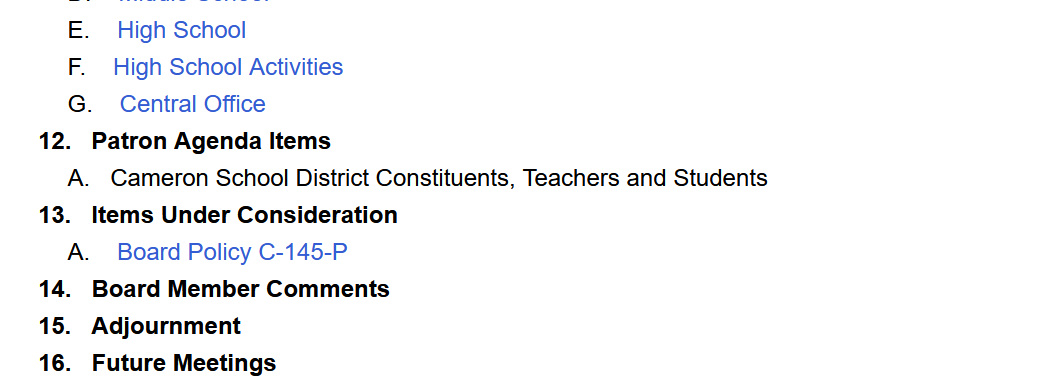
At the January 20, 2026 board meeting, the publicly posted agenda listed only one item under “Items Under Consideration”: Board Policy C-145-P, a routine change updating the custodian of records to Bridges Legal Services.

But that’s not all the board discussed and voted on.
During that same agenda section, Board President Andy Lockridge informed board members that a contract with Bridges Legal Services had “just been sent to your inbox.” She acknowledged they likely hadn’t had time to read it and gave them approximately two minutes to review the document on their computers during the meeting.
The board then discussed and voted to approve this contract—a contract that was never listed on the meeting agenda provided to the public.
Let that sink in. A governmental body, required by Missouri law to notify the public of items to be discussed, approved a binding contract that the public had no advance notice would even be considered.
The Law Is Crystal Clear
Missouri Revised Statute 610.020.1 could not be more explicit:
“All public governmental bodies shall give notice of the time, date, and place of each meeting, and its tentative agenda, in a manner reasonably calculated to advise the public of the matters to be considered.”
The Missouri Attorney General’s Office has repeatedly clarified what this means. In their brief supporting a Sunshine Law lawsuit against Western Cass Fire Protection District, Assistant Attorney General Jason Lewis wrote:
“A public governmental body cannot hide an elephant in a mouse hole by using vague or excessively broad terms to hide what the body intends to do. The tentative agenda must be specific enough for the public to be able to make an informed decision about whether to attend the meeting.“
The Attorney General’s Office has successfully prosecuted Sunshine Law violations for exactly this conduct. In their December 2023 case against the City of Belle, one of the five counts filed involved “discussing items of public business not on meeting agendas.”
Cameron R-1’s board didn’t just discuss a non-agenda item—they voted on it. They approved a contract. They took official action on a matter the public had no reasonable opportunity to know would be considered.
The Evidence: In Their Own Words
The audio recording from the January 20 meeting captures the entire sequence:
ANDI LOCKRIDGE (Board President): “Moving on to items for consideration in board policy C-145-P… Also, just into your inbox was the contract that the assessor has asked, which we will also need to approve. Which, if you want a second to look through that, we can take a second since that was a late addition.”
[Extended silence as board members read the contract on their computers]
ANN CLARK: “I like that there’s a cap.”
LOCKRIDGE: “I would make a motion to approve—”
CLARK: “That contract with Bridges for custodian of records.”
LOCKRIDGE: “I think we need a motion to approve the policy and then we need a separate one for the contract. So I’ll take the approval of the contract. Mrs. Clark has motioned, second by Mrs. Ice. All in favor, raise your hand. Motion passes.”
A contract emailed during the meeting. Read for two minutes. Voted on and approved. Never on the agenda.
And not one single probing question was asked.
Zero discussion about why the district was moving from fulfilling records requests in-house to contracting out the service. No questions about cost. No inquiry about whether the district solicited competitive bids for this service. No consideration of alternatives.
The board simply rubber-stamped a contract they’d just read for the first time—a contract that appears designed to serve the superintendent’s interests, not the taxpayers who fund this public school.
They Know Better—They’ve Used This Law Against Citizens
What makes this violation particularly egregious is that the Cameron R-1 Board demonstrably understands Missouri Sunshine Law agenda requirements. They’ve used this very principle to terminate public comment and ban citizens from district property.
Exhibit A: Andi Lockridge Invokes Agenda Requirements to Silence Dan Landi
At the August 2025 board meeting, Dan Landi attempted to address the board during his allotted public comment time. He was speaking about curriculum and library materials—topics he was permitted to discuss.
Board President Andi Lockridge repeatedly interrupted him, ultimately terminating his speaking time and ordering him to sit down. Her justification?
ANDI LOCKRIDGE: “We have to notice the topics that we’re going to talk about… You’re not talking about that, you’re talking about other things.”
In other words, Lockridge was invoking Missouri Sunshine Law—claiming that because topics must be noticed on the agenda for the board to discuss them in compliance with the law, Dan Landi could only speak about items shown on the agenda.
She didn’t just suggest this was a guideline. She enforced it. She ended a citizen’s First Amendment-protected speech because, in her determination, he wasn’t staying precisely on his noticed topic.
If Andi Lockridge believes the board “has to notice the topics” they’re going to discuss with such rigidity that she’ll silence a citizen mid-sentence, then she absolutely knows the board cannot discuss and vote on a contract that isn’t on the agenda.
Exhibit B: Ryan Murphy Demands the Public “Follow Our Policies”
The January 20 meeting featured another telling moment. As the board extended Dan Landi’s ban from district property, Vice President Ryan Murphy made the board’s expectations perfectly clear:
RYAN MURPHY: “The ban was in place due to the breaking of policy… I would say that we uphold and maybe move this further a little longer. All we’re asking is for people to come in here and follow the policies within our buildings.“
Read that again: “All we’re asking is for people to come in here and follow the policies.” Listen for yourself in this 16 second video.
But Missouri Sunshine Law isn’t just a policy—it’s state law. And Cameron R-1’s own Board Policy requires compliance with it.
The board demands citizens follow their rules with such fervor that they ban military veterans from public meetings. They extend those bans when individuals allegedly commit technical violations. They lecture the community about policy compliance.
Yet in the very same meeting where Ryan Murphy demanded policy compliance, his board violated Missouri state law by discussing and approving a contract not listed on the public agenda.
This Isn’t Ignorance—It’s Deliberate
Some might argue this was an innocent mistake, a last-minute necessity, an oversight.
The evidence contradicts that defense.
First, Board President Lockridge explicitly acknowledged this was a “late addition” that hadn’t been properly noticed. She knew it wasn’t on the agenda. She proceeded anyway.
Second, the board has received mandatory Sunshine Law training. Missouri school boards are trained on these requirements. They receive materials from the Missouri School Boards Association. They have legal counsel who should advise them.
Third, and most damning, the board has repeatedly demonstrated they understand agenda requirements by enforcing them against citizens. You cannot credibly claim ignorance of a law you’ve wielded as a weapon against the public.
The Pattern: One Standard for Citizens, Another for Themselves
This violation exemplifies a disturbing pattern at Cameron R-1 School District:
- Citizens are held to strict interpretations of policy. Dan Landi is banned for alleged recording violations, even when those allegations are disputed.
- The board operates under loose interpretations of law. They approve contracts without proper notice, claiming “tentative agenda” means they can add whatever they want.
- Citizens face escalating consequences. Bans are extended. Property access is restricted. First Amendment rights are curtailed.
- The board faces zero accountability. No consequences. No acknowledgment. No correction.
Here’s the question that should haunt every board member: Dan Landi was banned from district property for allegedly not following policies. How many board members will be banned for this Sunshine Law violation? How many will face consequences for breaking state law?
The answer, of course, is zero. The rules only apply one direction.
Missouri Law Provides Remedies
RSMo 610.027 establishes that any citizen can seek enforcement of Sunshine Law violations. The remedies include:
- Voiding actions taken in violation of the law
- Civil penalties for purposeful violations
- Attorney fees for successful complainants
- Court orders requiring compliance
The Attorney General’s Office has prosecuted and settled multiple cases involving the exact conduct Cameron R-1 committed: discussing and approving matters not listed on meeting agendas.
What Should Have Happened
Missouri Sunshine Law allows for emergency additions to agendas, but it requires justification and documentation.
RSMo 610.020.4 states: “When it is necessary to hold a meeting on less than twenty-four hours’ notice, or at a place that is not reasonably accessible to the public, or at a time that is not reasonably convenient to the public, the nature of the good cause justifying that departure from the normal requirements shall be stated in the minutes.“
If the Bridges Legal Services contract was truly such an emergency that it couldn’t wait until the February meeting with proper notice, the board should have:
- Stated the specific emergency necessitating immediate action
- Documented that justification in the meeting minutes
- Acknowledged they were departing from normal Sunshine Law procedures
They did none of these things. They simply added it, discussed it, and voted on it as if the public’s right to notice didn’t matter.
The Message This Sends
When a school board violates open meetings law, it’s not just a technical violation. It’s a breach of public trust.
When that same board simultaneously punishes citizens for alleged policy violations while breaking state law themselves, it reveals their true character.
The Cameron R-1 Board of Education doesn’t want accountability. They want control.
They want the authority to ban citizens from public meetings while conducting public business in secret.
They want the power to extend punishments against critics while operating above the law themselves.
They want the community to “follow our policies” while they ignore Missouri statutes.
Call to Action
This violation should be investigated by:
- The Missouri Attorney General’s Office, which has successfully prosecuted identical violations
- Missouri taxpayers and citizens, who have standing to file civil actions under RSMo 610.027
The board’s action approving the Bridges Legal Services contract should be declared void under RSMo 610.027’s remedies for Sunshine Law violations.
And every citizen of Cameron, Missouri should ask themselves: If the board won’t follow state law when conducting public business, what else are they hiding?
Documentation Available
I have archived:
- The publicly posted January 20, 2026 meeting agenda showing only Board Policy C-145-P under “Items Under Consideration”
- Complete audio/video recording of the contract discussion and approval (January 20, 2026 Board Meeting)
- Audio from the August 2025 meeting where Andi Lockridge cites agenda requirements to silence Dan Landi (August 2025 Board Meeting)
- Audio from the January 20 meeting where Ryan Murphy demands citizens “follow our policies”
Note: Board member quotes in this article are taken from transcripts of publicly available video recordings. There may be minor unintended inaccuracies based on audio quality.
All evidence will be provided to appropriate authorities and is available for public review.
The board knows the law. They’ve used the law against citizens. Now they’ve broken the law.
That’s not a mistake. That’s a choice.
And it demands accountability.
How to Take Action
File a Sunshine Law complaint with the Missouri Attorney General:
- Online complaint form: https://ago.mo.gov/get-help/programs-services-from-a-z/sunshine-law/sunshine-law-complaint-form/
- Phone: (800) 392-8222
Contact Cameron R-1 School District:
- Compliance Officer: complianceofficer@cameronschools.org
- Board of Education contact information: https://www.cameron.k12.mo.us/board-members
- Board email: boardmembers@cameronschools.org
Demand accountability. Demand transparency. Demand they follow the same laws they enforce against citizens.
Heath Gilbert is a U.S. Navy veteran and independent journalist covering government accountability in Cameron, Missouri. His investigative work focuses on transparency, constitutional rights, and institutional failures at Cameron R-1 School District. This article is part of ongoing coverage at Cameron School District Exposed.

By Heath Gilbert
Cameron School District Exposed
On September 12, 2024, the Cameron R-1 School District issued a press release that sent shockwaves through the community: a firearm had been discovered in a student’s vehicle on school property. The district assured parents that everyone was safe, the weapon was secured, and they would be investigating. Then, as has become their pattern over the past three years, the district went silent.
What they never told the community was that they got it wrong. What they never explained was why basic firearm safety protocols weren’t followed. What they never addressed was whether a student was unjustly punished and publicly branded. And what they certainly never acknowledged was yet another apparent violation of their own Memorandum of Understanding with the Cameron Police Department.
This is the story the Cameron School District doesn’t want you to know.
The Dispatch Record They Couldn’t Hide
Thanks to a public records request, I obtained Cameron Police Department dispatch records from September 12, 2024. At 14:02:22, Officer 1125—School Resource Officer Palmer—contacted CPD dispatch with a request to “run gun serial number.” The notes clearly state: “gun located in students car.”
At 14:03:49, dispatch closed the incident with a telling notation: “i notified 1125 we cannot run firearms serial numbers.”
This dispatch record confirms several critical facts: there was suspicion of a firearm in a student vehicle, the school district had physical possession of what they believed was a weapon, and they attempted to run a serial number through law enforcement channels.
The Truth Emerges Through Community Whispers
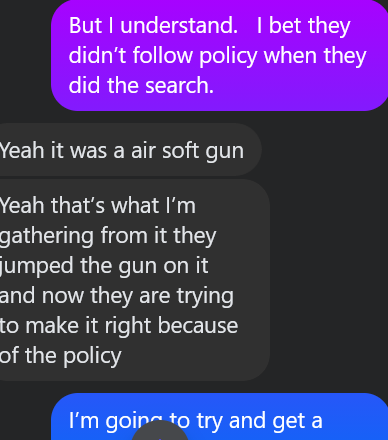
While the district maintained its public silence, the truth began trickling out through the community grapevine. In the Cameron Community Forum, an individual who claimed to work with the student’s father revealed that it wasn’t a firearm at all—it was an airsoft rifle. The school had also confiscated an emergency seatbelt cutter from the vehicle, apparently treating basic safety equipment as contraband.
On September 17, 2024, I encountered SRO Palmer after a school board meeting. When I pressed him about how a trained officer—a hunter and veteran—could mistake a plastic airsoft rifle for a real firearm, he repeatedly responded with “no comment.”
But I’m persistent. After continued questioning, Palmer finally made a statement that, while I cannot quote verbatim more than a year later, I interpreted as essentially asking whether I truly believed he—with his training and experience—couldn’t tell the difference between a real firearm and an airsoft rifle.
This raises critical timeline questions. At 14:02 on September 12th, Palmer requested a serial number check—suggesting he believed at that moment he was dealing with a real firearm. But at some point between that dispatch call and our September 17th conversation, Palmer clearly came to understand it was an airsoft rifle. When did that realization occur? And if Palmer eventually determined it wasn’t a real gun, why wasn’t that immediately communicated to the community through a corrective press release?
Palmer’s statement to me suggested that by mid-September, he knew the difference. So who made the initial misidentification? At the time, the Cameron School District employed only two school police officers: Palmer and SRO Ward. While we don’t have the complete incident report to know all the details, the fact that Palmer was on scene and in a position to request a serial number check suggests he had direct involvement with the suspected weapon. If so, this raises serious questions about supervisory responsibility. Palmer was the senior officer. Whether he personally handled the item or another officer did, he was responsible for ensuring proper protocols were followed—including the fundamental safety step of clearing and making safe what they believed was a loaded firearm.
Interestingly, in October 2024, SRO Ward resigned from the Cameron School Police Department. The district has never explained why, but one has to wonder if this incident played a role. If Ward was held accountable for the misidentification through his departure, why does Palmer—the supervising officer responsible for ensuring proper protocols—still have his position? Is this selective accountability? Did the district sacrifice the junior officer while protecting the senior one? This sounds a lot like the November details involving a certain coach and math teacher. These are questions the district’s silence leaves unanswered.
The MOU Violation Nobody Wants to Discuss
Here’s where this gets serious. The Cameron School District has a Memorandum of Understanding with the Cameron Police Department that specifically governs how certain incidents are to be handled. My understanding of this MOU is that when a potential weapon is discovered on school property, the school district is prohibited from conducting the investigation themselves. They are required to immediately turn the matter over to the local police department.
Instead, the school district took possession of what they believed was a firearm, attempted to run the serial number themselves, and then conducted their own internal investigation. If my understanding of the MOU is correct, this represents a clear violation of the agreement they have with CPD—an agreement that exists precisely to ensure proper handling of serious incidents like this.
The Firearm Safety Failure That Should Terrify Every Parent
But there’s an even more disturbing aspect to this story that speaks to basic competency and safety.
When school resource officers removed what they believed was a firearm from that student’s vehicle, the very first action they should have taken—before calling dispatch, before documenting serial numbers, before doing anything else—was to make the weapon safe. Clear it. Verify whether it was loaded. Ensure no round was chambered.
This is not advanced tactical training. This is basic hunter safety course material. Every firearm is treated as if it is loaded until you personally verify otherwise.
Had the officer who retrieved that “firearm” followed elementary safety protocols and cleared the weapon, they would have immediately discovered it was an airsoft rifle. The entire incident would have been resolved in seconds. There would have been no dispatch call. No serial number check. No press release. No public alarm. No student suspension. No family humiliation.
Instead, school police officers handled what they believed was a loaded firearm without clearing it first—a breathtaking failure of basic gun safety that should concern every parent whose child attends Cameron schools.
The Student Left in Limbo
According to my conversations with the individual who knew the family, the student was suspended and kept out of school while the district “reviewed” the matter. The family was told to remain quiet for a week while the review was conducted.
Here are the questions the district has never answered:
- Was the student ultimately allowed to return to school?
- If so, how long were they kept out for possessing what turned out to be a toy?
- Were they allowed to make up the missed work?
- Was this student punished under a policy that may not even prohibit airsoft rifles on school property?
- Was an apology issued to the student and family for the misidentification?
- What disciplinary action, if any, was taken against the officers who failed to properly clear what they believed was a firearm?
The Cameron School District cannot legally tell us the student’s name or specific disciplinary details. But they absolutely could—and should—have issued a follow-up statement clarifying that the original press release was based on incorrect information.
The Public Relations Cleanup That Never Came
When the district issued that September 12th press release announcing a firearm on campus, they put this student’s reputation on trial in the court of public opinion. Students knew whose car was surrounded by police. They knew who was called to the office. They knew who disappeared from school.
The rumor mill at any high school is vicious. What do you think students were saying about this kid? What assumptions were made? What labels were applied? In an era where school shootings dominate the news cycle, being publicly identified as the student who brought a gun to school carries devastating social consequences. In a school district with well-documented bullying problems, was this student bullied because of the misinformation released to the public by the Cameron School District due to poor police work and a mockery of an investigation?
The district created this problem with their press release. They branded this student—perhaps unjustly—as someone who brought a weapon to school. And then they simply walked away, leaving that student to deal with the social fallout of their mistake.
A simple follow-up statement could have clarified the situation: “Out of an abundance of caution, we initially reported an item as a firearm. Upon further investigation, we determined this was not the case. We appreciate the community’s patience and understanding.” They wouldn’t have to name the student. They wouldn’t have to reveal disciplinary details. They would simply have to be honest.
But honesty and transparency have never been the Cameron School District’s strong suits.
The Pattern We’ve Been Documenting for Three Years
I want to be crystal clear about something: I don’t know if district policy specifically prohibits airsoft rifles on school property. That’s actually relevant information the district should have clarified in a follow-up statement. Even if the item was ultimately harmless, is it still a violation to bring realistic-looking replica weapons to school? That would have been an excellent teachable moment for the entire community.
Instead, the district chose silence. They chose to bury the story. They chose to let a potentially false narrative stand uncorrected in the public record.
This is not an isolated incident. This is the pattern we’ve been documenting since September 2022. The Cameron R-1 School District consistently chooses opacity over transparency, silence over accountability, and institutional protection over public trust.
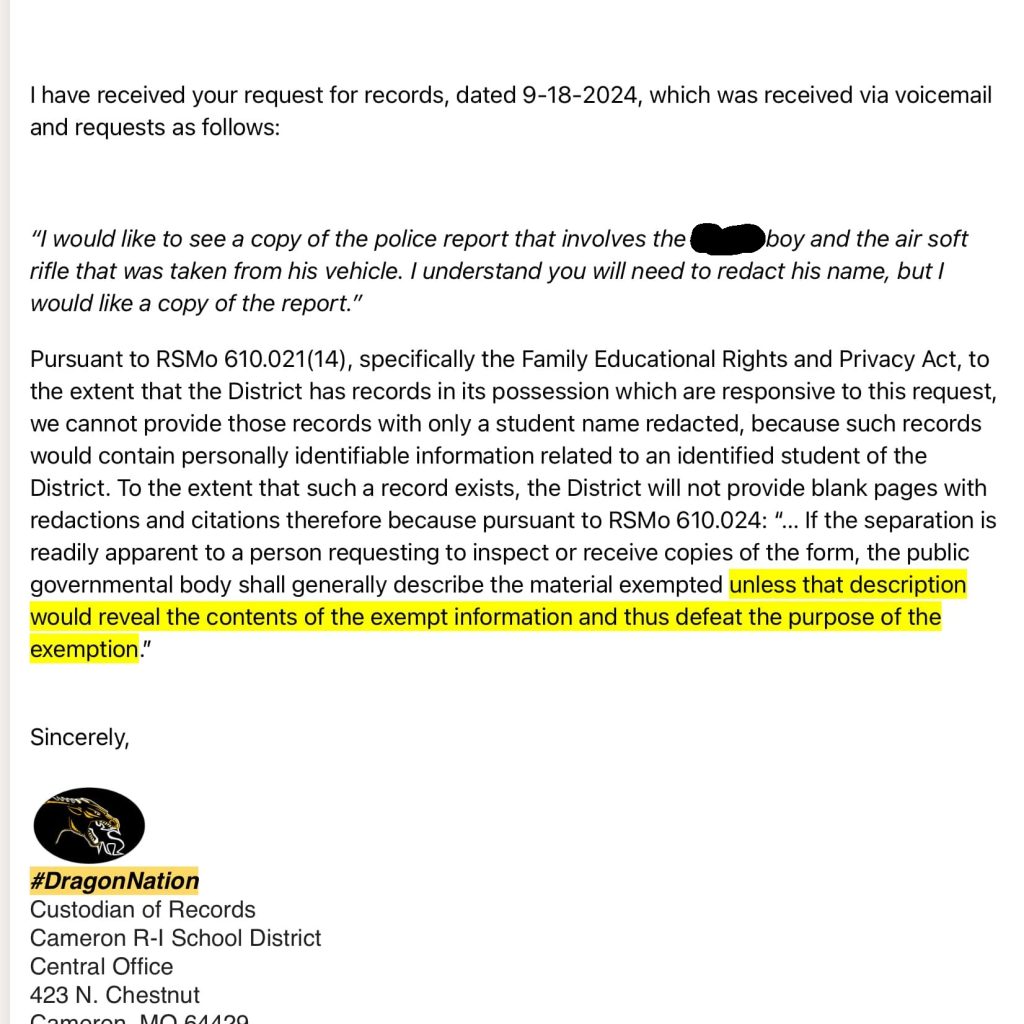
When my initial Sunshine Law request for the police report was denied, the district’s Custodian of Records cited RSMo 610.021(14) and FERPA, claiming they couldn’t provide records with only a student name redacted because “such records would contain personally identifiable information related to an identified student.” They went on to cite RSMo 610.024, stating they wouldn’t provide “blank pages with redactions and citations” because doing so “would reveal the contents of the exempt information and thus defeat the purpose of the exemption.”
Translation: “We have records, but we’re going to use student privacy as a shield to prevent you from learning about our mistakes.”
The irony is that I wasn’t asking them to identify the student—I already knew who it was from community sources. I was asking for documentation of how the incident was handled, whether proper protocols were followed, and whether the MOU with CPD was honored. Those are matters of public accountability that have nothing to do with student privacy.
The Questions That Demand Answers
The Cameron community deserves answers to these questions:
- Does the district’s MOU with Cameron Police Department require them to turn over weapons investigations to CPD? If so, why didn’t they?
- What training do school resource officers receive in basic firearm safety and identification?
- Why wasn’t the suspected firearm immediately cleared and made safe, which would have instantly revealed it was an airsoft rifle?
- Was SRO Ward’s October resignation related to this incident?
- Does district policy specifically prohibit airsoft rifles or realistic weapon replicas on school property?
- How long was the student suspended or kept out of school?
- Was the student’s academic standing affected by missing school days?
- What compensation or remediation was provided to the student and family for the public mischaracterization?
- Why was no corrective press release issued to clarify the initial announcement?
- How and where was this “firearm” stored during the “investigation”? Was a “weapon” that hadn’t been cleared and made safe stored inside the school building?
- Did the actions of the district and the arguably wrongful suspension put the school district and taxpayers in jeopardy of a lawsuit?
- What policy changes have been implemented to prevent similar misidentifications in the future?
The Real Issue: Institutional Accountability
This story isn’t really about an airsoft rifle. It’s about a school district that consistently refuses to be forthright with the community it serves. It’s about administrators who treat transparency as optional rather than obligatory. It’s about a culture where mistakes are buried rather than acknowledged and corrected.
For three years, I’ve been documenting this pattern. The Cameron R-1 School District announces partial truths, withholds complete information, uses student privacy laws as shields against legitimate accountability questions, and then simply goes silent when inconvenient facts emerge.
This September 2024 incident is textbook Cameron School District: dramatic announcement, investigation promised, community left in the dark, questions left unanswered, records requests stonewalled, and ultimately, another story buried by institutional silence.
A Message to District Leadership
To Superintendent Matt Robinson and the Cameron R-1 School Board:
Your silence is not protecting student privacy. Your refusal to issue a corrective statement didn’t protect that student—it abandoned them to deal with the social consequences of your mistake. Your invocation of FERPA to deny basic accountability records is not a legitimate exercise of legal protection—it’s a cynical abuse of privacy laws to avoid public scrutiny.
You could have handled this incident with basic honesty: “We made a mistake out of an abundance of caution. Here’s what we’re doing to ensure better training and protocols going forward.” Instead, you chose what you always choose: silence, stonewalling, and institutional self-protection.
This is why three military veterans have been banned from your board meetings. This is why I’ve spent three years documenting your failures. This is why I’m dug in like a tick and not going anywhere. This is why the community’s trust continues to erode.
You have created an accountability crisis through your own choices. And until you start treating transparency as a responsibility rather than an inconvenience, incidents like this will continue to chip away at whatever credibility you have left.
Conclusion: The Transparency Crisis Continues
Cameron parents send their children to school trusting that the district will keep them safe and treat them fairly. When mistakes happen—and they will, because humans are imperfect—the community expects honesty and corrective action.
Instead, the Cameron R-1 School District offers press releases that tell half-truths, investigations conducted behind closed doors in apparent violation of their own MOUs, records requests denied under questionable legal theories, students potentially punished for policies that may not exist, and a wall of silence when uncomfortable questions are asked.
This is not how public institutions are supposed to operate in a constitutional republic. This is not how you build community trust. This is not how you demonstrate respect for the taxpayers who fund your operations.
The Cameron School District had multiple opportunities to handle this incident with integrity: immediately clear the suspected weapon (proper safety protocol), recognize it was an airsoft rifle (competent observation), decide if that violated policy (clear rules), apply appropriate consequences if any (fair process), and inform the community of the outcome (basic transparency).
They failed at every step.
And now, as always, they hope silence will make it go away.
It won’t.
Because there are still a few of us who believe public institutions owe the public honesty. There are still a few of us who will keep asking the questions nobody wants to answer. There are still a few of us who remember that in a transparent constitutional republic, sunlight is the best disinfectant.
Whatever happened to the gun?
It was never a gun. But the real question is: whatever happened to accountability at the Cameron R-1 School District?
UPDATE: Airsoft Dad Breaks His Silence
January 12, 2026
This afternoon at approximately 12:30 PM, I received a response to my request for comment from the father at the center of the September 2024 airsoft rifle incident. Speaking on condition of anonymity to protect his child’s identity, the father—whom we’ll call “Airsoft Dad”—has authorized me to share his account of what happened after the district’s own police department misidentified toys as a firearm.
How It Started
According to Airsoft Dad, another student who had a problem with his son reported the item in the vehicle. Airsoft Dad claims this student knew it was an airsoft toy. When school staff confronted Airsoft Student, he immediately told them it was an airsoft pistol—not a real firearm.
Despite this disclosure, the school district police proceeded to search the vehicle and treat the matter as a weapons incident.
The Punishment
Airsoft Student received a full year expulsion from the Cameron School District.
According to Airsoft Dad, the items found in his son’s vehicle were:
- An airsoft pistol (a toy that fires plastic BBs)
- A nerf gun (a foam dart toy)
- A seatbelt cutter (a common emergency safety tool)
- A box of corroded .22 caliber shells that Airsoft Student didn’t know were there—they “had been in there for a while because they were corroded” and “probably were in there from when my mom had the car before she gave it to him”
No criminal charges were ever filed. “No charges were filed and never got a police report,” Airsoft Dad confirmed. He was “never at the station with my son or anything.” The Cameron School District Police Department conducted the investigation, and despite finding only toys and forgotten ammunition—nothing that warranted involvement from the actual Cameron Police Department or criminal prosecution—the district expelled his son for 365 days.
Meanwhile, according to Airsoft Dad, around the same time another student who allegedly made threats against a Cameron school on social media received only five days of in-school suspension. While I cannot independently confirm all details of that separate incident, I do recall a district press release addressing social media threats during that same September 2024 timeframe.
The Disparity
Airsoft Dad offered his assessment of what motivated such disproportionate punishment, and his response was devastating:
“It boils down to I don’t have a well known name in Cameron and wasn’t part of the school’s elite.”
He continued: “I try to live right and raise my kids to be the same and not be a ‘hey look at me’ person but always look out for others and do the right thing and have integrity.”
According to Airsoft Dad, his son was “railroaded for a toy because some other Cameron middle school student made statewide threats.” The result: forced to finish schooling online, lost all extracurricular opportunities, and permanently stigmatized by an expulsion that will follow him through future applications.
“My son lost out on so much of his future because of this,” Airsoft Dad said. “The sad part is there isn’t even a way they could make it right now.”
The Questions This Raises
Airsoft Dad’s account demands answers:
- If Airsoft Student immediately told staff it was an airsoft pistol, why did the district proceed as if it were a real firearm?
- Why did a student with toys and forgotten ammunition receive 365 days expulsion while another student who allegedly made threats received 5 days ISS?
- If the school district police investigation found nothing worthy of actual criminal charges, what justified imposing a year-long expulsion?
- When did the school district police officers confirm it was an airsoft pistol, and why did administrators proceed with maximum punishment anyway?
- Does the Cameron R-1 School District maintain a two-tiered disciplinary system based on family social status?
Whatever happened to the gun?
It was never a gun. Airsoft Student told them it wasn’t a gun. But what the Cameron School District did to that student—taking a year of his education over toys and his grandmother’s forgotten ammunition when their own investigation found nothing criminal—reveals an institution more interested in making examples than serving justice.
If you are a current or former Cameron School District family who has experienced similar disparate treatment, contact Heath Gilbert through Cameron School District Exposed.
Heath Gilbert is a U.S. Navy veteran and independent journalist who has been documenting Cameron R-1 School District board meetings and transparency issues since September 2022. His work can be found at Cameron School District Exposed.
If you have information about transparency, accountability, or policy violations in Cameron-area public institutions, contact Heath Gilbert through his journalism platform.
Last nights Cameron R-1 school districts board meeting we heard concern raised about possible unnecessary and wasteful spending in the district. Were these legitimate concerns about wasteful spending, or a veiled attempt by the district to discredit a local resident? Let’s flesh this out a little and allow you to draw your own conclusion.
The relevant discussion happened in the first few minutes of last nights meeting. School board vice president Ryan Murphy brought up a concern and started a discussion about a large bill for attorney services to redact records for a single Missouri Sunshine Law request. During the discussion about that bill, board member Pam Ice asks Superintendent Matt Robinson how much that specific records request cost the district to make redactions. Matt responded that it was $8200. That is unquestionably a lot of money.
You can watch that full exchange in the following video. But be sure to continue reading as we will provide additional and relevant details about likely reasons why attorneys are now making these redactions.
Can those redaction be made by school staff to save money?
That is the relevant question I would have liked one of the board members to have asked superintendent Robinson. Board members Peck, Ice and board president Lockridge all joined in the conversation to share concern about the cost for redactions. They were concerned about the cost, why were there no questions on how the district could reduce that cost?
I believe that both the district and school board have a fiduciary responsibility to the tax payers to spend our money wisely. Paying a law firm $200 plus dollars an hour to redact names from public records doesn’t seem like a good use of tax dollars IF those redactions can be made by the district.
Around the 2 minute and 45 second mark in the above YouTube video, Robinson mentions the district can only charge the individual requesting the records an amount equal to the lowest paid qualified staff member to complete that task. Robinson mentions that is around $20 an hour.
Why then isn’t the Cameron school district making their own redactions and saving tax payers $180 an hour? Of course hindsight is 20/20, but this would have been a good question for a member of the board to ask. I’d love to hear a cost reduction question at every board meeting!
Has the school district previously completed their own records redactions
That is another question I would have liked to hear a board member ask. And if the answer provided was “yes”, a follow on question to ask why the change from previous and cheaper in house redactions. The board didn’t ask those questions, but i can still provide an answer to that question.
Yes, the Cameron school district has made its own redactions in the past.
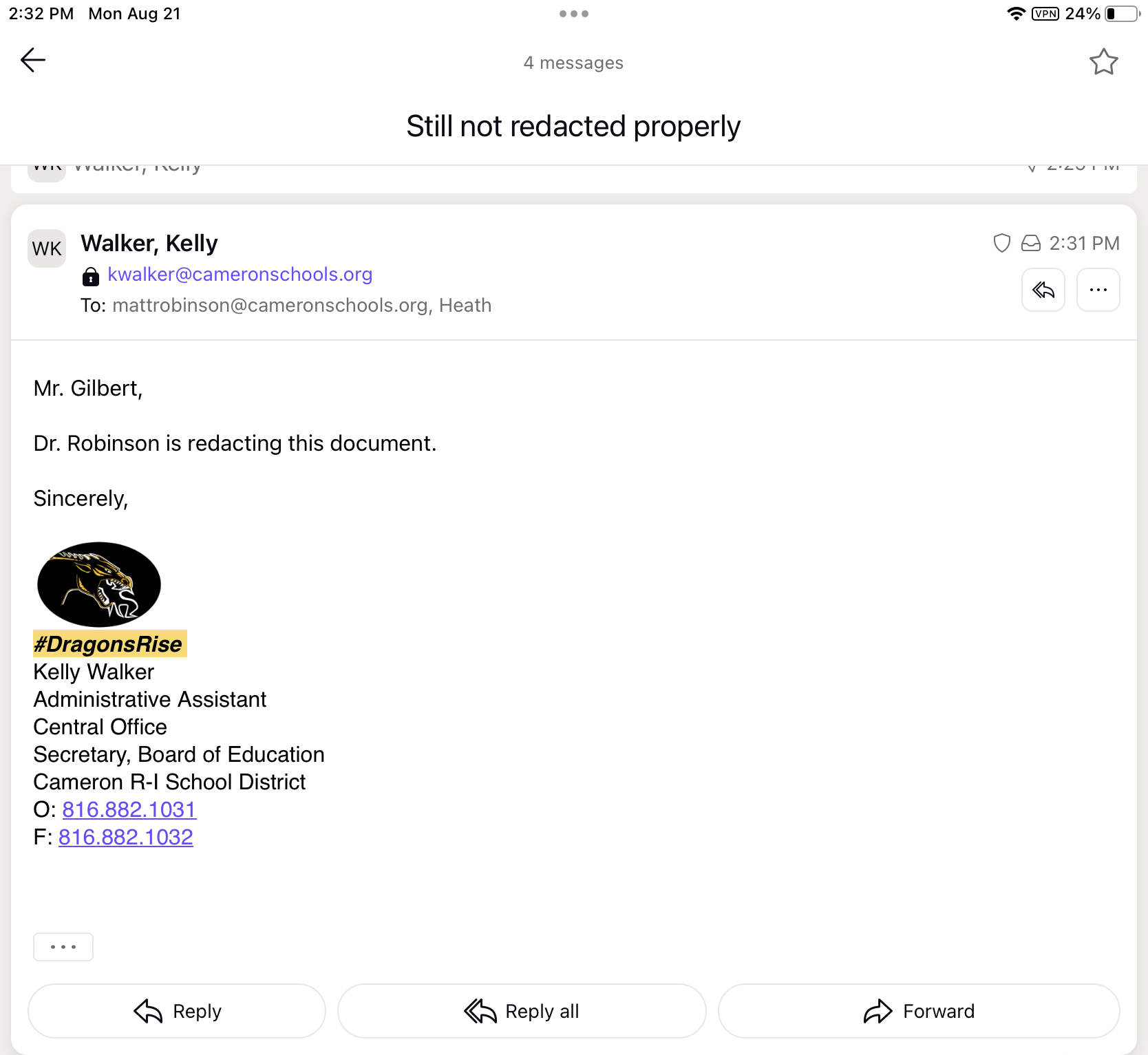
In this screenshot you will see an email response from the district where they state that the superintendent was personally redacting records requests previously. Why was the highest paid staff member for the district conducting this task?
This image is from one of my own Sunshine Law requests and the redactions being made were staff names, the same type of redactions made in the $8200 request mentioned at last nights May 20th board meeting. If the district was previously able of making redactions to protect the names of district employees, why outsource that task to a significantly more expensive law firm? Another good question I wish one of the board members had asked.
Why did the Cameron school district stop completing their own redactions for records request?
While it is typically frowned on to comment on such questions with mere speculation, in this instance my answer is based on irrefutable fact. Records we previously obtained through Sunshine Law requests pertaining to the dirty book fight appear to indicated unlawful redactions made by the district.
One of the redactions appears to be an attempt to avoid transparency and coverup proof of records the district previously said didn’t exist. We can show you that unlawful redaction.
 To the right in the attached screenshot you can see a record with a poorly made redaction. The link is to a google document of book votes taken by a book review committee. This is important because when I originally asked for records of these votes I was told that no records existed. This redaction appears to be an attempt made by the district to cover up the existence of public records. This is the exact opposite of transparency.
When did the district switch to using lawyers for redactions
If Mr Murphy were to extend his records request he shared with the board and made a public record at last nights meeting to around the time of my records request, I suspect we will find an uptick in the billable hours by Ed Council. It is my belief that it was around this time that found this unlawful redaction and attempt to avoid transparency that the district began outsourcing simple redaction duties to its law firm.
Was this a personal attack or legitimate concern about wasteful spending
Once again I can only speculate on this question. In the 2 plus years I have been attending these board meetings, last night was the first time I recall a monthly expense budget item being questioned during a meeting. If this was a one time event and we don’t hear similar questions in the future, we have our answer.
I hope that I am wrong. I hope this is a sincere concern about possible wasteful spending of our tax dollars in the Cameron R-1 school district. I hope to see additional concerns about expenses brought up at future meetings. Hopefully routine series of questions are developed and asked during those meetings to ensure our hard earned tax dollars are being spent responsibly and wisely.