

An untold story of courage at McCorkle’s
CAMERON, Mo. — On the evening of December 20, 2025, just five days before Christmas, while families enjoyed dinner and friends gathered for drinks at McCorkle’s restaurant in Cameron, Missouri, a crisis was unfolding that could have ended in tragedy. What didn’t make the news that night—and what many patrons still don’t know—is that one man’s decisive action may have saved multiple lives and prevented a Christmas tragedy for Cameron families.
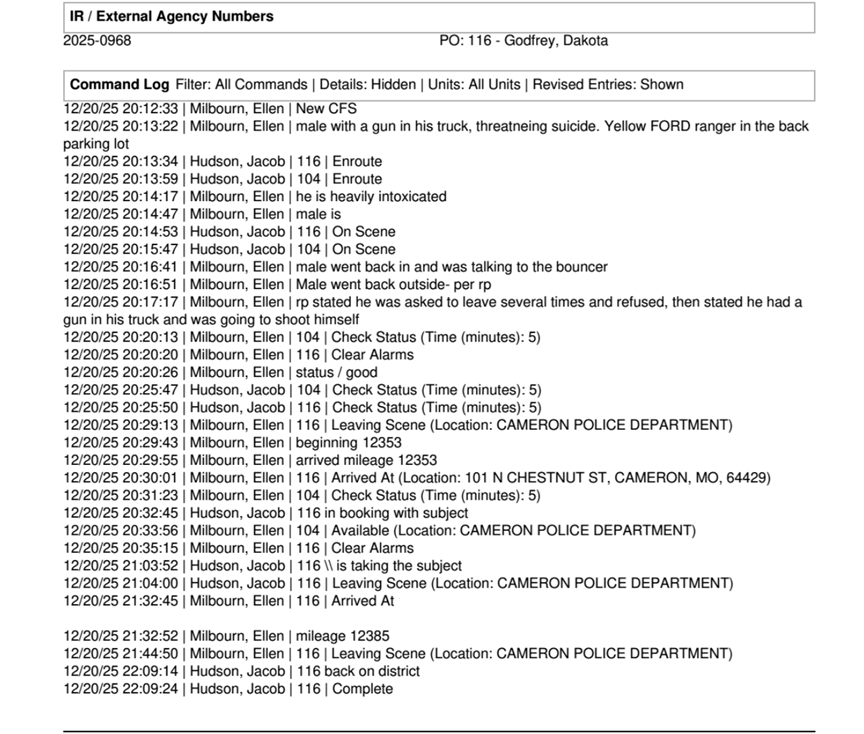
Michael Hullinger, working security at McCorkle’s that Saturday evening, confronted an individual on the back stairs leading into McCorkle’s. According to a witness who asked to remain anonymous, the individual was attempting to enter the establishment with a loaded firearm. Cameron Police Department records obtained by Cameron School District Exposed confirm officers responded to an incident at McCorkle’s involving an individual who was “heavily intoxicated.” The records list Hullinger as a witness to the incident.
A Dangerous Situation
The incident began around 8:12 p.m., according to Cameron Police Department dispatch records, when an individual described as “heavily intoxicated” made threats of self-harm. After going to his vehicle—a yellow Ford Ranger—the individual retrieved a firearm and began making his way back toward McCorkle’s. If his intention was only to harm himself, why return to a crowded restaurant with a loaded weapon?
What happened next demonstrated both courage and selflessness. Rather than allowing a potentially volatile situation to unfold inside McCorkle’s, which was filled with patrons including families with children, Hullinger intercepted the armed individual on the stairs. Working security at McCorkle’s, Hullinger almost certainly wasn’t paid enough to risk his life confronting an armed, intoxicated individual—but he did it anyway. When he encountered the armed individual, Hullinger could have fled to safety. He could have looked out for himself. Instead, in that moment, he put himself in harm’s way to protect complete strangers.
“The male went back in and was talking to the bouncer,” reads one entry in the CPD dispatch log, documenting the moments when Hullinger was engaging with the armed individual. Shortly after, another entry states: “Male went back outside – per rp [reporting party].”
According to a witness who was present that evening and wishes to remain anonymous, the individual had told friends he intended to harm himself, and had also made a statement about “shooting up McCorkle’s.”
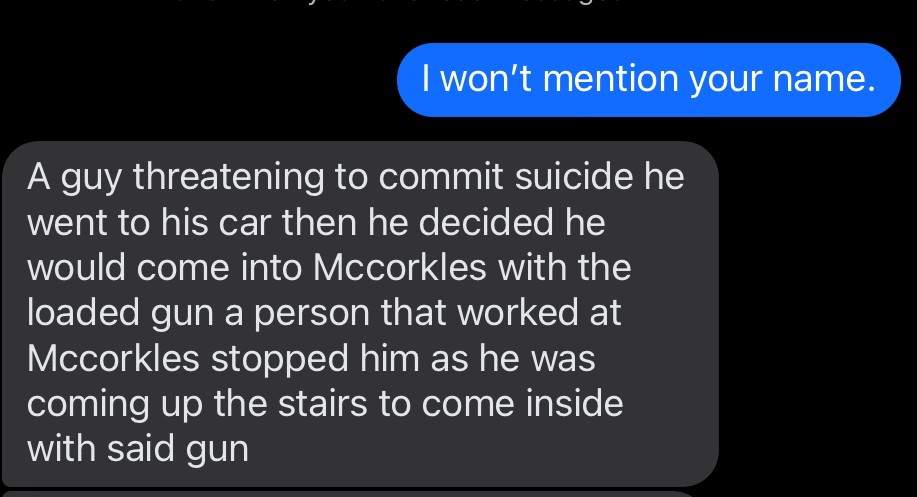
“A person that worked at McCorkle’s stopped him as he was coming up the stairs to come inside with said gun,” the witness reported. “The gentleman working that night possibly saved many lives.”
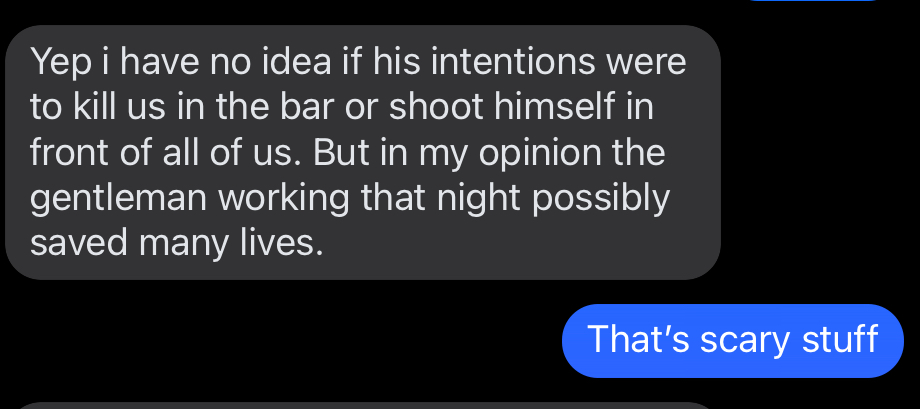
The witness emphasized uncertainty about the individual’s true intentions: “I have no idea if his intentions were to kill us in the bar or shoot himself in front of all of us. But in my opinion, the gentleman working that night possibly saved many lives.”
The witness also emphasized the danger faced by unsuspecting patrons: “There were families at that time with children as well, eating supper, that still to this day have no idea this happened.”
Those families, many likely preparing for Christmas celebrations just days away, were unaware of the danger in their midst. The situation was handled quickly enough that those inside McCorkle’s continued their meals in peace, never knowing how close they had come to potential tragedy. Panic never spread, chaos never erupted, and families finished their dinners safely—all because one man stood between them and harm.
A Hero Worth Recognizing
Whatever questions remain about how the incident was handled afterward, one fact is clear: Michael Hullinger put himself between an armed, intoxicated individual and McCorkle’s, which was full of unsuspecting people, in the days before Christmas. He wasn’t a police officer responding to a call. He wasn’t required to intervene. His job was to check IDs and keep order, not to face down an armed threat. Yet when the moment came, he didn’t hesitate. He stepped forward, risking his own life to protect others, likely preventing injuries or deaths and sparing families from a holiday season marked by tragedy.
That kind of selfless courage deserves recognition.
In an era where we often hear about violence in public spaces, it’s worth pausing to recognize those who act to prevent it. Michael Hullinger is one of those people. His actions on December 20 merit more than this article—they deserve official recognition from the City of Cameron, the Cameron Police Department, and the community itself. A public commendation, a citizen award, or even a simple acknowledgment of his bravery would send an important message: that courage and selflessness matter, and that those who put themselves at risk to protect others will be honored and celebrated. And perhaps McCorkle’s should consider giving this man a serious raise—his actions that night went far beyond the job description of McCorkle’s security.
If you’re a regular at McCorkle’s, take a moment to thank Michael Hullinger and shake his hand the next time you see him there. That man has your back.
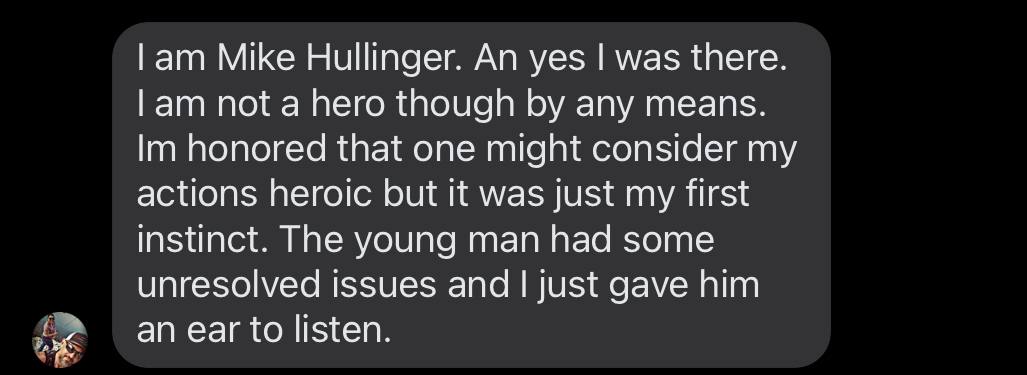
UPDATE — January 12, 2026: Michael Hullinger has responded to Cameron School District Exposed’s request for comment. In his message, Hullinger emphasized his humble perspective on what happened that night:
“I am Mike Hullinger. An yes I was there. I am not a hero though by any means. Im honored that one might consider my actions heroic but it was just my first instinct. The young man had some unresolved issues and I just gave him an ear to listen.”
Hullinger’s response reflects the character of someone who acted not for recognition, but out of genuine concern for another human being in crisis. His willingness to listen to someone in distress, even while that person was armed and intoxicated, demonstrates the kind of compassion that likely de-escalated what could have been a deadly situation. Whether Hullinger considers himself a hero or not, his instinct to help rather than run, and to listen rather than judge, speaks to the best of what we hope to see in our community.
The Police Response
Cameron Police Department officers Dustin McCloud and Dakota Godfrey responded to the scene. According to dispatch records, officers arrived on scene at 20:14:53 and 20:15:47 respectively. The logs indicate officers spent considerable time managing the situation, with multiple status checks documented throughout the evening.
By 20:17:17, dispatch records note: “rp stated he was asked to leave several times and refused, then stated he had a gun in his truck and was going to shoot himself.”
The officers were able to secure the individual to prevent self-harm, assess the situation, and determine how to best serve both him and the community. The individual was eventually taken into custody and transported to a medical facility, apparently in St. Joseph, Missouri, according to dispatch records.
The City of Cameron and the Cameron Police Department have an opportunity here not only to celebrate Michael Hullinger’s heroism, but also to acknowledge Officers McCloud and Godfrey for calmly responding to and professionally handling a call involving an armed individual. Because of their work, that man was able to be transported safely to get the help he needed.
Background Details
The identity of the individual involved in the incident has not been confirmed. Because he was transported for medical evaluation rather than being charged with a crime, the police report and body camera footage are not available to the public under Missouri law. The dispatch records list the incident under IR/External Agency Number 2025-0968, with Dakota Godfrey documented as the primary officer (PO: 116).
Cameron School District Exposed is an independent journalism platform focused on transparency and accountability in local institutions. If you have information about this incident or other matters of public interest in Cameron, Missouri, you can reach us through our Facebook page at Show Me Transparency.
Anyone who was present at McCorkle’s on the evening of December 20 and has information about this incident is encouraged to contact the Cameron Police Department at their non-emergency line: (816) 632-6521.
Note to journalists: Questions regarding this incident can be directed to Cameron Police Chief Dan Miller.
Editor’s Note: This publication protects confidential sources and will not reveal the identity of the witness who provided information for this story. All factual claims have been corroborated through official dispatch records or multiple sources where possible..

Who Really Runs Cameron?
Not the people you elected.
Have you considered that someone who isn’t an elected official is making decisions on how Cameron runs? Someone who never campaigns. Someone who never faces voters. Someone who operates from the shadows using money as a weapon.
Call this person what they are: the puppet master.
You see the puppet master’s work everywhere in Cameron. You just don’t see the puppet master.
The Evidence
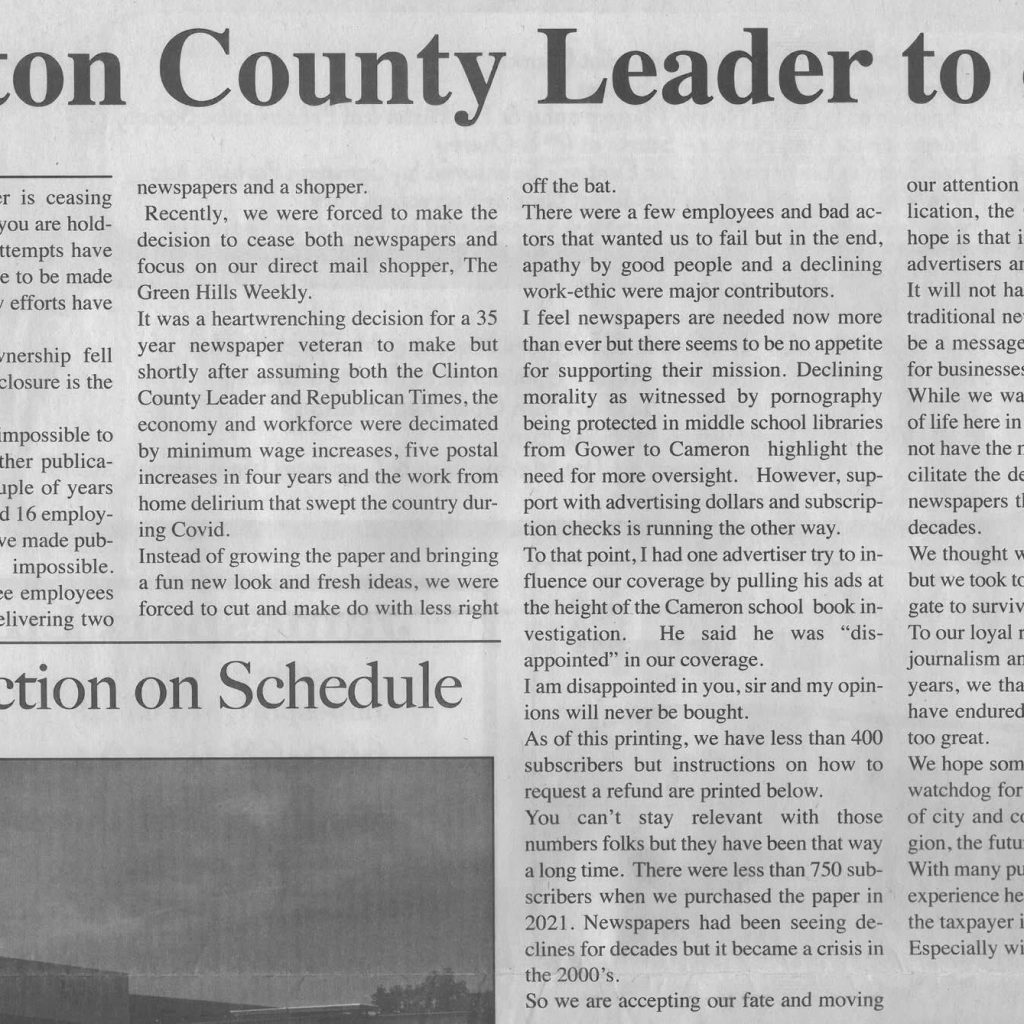
When Jamey Honeycutt owned the Clinton County Leader, he published sexually explicit passages from books found in Cameron High School libraries. The articles were scathing—calling out the school and its leadership for making these materials available to students.
The puppet master didn’t like it.
Honeycutt described what happened next: “I had one advertiser try to influence our coverage by pulling his ads at the height of the Cameron school book investigation. He said he was ‘disappointed’ in our coverage.”
Honeycutt’s response: “I am disappointed in you, sir and my opinions will never be bought.”
Honeycutt upheld his journalistic standards. He refused to cave to the puppet master’s threats. He ultimately sold the paper rather than compromise his integrity.
Around the same time, Mark McLaughlin edited the Cameron Citizen-Observer. McLaughlin faced similar pressure. He later admitted: “I had a conversation with my publisher. There was a strong sentiment arising from the community that wanted this to go away. There was a veiled statement that not doing so would result in a loss of advertising revenue.”
McLaughlin explained his publisher’s directive came from “discomfort of local business people and advertisers.”
Before the pressure, McLaughlin had written supportively. He called citizens who documented school district problems “bell-ringers”—watchmen standing guard and warning the community. He wrote that dismissing their concerns “would be a danger to all of us.”
After the pressure?
The Citizen-Observer stopped covering the book issue. It stopped covering other serious concerns that arose relating to the school district. McLaughlin’s supportive language disappeared.
The paper refused to print about an order of protection that a school district employee took out against a citizen documenting board issues. They also refused to print when that protection order was dismissed with prejudice in a court of law.
When the puppet master says make it “go away,” even court rulings favorable to citizens don’t get reported.
The accountability journalism didn’t just diminish. It disappeared.
Was it the same man who pressured both newspapers? Did the puppet master’s “discomfort” change McLaughlin’s language?
Two newspapers. Two editors. Same pressure. Same timeline. One refused and lost his paper. The other complied and kept his job.
Cameron’s city council moved forward with a water line project connecting to St. Joseph’s water supply. Voters reportedly rejected this project twice at the ballot box.
The council proceeded anyway.
The original estimate was $12 million with 27 cities participating. Current city council member John Feighert posted on December 22, 2025, in the Cameron Community Forum that he’s “guessing it will end up around $49-50 million.” That’s more than four times the original estimate.
Feighert added: “We will run people out of Cameron with these prices. I know a lot of seasoned citizens that cannot afford this and it will be a large burden on our businesses which means……. higher costs to us there as well or they just close down.”
Residents now pay double or more for water and sewer—for infrastructure they voted against twice. And the final bill keeps climbing.
Who benefits when voter referendums get ignored?
The Cameron R-1 School Board terminated middle school teacher Rachel Barlow in 2025. The board voted 4-1 to uphold her termination for allegedly failing to comply with an administrative directive. Two board members were not present.
Other employees violated similar or more serious directives. They kept their jobs.
Who decides which employees get fired and which get protected?
Citizens who document school board problems face escalating retaliation. They’re banned from school property. Prohibited from attending public meetings. Subjected to character assassination.
Public records requests meet systematic delay and resistance. Constitutional rights to record public meetings get restricted.
Dan Miller, the police chief, currently serves as Cameron’s interim city manager. The community has been vocal—multiple newspaper articles and numerous community forum posts call for his permanent hiring.
Yet months pass. The position remains “interim.” Despite overwhelming public support for a candidate already doing the job successfully, the city council hesitates.
What are they waiting for? Whose approval do they need?
The Pattern
These aren’t isolated incidents. This is a pattern.
When newspapers face financial pressure for accountability journalism.
When voters reject projects that proceed anyway.
When teachers get selectively terminated.
When citizens face retaliation for documentation.
When hiring decisions ignore overwhelming public support.
Someone is pulling strings.
The puppet master doesn’t attend board meetings. Doesn’t speak during public comment. Doesn’t need to.
The puppets already know what’s expected.
Why “Go Away”?
Remember McLaughlin’s admission? The puppet master wanted school district coverage to “go away.”
Not because the reporting was false.
Not because the concerns weren’t legitimate.
The school district never claimed the documented problems weren’t true. The community never disputed the facts.
The puppet master wanted it to “go away” because it was inconvenient. Because some knucklehead with money thinks accountability threatens his control. Because transparency exposes influence.
Truth doesn’t matter to puppet masters. Only compliance matters.
Why Does the Puppet Master Do This?
Money. Power. Control. Secrets. Ideology.
Maybe all of the above.
But here’s what matters: None of these justify using financial pressure to override democracy.
When one person determines what newspapers publish, which projects proceed despite voter rejection, who gets fired and who gets protected, and who gets hired—democracy becomes theater.
Elections become meaningless when the puppet master picks the puppets.
The April Choice
Three school board seats. Two city council seats. April election.
The city council seats matter too. One became available after Gina Reed resigned. Her resignation letter gave no reason, but the timing suggests it was related to her Third Street properties—a train wreck that left taxpayers responsible for tearing down buildings on her property.
Dan Miller, the police chief currently serving as interim city manager, has overwhelming community support for the permanent position. Citizens wore “Team Dan” shirts to city council meetings. Newspaper articles documented the support. The Cameron Community Forum is flooded with posts supporting Miller.
Yet the council hesitates. The community is left without knowing why Dan was passed over for the job. What are they waiting for? Whose approval do they need?
Voters can choose representatives who dance on command for the puppet master who doesn’t answer to voters. Or they can elect leaders who cut the strings.
Cameron can change this pattern. But only if voters demand candidates who state clear positions before election. Who commit to answering constituent questions. Who investigate rather than accommodate.
What questions should voters ask candidates before April?
Here are some examples:
For all candidates:
Will you commit to answering constituent questions after election?
Will you prioritize transparency over administrative convenience?
Do you have ties to the puppet master? Will you serve constituents or someone who never faces voters?
For school board candidates:
Do you believe citizens have a constitutional right to record public meetings?
Will you vote to investigate retaliation against citizens who document school board issues?
Do you support selective enforcement—firing some employees while protecting others who commit similar violations?
Who do you believe the school board serves—administrators or constituents?
For city council candidates:
Will you support Dan Miller’s permanent appointment as city manager based on overwhelming community support?
Will you explain why decisions get made behind closed doors without public input?
Will you commit to following voter referendums even when they conflict with other interests?
What questions do you think candidates should answer? These are just examples. Cameron voters should demand clear positions before election day.
Candidates who refuse to answer have already told you whose strings they’ll dance on.
April Will Tell the Story
Three school board seats. Two city council seats. One election.
The puppet master is counting on voters to choose candidates who won’t ask hard questions. Who won’t demand accountability. Who value “getting along” over transparency. Candidates who will make problems “go away.”
The puppet master is counting on voters to forget about Jamey Honeycutt’s newspaper. To ignore the water line voters rejected twice. To overlook the retaliation against citizens who document problems.
Maybe the puppet master is right. Maybe Cameron voters will keep electing knuckleheads who serve the man with money instead of constituents.
Or maybe enough residents are tired of watching their town get run by someone they never elected and can’t vote out.
April will tell the story.
The choice is simple: elect puppets or cut the strings.
Questions for Cameron
Does the community want puppet masters making decisions for them behind closed doors? Ignoring the will of the people?
Is there just one man pulling strings? Or are there several?
What drives them to make these decisions on our behalf? Money? Power? Control? Protecting secrets?
These are questions Cameron residents must answer for themselves.
A Challenge to Cameron’s Newspapers
The Cameron Citizen-Observer and the Clinton County Leader both know who threatened to pull advertising dollars if they didn’t make the school district problems “go away.”
Both papers have the facts. Both papers know the puppet master’s identity.
We challenge both newspapers to uphold their journalistic integrity. Share the facts. Let the community form their own opinions.
Reveal who used financial pressure to silence accountability journalism.
That way voters can ask candidates directly: Do you have ties to the puppet master? Will you serve constituents or the man who controls the strings?
But here’s the harder question for Cameron residents: Can you trust newspapers that decide what stories to print based on what their advertisers want?
When money determines coverage, is it still a newspaper? Or is it just another advertising platform?
Real journalism serves readers, not advertisers. Real journalism asks uncomfortable questions. Real journalism publishes truth even when it costs revenue.
McLaughlin admitted his publisher told him to make it “go away” because of advertiser pressure. He complied.
That’s not journalism. That’s public relations for whoever pays the bills.
The community deserves to know who really runs Cameron before they cast their votes in April.
For the past three years, I’ve attended Cameron R-1 School District board meetings, documenting decisions and requesting public records under Missouri’s Sunshine Law. During that time, I’ve witnessed firsthand how the school board uses complicated procedures to silence responsive public comment. Meanwhile, just down the street, Cameron’s city council allows citizens to sign up and speak on the night of the meeting—after seeing what’s on the agenda.
Why can the city council handle same-day public comment, but the school board refuses to allow it? The answer reveals an uncomfortable truth: school boards are either misinterpreting the law or deliberately restricting participation.
The Impossible Timeline
Missouri law creates a catch-22 that effectively silences citizens who want to participate in school board governance. Here’s how it works:
Missouri Revised Statute § 162.058 requires citizens to request agenda items at least five business days before a meeting. But the Missouri Sunshine Law (§ 610.020) only requires school boards to post their agendas 24 hours in advance.
Do the math. Citizens must predict what will be discussed four to five days before they can possibly know what’s on the agenda.
This isn’t just inconvenient—it’s an impossible standard that defeats the entire purpose of transparency. You cannot respond to specific board actions, proposals, or agenda items you learn about from the posted agenda. You must be clairvoyant.
What the Law Actually Says
Here’s what many school boards either don’t understand or deliberately ignore: § 162.058 only governs formal agenda items—not general public comment.
The statute creates a process for residents to “have an item placed on the agenda.” This means adding a new topic that guarantees the resident can present their concerns to the board—not that the board must take action or even respond. It does not prohibit boards from allowing same-day public comment on items already on the agenda.
Yet Cameron R-1 and many other Missouri school boards treat the five-day requirement as a blanket prohibition on all public participation. They’ve created a First Amendment-free zone where responsive speech is impossible.
Missouri Districts That Get It Right
Not all Missouri school boards misinterpret the law. Liberty Public Schools allows citizens to fill out request forms and submit them before the meeting starts—the same day. North Kansas City Schools lets people sign up at the “Visitors’ Comments” agenda item. Park Hill School District opens online sign-up 48 hours before meetings.
These districts comply with § 162.058 while still allowing responsive public participation. They’ve figured out what Cameron R-1 apparently cannot: you can have orderly meetings without silencing the public.
The Cameron Comparison
Here’s where it gets interesting. Cameron’s city council allows same-day sign-up for public comment at two points during meetings—once at the beginning and again after the council has discussed public business. This second opportunity lets citizens respond to what they’ve just heard discussed. Citizens can show up, see what’s on the agenda, listen to the council’s deliberations, and then speak directly to those specific discussions.
The city doesn’t descend into chaos. Meetings don’t become unmanageable. The sky doesn’t fall.
The Cameron R-1 School Board, meanwhile, expressly forbids this kind of interaction. They don’t claim they can’t handle it—they simply refuse to allow it. If city council members can manage responsive public comment after hearing citizen reactions to their deliberations, what makes school board members unwilling to do the same?
The answer is simple: choice. School boards choose not to allow same-day comment because advance notice gives them control. They want to know what’s coming. They want time to prepare counter-narratives. They want the ability to contact citizens before meetings to “discuss concerns.”
Most importantly, they don’t want citizens responding to surprise agenda items.
The Excuses Don’t Hold Up
When pressed, school boards offer various justifications for restrictive policies. None withstand scrutiny.
“We need advance notice to prepare responses.” City councils handle same-day comments without preparation. Besides, boards aren’t required to respond during meetings. They can take matters under advisement.
“We need to manage meeting length.” Legitimate concern, but easily addressed through content-neutral time limits. Three minutes per speaker, first-come first-served. That’s what city councils do.
“The law requires five days notice.” Wrong. That’s a misreading of § 162.058. The statute governs formal agenda items, not public comment periods.
“We need to screen comments for inappropriate content.” Constitutionally problematic. You cannot engage in advance censorship based on content. Boards can establish decorum rules and stop disruptive speakers in real-time.
The real reason? Control.
First Amendment Problems
When government creates a forum for public comment, restrictions must be content-neutral, reasonable, and narrowly tailored to serve a legitimate interest. The five-day advance requirement, combined with 24-hour agenda posting, fails this test.
Recent federal court decisions support more permissive public comment policies. In Ison v. Madison Local School District, the Sixth Circuit struck down overly restrictive board policies. In Moms for Liberty v. Brevard County, the Eleventh Circuit ruled that boards’ vague and restrictive policies violated the First Amendment.
A complete ban on same-day responsive comment is more restrictive than the policies struck down in those cases. Missouri school boards are legally vulnerable.
What Needs to Change
The Missouri General Assembly should clarify the law. Here’s how:
First, amend § 162.058 to make clear it doesn’t prohibit general public comment periods. Add language stating: “Nothing in this section shall be construed to prohibit school boards from establishing public comment periods at board meetings where residents may comment on agenda items without advance notice, subject to reasonable time, place, and manner restrictions.”
Second, extend the Sunshine Law notice period for school boards from 24 hours to 72 hours for regular meetings. Emergency exceptions would remain in place, allowing boards to meet with less notice when genuine emergencies require immediate action. This aligns Missouri with California, Texas, and other states that give citizens adequate time to review agendas and prepare comments.
Third, reduce the agenda request period from five days to 48 hours. This gives boards reasonable notice while allowing citizens to respond to posted agendas.
These reforms would restore meaningful public participation while maintaining orderly meetings.
A Two-Tier Solution
Until the legislature acts, school boards should adopt two-tier public participation policies:
Tier One: Citizen-requested agenda items following § 162.058. Five days notice, meeting with superintendent required, formal presentation time.
Tier Two: Responsive public comment period. Sign-up sheet available 30 minutes before meeting, first-come first-served, three minutes per speaker, 30-minute maximum. May comment on agenda items or other district matters.
This balances the board’s need for orderly meetings with citizens’ constitutional right to responsive speech.
The Bottom Line
Missouri school boards can allow same-day public comment. They just refuse to.
Cameron’s city council proves it works. Liberty Public Schools, North Kansas City Schools, and Park Hill School District prove Missouri school boards can do it while complying with state law.
The five-day advance requirement was never intended to silence responsive participation. It was meant to give boards notice when citizens want to add formal items to the agenda. School boards have twisted it into a blanket prohibition on public comment—not because they must, but because they choose to.
This isn’t about maintaining order. It’s about control. It’s about administrators and board members who are uncomfortable with criticism and prefer to preview—and prepare for—anything the public might say.
The question for Cameron and every other Missouri community is this: Do we want school boards that serve the public, or school boards that expect the public to serve them?
A Direct Appeal to Board President Lockridge
Andi Lockridge, as president of the Cameron R-1 Board of Education, you have the power to change this today. You don’t need to wait for the legislature. You took an oath to uphold the Constitution—including the First Amendment.
You can introduce a policy allowing same-day public comment. You can establish a two-tier system that complies with state law while respecting citizens’ constitutional rights. You can prove that Cameron’s school board is as capable of handling responsive public participation as Cameron’s city council.
The law doesn’t require you to silence your critics. That’s a choice you and your board are making. You can make a different choice.
Will you honor your oath of office and protect the First Amendment rights of the citizens you serve? Or will you continue hiding behind procedural barriers that serve no legitimate purpose beyond avoiding accountability?
The choice is yours. Make it count.
In April, three seats on the Cameron R-1 Board of Education are up for election. Voters should ask candidates whether they’ll support policies that encourage public participation or continue hiding behind procedural barriers.
Public education belongs to the public. School boards that forget this deserve to be replaced.
Heath is an independent journalist and government accountability advocate based in Cameron, Missouri. He has attended and documented Cameron R-1 School District board meetings for over three years.

A few-second Facebook reel video has now been viewed over 936,000 times. In it, Cameron resident Dan Landi asks a simple question at his own appeal hearing—a hearing where the school board was deciding whether to ban him from attending public meetings. He’d heard that public comments had been disabled on the live stream. Board member Pam Ice, leading the hearing that night, clearly heard him. She chose not to answer. Instead, she simply reconvened the meeting and moved forward as if he’d never spoken.
The video’s reach far exceeds our small following. I believe it resonates because it captures something Americans are tired of: elected officials who forget whom they serve.
For three years, residents have attended Cameron R-1 School Board meetings with legitimate questions about district decisions. Before each meeting, they’ve raised concerns about transparency, accountability, and the district’s compliance with state and federal law. In response, they’ve received silence, deflection, or—in Dan Landi’s case—a ban from future meetings.
This pattern isn’t unique to the school board. It extends to other local governing bodies where officials seem more interested in protecting their authority than serving their constituents. When Dan Miller applied for a city manager position and made it to the final two candidates, the city council chose neither finalist. Instead, they reopened the application process for a second round. The city council hasn’t commented on why both finalists were passed over or what criteria they’re now using. Voters who trusted these officials with this important hiring decision deserve to know how that authority is being exercised.
The problem begins before Election Day. In Cameron, candidates routinely campaign without taking clear positions on controversial issues. They’ll talk about how long they’ve lived in Cameron, their local businesses, their children in district schools. They’ll emphasize their roots in the community while avoiding any discussion of actual issues. What they won’t do is take clear positions on controversial questions or commit to specific governance principles.
Cameron deserves better from those seeking public office. Candidates for school board, city council, and other local positions should participate in public debates before elections. These debates would give voters the opportunity to hear candidates answer the same questions, compare their approaches to governance, and understand their priorities. A candidate forum where competing candidates must articulate and defend their positions would reveal far more about how they’ll govern than any campaign literature or yard sign. Voters could ask directly about controversial decisions facing the district or city and hear substantive responses. This isn’t an unreasonable expectation—it’s a basic standard that communities across the country employ to ensure informed voting.
Voters are left to choose based on familiarity and likability rather than governance philosophy or policy positions. We elect popularity, not principle. We select people based on who they are, not what they’ll do once in office.
This approach has predictable consequences. When we elect people without knowing how they’ll govern, we get officials who govern without consulting the people—or who only consult those who are politically connected or have some form of influence or power. When candidates don’t have to articulate positions during campaigns, elected officials don’t feel obligated to defend decisions once in office. The lack of accountability during elections creates officials who see no need for accountability while serving.
The 936,000 views on that Facebook reel tell us something important: people everywhere recognize what’s happening in Cameron because it’s happening in their communities too. They’ve watched their own questions ignored at school board meetings. They’ve seen their own city councils override voter preferences. They’ve experienced their own officials treating public accountability as an optional courtesy rather than a fundamental obligation of public service.
Voters deserve better. We deserve candidates who will answer questions before election day and after taking office. We deserve officials who justify decisions affecting our children, our tax dollars, and our community’s future. We deserve representatives who remember that “public servant” isn’t just a ceremonial title—it’s a commitment to transparency, responsiveness, and accountability to the people who elected them.
When Dan Landi asked whether public comments had been disabled on his own hearing’s live stream and received only silence before being banned from future meetings, he experienced in concentrated form what Cameron residents face routinely. The real question isn’t why that Facebook reel went viral. It’s why we keep electing people who think ignoring constituents is acceptable governance, and what we’re going to do about it this filing season.